Writing / criticism · 2017 · 中文
On Yang Jian's 'Building Ruins'来去日光亭——谈杨健的"建造废墟"
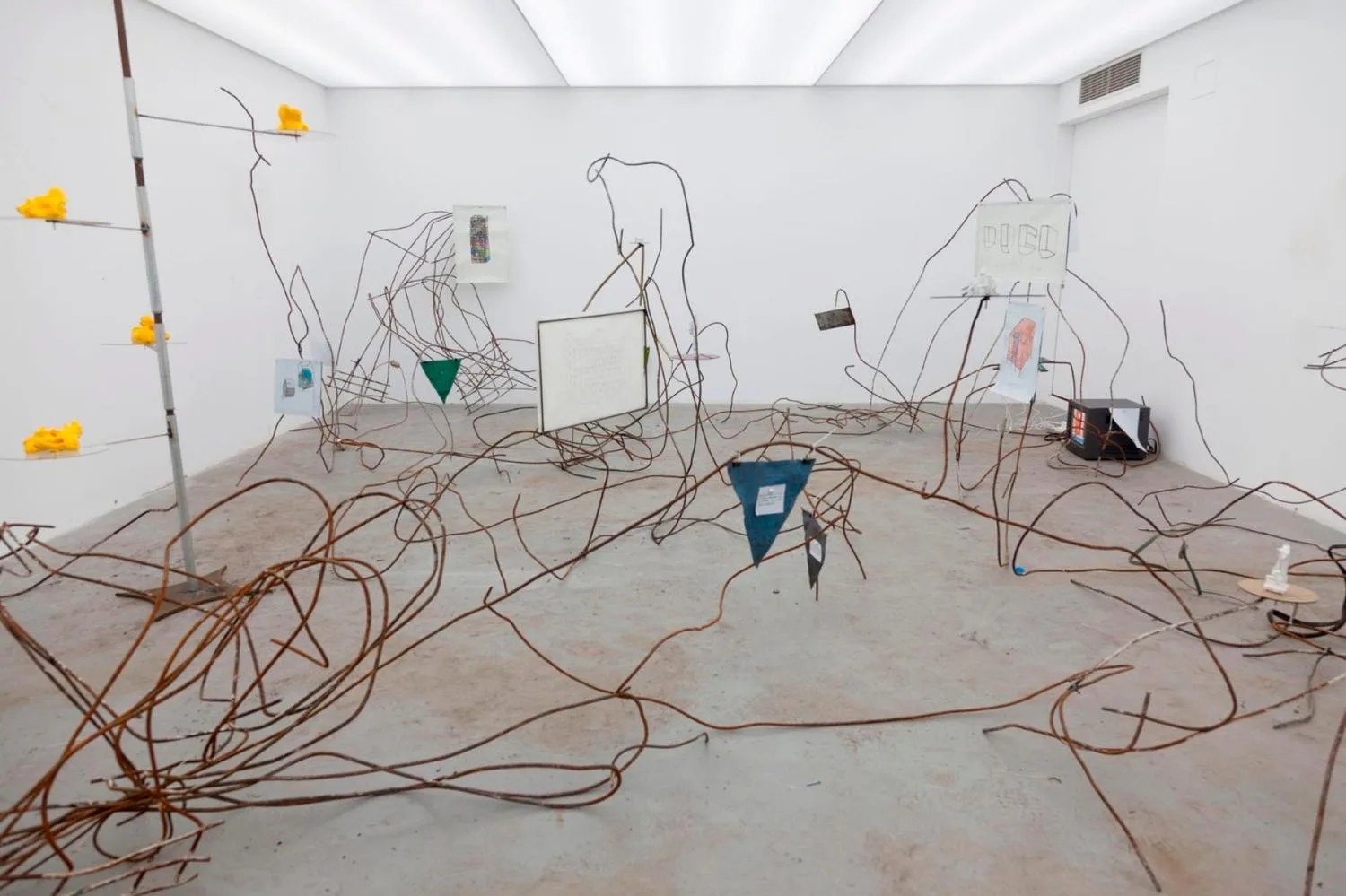
泰康空间二层「日光亭」里的杨健个展「建造废墟」:连绵纠缠的钢筋与悬挂其上的水粉画。
我一直钟爱泰康空间二层的“日光亭”,在那里作品自成天地,纯净的白光从低矮的天顶均匀洒下,局促的长和宽让我一踏入房间就被推搡着进入作品。和2014年刘窗用“爱情故事”让观众在房间中央的口袋言情书和墙壁上的涂鸦间来回反弹相似,杨健在“建造废墟”中把这里塞满了连绵纠缠的钢筋,像一群狂舞的细蛇在被阳光照射时突然僵死在地。我必须迈入起伏的铁锈色线条中才可躬身或蹲下细看悬挂在钢筋上色彩鲜艳的水粉画……脚踩着地上焦黑的灰尘摸索行进路线时,我的身体偶然碰到钢筋,整个屋子都在微微颤动。
早前的中国当代艺术家们偏爱过废墟,毕竟他们都曾心怀戚戚地将自己投射在被否定的事物上。荣荣记录过弃屋里的女星海报,张大力曾在京城中隐秘地把光头涂鸦布满被标记了“拆”字的残墙上。王卫倒是在白盒子中造出过废墟,展览就叫“临时空间”。2003年,他请了十位民工在长征空间的展厅里砌了一间无门无顶无人可进的砖房,开幕后又让民工从内部砸碎砖墙,在废墟中挑拣出尚完整的砖叫砖贩子拖回郊区。那时,北京的当代艺术圈和城市一起汹涌扩张着,人们充满欲望、热情和不安全感。十四年后的夏天,内城的胡同似乎免除了拆迁的命运,甚至在封堵“开墙打洞”运动中日益坚固,所以此时此地的日光亭里,杨健展览的标题“建造废墟”更叫人困惑:废墟在哪里?如何建造?谁在建造?随着在钢筋中艰难勘探,我意识到这些问题的答案都是复数的,重叠、交战着的废墟意象以图纸、传说、录像和模型等微小化身,散乱地依附在钢筋上,构成展览中最轻易可见也符合人们想象的废墟:杨健从草场地捡拾被废弃的钢筋带回日光亭,这里是他的工作室,他在此无中生有,把钢筋弯曲、焊接出一地混乱,破碎地勾连起不同的废墟叙事。
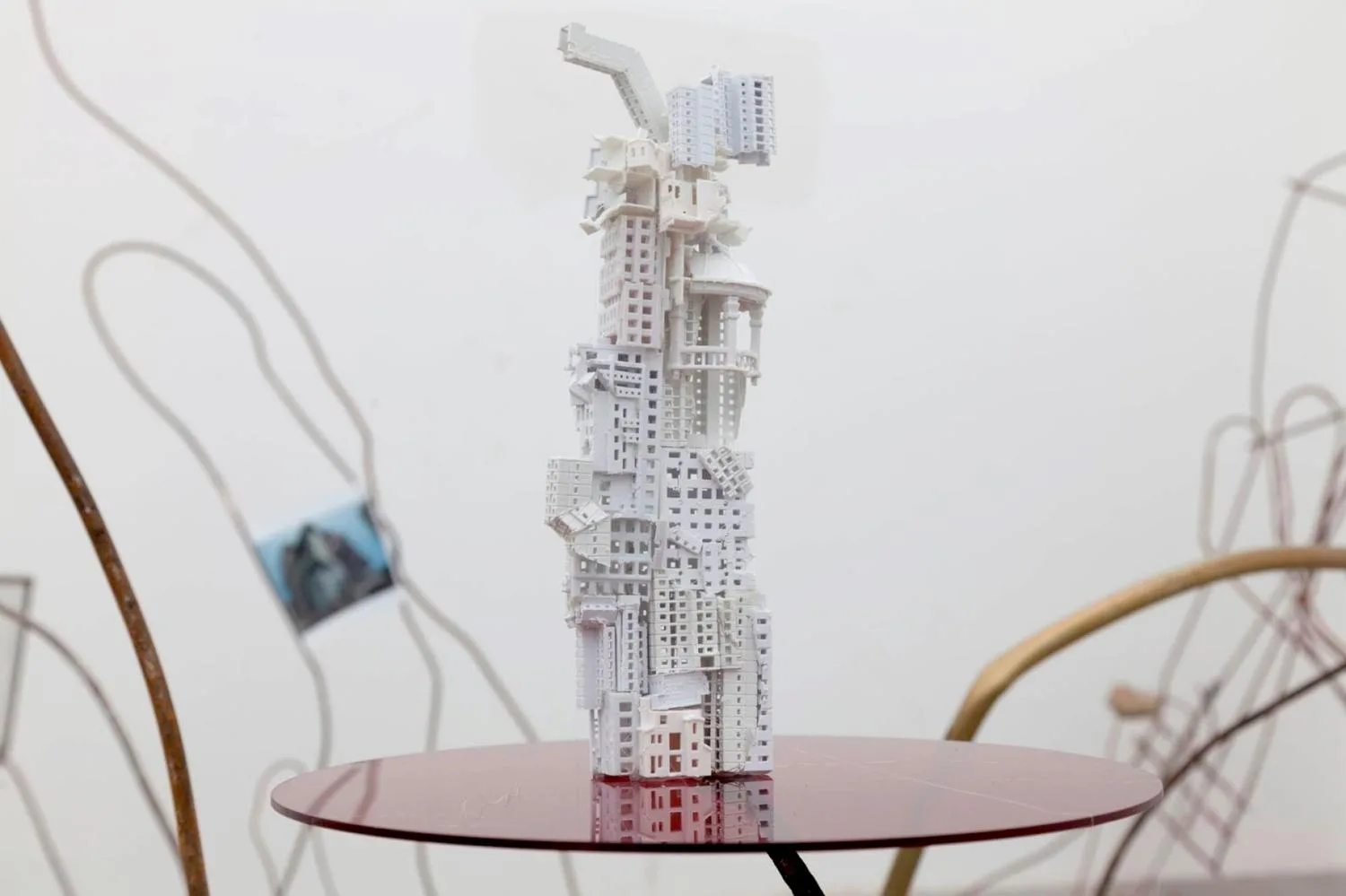
嵌套着神庙而缺失屋顶的房子,有弧形底部所以摇摇欲坠的办公楼,这些白色微缩模型和设计院图纸上的彩色涂绘说明着杨健的发明:“以废墟为概念的建筑”。它们荒谬十足而自得其乐,与废墟的区别在于,它们无需经过损毁就已无法使用。改变形状,让人造物脱离功能让我想起在不远处的长征空间里正展出的吴山专和英格的作品,按照格罗伊斯的话来说,杨、吴都是让物对人类的目的进行“暴力的反动”。但吴山专和英格更近于借艺术和审美把物从头再造,杨健对建筑的解放则更“幼稚”,直接悖反现有建筑的功能设计原则,把直墙变弯,把内里翻到外部,把建造状态拉长为常态。杨健留了一张没写完的“建造废墟”方法论在展场,窝在角落里,像一篇等待被发现的革命纲领。
正对着钢筋的录像《我们正在建造废墟》指认了艺术家之外的建造者,即便播放录像的LED屏幕上没有任何图像、只以文字脚本展示了一部散文电影(essay film),它的叙述也毫不留情地把观众拉入了一个更庞大而无人可逃的废墟。中国近年来疯狂的新城运动造出了许多如鄂尔多斯般寂寥无人的鬼城,连片的高层建筑常在“航拍中国”中出现代表崭新的美好未来。现实中,无人在那里出生、死亡、生活,大多数房子保持着水泥毛坯的状态,毕竟人们只需要它输出房产证来缓解被通胀偷走财产的恐惧或撬动更大的资本。在把允诺未来的新城看作废墟时,杨健抽取了废墟这个隐喻中的死亡和终结意味。对这些可用而不被使用的房屋而言,无人居住等于从未活过。更可怖之处是,为了建造这些资本的符码,无数民工重复着无意义的劳动,而且有更多人(比如置身展览中的我们)也为房子抵押了自己剩余的人生。在这个生命政治-经济系统中,人命和水泥一样,都是廉价的消耗品,“建造这些废墟的人们也在建造中日益萎缩,形容枯槁,成为人中的废墟”。 废墟曾和倒塌、坠落相连,比如圆明园遭乱后的土丘断石、强拆现场的碎砖破瓦,但今天的废墟不再匍匐在地,相反,它们可以高耸周正如纪念碑;废墟也曾和残败相连,但今天它们可以光鲜亮丽,只有明眼人看得到纪念碑上刻写的是人的耻辱。录像上滚动的文字被蓝屏“未渲染”持续打断,仿佛是拒绝任何幻觉,而下面的小屏幕上,简欧式样板间的3D效果图在缓慢转动着。
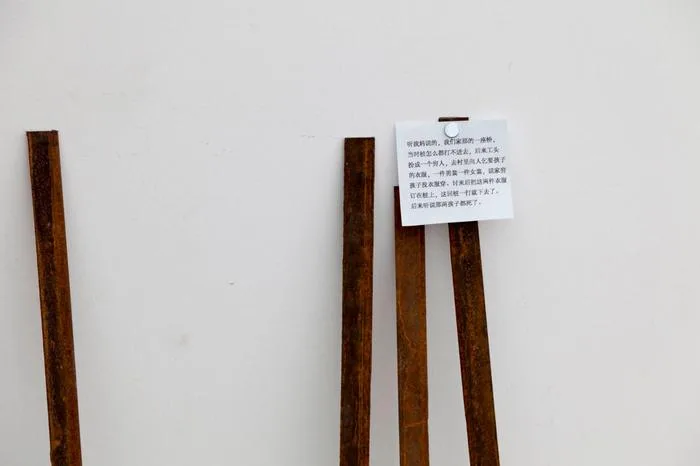
录像结尾最后落在了以人血祭建筑的谣言,一些打印在白色纸条上的此类恐怖故事就被钉在钢筋上,读时我不免会想,人就是变成了木桩和钢筋支撑起屋宇桥梁的吧!在我离开展览后骑单车经过环铁去东坝的柏油路上,浅浅印在脑海中的前现代传说和眼前密布着细小窗格的高层住宅交叠在一起,血腥的故事相形之下竟显得浪漫。跳入熔炉死去的人有更事件性的死亡,他们至少化为了一则传说浮动在城市里。今天人们的死则过于温和了。在杨健的钢筋废墟的深处,一些铁托架包裹的iPad和iPhone播放着视频。iPad上播的是杨健的一位加拿大朋友在暮色沉沉中散步,他非法滞留中国八年,从一切轨道上脱离,从一个体面人堕落为流浪汉。杨健说,“他自愿的成为了人中的‘浪漫主义’废墟”。 是啊,似乎只有凭借酒神的狂妄,只有主动失格于人世,才能从劳动致富、社会进步的幻觉中抽身。四个iPhone上的短视频分别叫《End》、《Fin》、《完》、《终》,是不同颜色滤镜下的一滩砂砾,浮夸的色彩和无聊的内容反倒让人跳跃到《红楼梦》的结尾。“好一似食尽鸟投林,白茫茫大地真干净”。
离日光亭越来越远时,黄昏终于降临在路的尽头。“建造废墟”在我心里从陈述句骤变为一个祈使句,我必须成为废墟,我必须获得自由。
Machine translation (AI) of the Chinese original, not yet reviewed by the author. Please cite the original.
I have always loved the “Light Pavilion” on the second floor of Taikang Space. Works there become worlds of their own: clean white light falls evenly from the low ceiling, and the cramped length and width of the room push you into the work the moment you step through the door. Much as Liu Chuang, in his 2014 “Love Story”, had visitors bouncing back and forth between the pocket romance novels in the middle of the room and the graffiti on its walls, Yang Jian has filled the space for “Building Ruins” with endless tangles of steel rebar, like a nest of wildly dancing thin snakes that froze dead on the floor the moment the sun hit them. I had to wade into the undulating rust-coloured lines before I could stoop or crouch to look closely at the brightly coloured gouache paintings hung on the rebar… As I felt my way along, treading the scorched black dust on the floor, my body would now and then brush against the steel, and the whole room would tremble slightly.
Chinese contemporary artists of an earlier generation had a fondness for ruins; after all, they had all, with a sense of fellow feeling, projected themselves onto things that had been negated. RongRong photographed posters of female stars in abandoned houses; Zhang Dali covertly sprayed his bald-head graffiti across Beijing’s broken walls daubed with the character for “demolish” (拆). Wang Wei actually built a ruin inside a white cube, in an exhibition titled “Temporary Space”. In 2003 he hired ten migrant workers to lay a brick house – no door, no roof, impossible to enter – in the gallery of Long March Space; after the opening he had them smash the walls from the inside, pick out the bricks that were still whole from the rubble, and have a brick dealer haul them back to the outskirts of the city. At that time Beijing’s contemporary art world was expanding as tumultuously as the city itself, and people were full of desire, passion and insecurity. Fourteen summers later, the hutongs of the inner city seem to have been spared the fate of demolition, and have even grown more solid in the campaign to brick up “holes knocked in walls”. So here and now, in the Light Pavilion, the title of Yang Jian’s exhibition, “Building Ruins”, is all the more puzzling: where are the ruins? How are they built? Who is building them? As I laboriously prospected my way through the rebar, I realised that the answers to all of these questions are plural. Overlapping, warring images of ruins – in the tiny incarnations of drawings, legends, videos and models – cling haphazardly to the rebar, forming the ruin that is most easily visible in the exhibition and closest to what people imagine a ruin to be: Yang Jian collected discarded rebar from Caochangdi and brought it back to the Light Pavilion, which serves as his studio. Here he made something out of nothing, bending and welding the steel into the mess on the floor, which loosely stitches together different narratives of ruin.
A house with a temple nested inside it and no roof; an office building teetering on its curved base – these small white models and the coloured drawings on design-institute blueprints explain Yang Jian’s invention: “architecture that takes ruin as its concept”. They are thoroughly absurd and perfectly pleased with themselves; what separates them from ruins is that they are unusable without ever having been damaged. Changing the shape of man-made things and prising them away from their function reminded me of the work by Wu Shanzhuan and Inga Svala Thórsdóttir then on show at Long March Space not far away. In Boris Groys’s terms, both Yang and Wu make objects stage a “violent revolt” against human purposes. But Wu Shanzhuan and Inga are closer to remaking objects from scratch by means of art and aesthetics, while Yang Jian’s liberation of architecture is more “naive”: he simply goes against the functional principles of existing building design, turning straight walls into curves, turning insides out, stretching the condition of being under construction into a permanent state. Yang Jian left an unfinished methodology of “Building Ruins” in the exhibition, tucked away in a corner like a revolutionary manifesto waiting to be discovered.
The video facing the rebar, We Are Building Ruins, identifies builders other than the artist. Even though the LED screen playing it shows no images at all – it presents an essay film solely as a text script – its narration drags the audience, without mercy, into a vaster ruin from which no one can escape. China’s frenzied new-town campaign of recent years has produced many ghost towns as desolate as Ordos, and swathes of high-rises often appear in the documentary series Aerial China to stand for a shining new future. In reality no one is born, dies or lives there; most of the flats remain bare concrete shells, since people only need them to issue property deeds, to ease their fear of inflation stealing their wealth or to leverage more capital. In seeing the new towns that promise a future as ruins, Yang Jian extracts the connotations of death and ending from the metaphor of ruin. For these houses, usable yet unused, being uninhabited is the same as never having lived. More frightening still, in order to build these ciphers of capital, countless migrant workers repeat meaningless labour, and many more people (including us, standing in the exhibition) have mortgaged the rest of our lives for a flat. In this biopolitical-economic system, human lives, like cement, are cheap consumables: “the people who build these ruins are also withering in the building, growing haggard, becoming ruins among people.” Ruins were once bound up with collapse and falling – the mounds and broken stones of the Old Summer Palace after it was sacked, the smashed bricks and tiles of a forced demolition – but today’s ruins no longer lie prostrate on the ground. On the contrary, they can stand tall and upright like monuments. Ruins were once bound up with decay, but today they can be glossy and gleaming, and only the clear-sighted can see that what is inscribed on the monument is human shame. The scrolling text of the video is repeatedly interrupted by a blue “unrendered” screen, as if refusing any illusion, while on a small screen below, a 3D rendering of a show flat in simplified European style slowly rotates.
The video ends on rumours of buildings consecrated with human blood, and some horror stories of this kind, printed on strips of white paper, are nailed to the rebar. Reading them, I couldn’t help thinking: so people did become the wooden piles and steel bars that hold up houses and bridges! After leaving the exhibition I cycled along the asphalt road past the railway ring towards Dongba, and the pre-modern legends lightly imprinted in my mind overlapped with the high-rise housing, dense with tiny window grids, in front of me. By comparison, the bloody stories seemed almost romantic. Those who died by leaping into the furnace had a death that was more of an event; at least they became a legend floating around the city. Today people’s deaths are far too mild. Deep inside Yang Jian’s ruin of rebar, some iPads and iPhones held in iron brackets play videos. The iPad shows a Canadian friend of Yang Jian’s walking in the gathering dusk. He had overstayed illegally in China for eight years, slipping off every track, falling from a respectable man into a vagrant. Yang Jian says: “He voluntarily became a ‘romanticist’ ruin among people.” Yes – it seems that only through Dionysian arrogance, only by actively forfeiting one’s standing in the world, can one extract oneself from the illusion of getting rich through labour and of social progress. The short videos on the four iPhones, titled End, Fin, Wan (《完》) and Zhong (《终》) – the last two also meaning “the end” – show a patch of gravel under filters of different colours. The garish colours and boring content, if anything, make you leap to the end of Dream of the Red Chamber: “Like birds that scatter into the woods once the food is gone, leaving only a vast white earth, so very clean.”
As I moved further and further from the Light Pavilion, dusk finally fell at the end of the road. In my mind, “Building Ruins” suddenly turned from a declarative sentence into an imperative one: I must become a ruin; I must gain my freedom.