Writing / essay · 2024 · 中文
Surabaya Journal: Being Alive Is Wondrous泗水游记:活着就奇妙
2024年夏天赴泗水参加第13届国际亚洲研究学者大会(ICAS)的游记:吉隆坡转机、泗水街头的摩托车潮、韩家祠堂里的华人圆桌,以及在陌生中重新感到「在活着」。
一 在赤道避暑
很难说清楚为什么我一开始就对这趟印尼之旅抱有那么多兴奋,或许是因为去过的朋友都会一去再去,或许是因为我太想念学术会议讨论问题的热烈气氛,也或许是因为第一次去东南亚。总之,今年7月28日到8月1日在泗水的第13届国际亚洲研究学者大会(International Conventions of Asia Scholars,简称ICAS),没有让我失望,反而让我一而再、再而三的和朋友谈起,那里如何叫人放松又热烈地谈论心头所好,即便在旅行中拉肚子虚脱,也觉得不枉此行,情愿再吃一顿辣椒炸鸡Ayam geprek(不过我最爱的其实是在吉隆坡的娘惹餐厅吃到的、味道浓郁到臭鼻的黑果焖牛肉)。
上海没有直达泗水的航班,所以我和Lillian决定从吉隆坡转机,顺便逗留几日。那几天,我们在马来西亚的国家清真寺披上罩袍,惊奇于伊斯兰教装饰中繁复的几何结构,在国家美术馆看到了文化背景迥异的艺术家交汇于一片时空,也体会了在遍布高速路城市中步行之不可能。但印象最深的是最后一日,我们拜访了我的研究生好友Zena Khan一家。她的母亲、父亲Aliya and Farouk Khan创立了AFK收藏,从1990年代中期至今一直支持着马来西亚本土艺术家的发展,尤其是如何令伊斯兰教背景的艺术家也能在当代语境中得到认可——有宗教信仰的艺术家就只能做出宗教作品吗?我们带着这振聋发聩之问匆匆去往机场,搭上Air Asia,手忙脚乱在机场填写印尼落地签,终于在飞机起飞前完成了信用卡缴费。我掏出电脑,继续临时抱佛脚地阅读《印尼etc.:众神遗落的珍珠》。
下午六点钟,我们到达泗水。从朱安达(Juanda)机场到市区的路上,黄昏如有魔法。出租车往市区开,日光也缓缓离去,淡黄、淡紫、殷红的晚霞慢慢浮上天际——而它的前景处则是连绵的棚屋、砖房,以及呼啸向前的摩托车手。他们有男有女,戴着头盔,载着货物和亲人朋友,从城市的不同角落向街道涌来,汇成一股强劲声浪,与汽车并驾齐驱。摇下车窗时,浓重的机油味和尾气涌入车厢。闻见尾气味的那一刻,我突然想起了千禧年之前在故乡小城第一次闻见汽车尾气的时刻。那时我只有五六岁,涌入鼻腔的陌生味道刺鼻但又嚣张,它像是知晓自己意味着急速、前进和机械之力,让我不得不生出尊重和贪婪。在红灯出现时,泗水街头的摩托车手便停在车窗外。他们的神情也让我想起1990年代:人们忙碌、奔波,寻觅机遇,对世界一无所知却抱着美好幻想,眼睛都是亮晶晶的。我们还未踏出车厢,和司机爷爷也一句话都讲不通,但神奇的是,我们已经激动地战栗。这是在上海听多少讲座、看多少书都比不得的,那是我们的日常,而这里我们踏入了陌生。我们向晚霞和这城市里的力量投降:在摄人心魄的晚霞里,飞驰而过的摩托车不屑作任何说明。我们开着窗,漫天尾气又如何呢?感觉这趟进城之旅,已经让我们加入了这进行中的伟大。
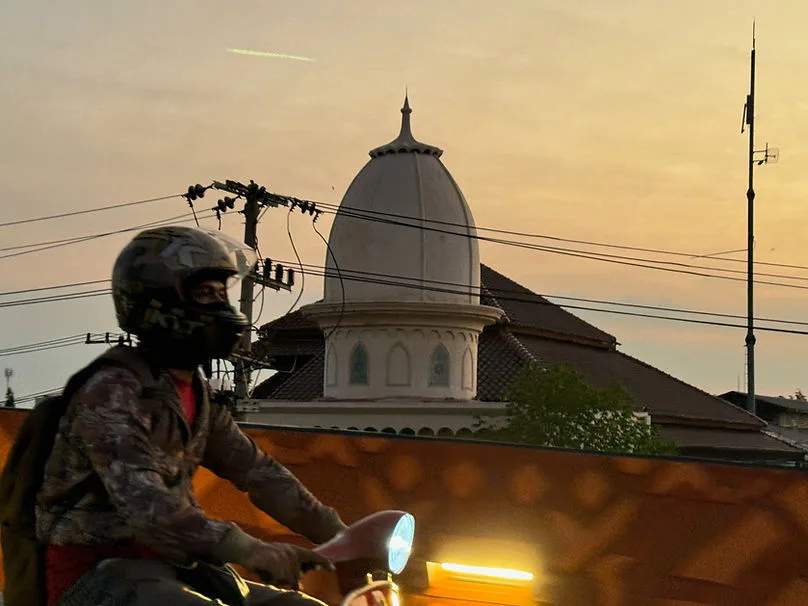
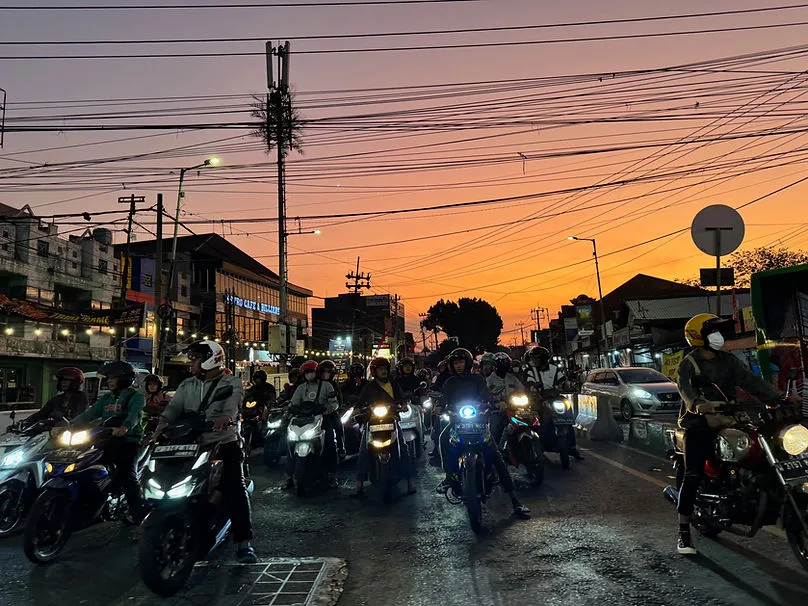
7月27日,泗水街头 除特殊标明外,图片均为作者拍摄
泗水的英文拼写是“Surabaya”,中文里有时也称为“苏腊巴亚”。它是雅加达之外的印尼第二大的城市,但很少成为国外游客的目的地。2024年的7月末,因为ICAS会议,这里迎来了超过1500位世界各地的亚洲研究学者。“亚洲研究”是区域研究的一种,但这一会议的主办方却不来自亚洲,而是位于荷兰莱顿的亚洲研究国际机构The International Institute for Asian Studies(IIAS)。ICAS诞生在新国际主义盛行、全球化口号高昂的1990年代,它的目的也如此乐观——在官网上,我读到它“旨在为全球范围内其研究或活动与亚洲有关的研究者、机构提供一个沉浸式的交流平台(a global immersive platform)”。我对这里“沉浸式”一词的理解并不是teamLab做的复古花蝴蝶九面投影,而是周遭都是与我一样对某个话题抱持着钻入牛角尖心态的热情之人,而我们又对彼此的研究充满非功利心的好奇。这,难道不是个乌托邦吗?
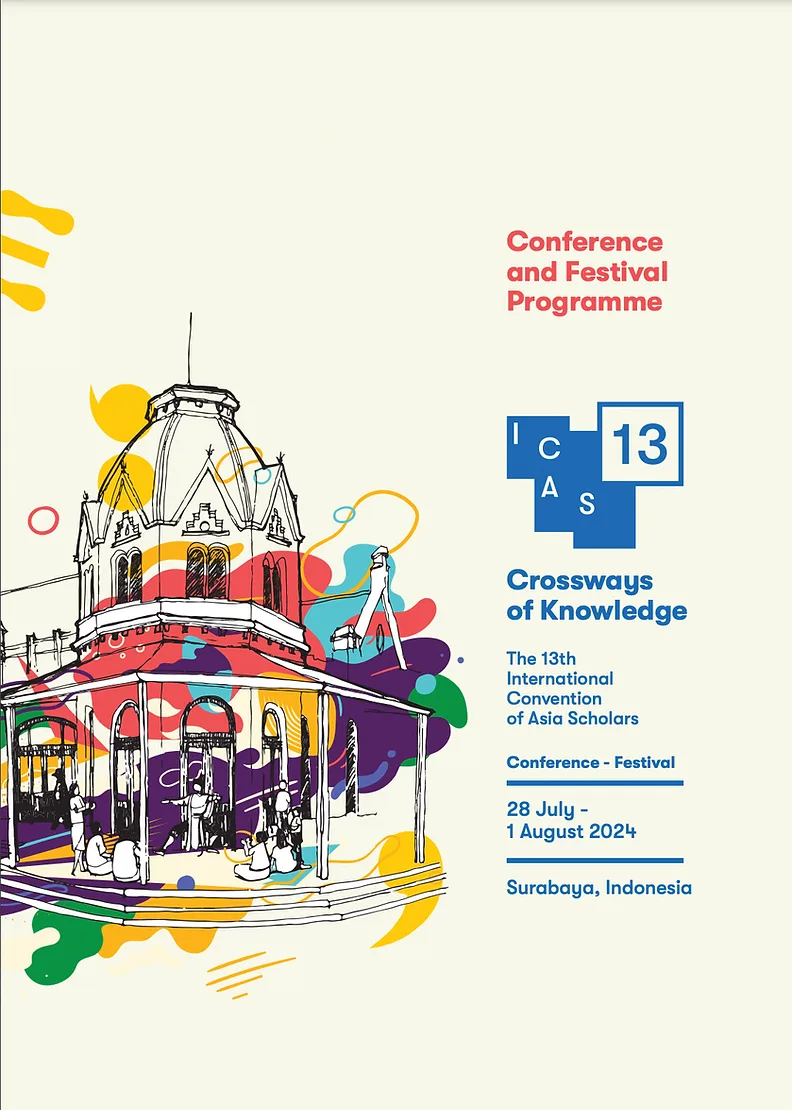
ICAS13海报
在泗水的这次ICAS,是疫情之后在线下举办的第一届。为什么还要举办线下的学术会议?或许因为线上太乏味。这几年我参加了几次在Zoom上的学术会议,流程大致如下:准备好讲稿,在自己的电脑前讲完,听其他人讲,参与讨论大约半小时,最后关掉电脑。会议大概进行两个小时,而这前后都是每个人业已熟悉的生活与工作。即便参加了同一个会议,我也很难觉得自己“认识了”同场讨论的研究者——我了解了他们的研究,但似乎还离作为个体的他们很远。而线下开会会让所有人共同经历同一个地方,就像被一起扔进某个池塘,要一起呼吸和游泳。这大概是“区域研究”变为“地方生活”的时刻。
在旅馆放下行李之后,我和Lillian浸在晚上八九点的夜色里,去和朋友汇合。大街上有些小贩在卖饮料,木质手推车旁,许多年轻人三三俩俩坐在地垫上,在夜风中放松地聊天,其中不乏裹着头巾但没戴面纱的伊斯兰教背景的年轻女生——感觉这里的宗教氛围也很开放。空气舒爽干燥,气温只有二十八九度。在荷兰阿姆斯特丹大学读博的中非研究者冯启頔、汉雅精舍的吴建儒呼唤我们去一家露天酒吧,到了那儿,才发现有歌手在现场唱着美国的流行爵士乐。冯启頔一边带着我们买酒,一边向我们宣告了三件大事——
一,我们在南半球!泗水在南纬6度。
二,要多取些现金,印尼大部分地方要用现金,因为很少地方可以刷Mastercard或者VISA。
三,泗水很少地方卖酒,因为这里是伊斯兰教的地区,偶尔有卖酒的地方也会卖得很贵。这里的一瓶Bintang啤酒要大约30多块人民币。
我还在困惑为什么印尼比上海还要凉快:我们难道不是来了热带,正在赤道附近?建儒说,太阳在直射北回归线附近,现在其实是太阳离泗水最远的季节。在赤道避暑,这句话怎么听都觉得帅气。4月至9月是爪哇岛的旱季,季风正从澳大利亚大陆由南向北而来。我们在酒吧的二楼,微风拂面,四个人都觉得神奇——我们到印尼了,正在泗水——一个我们此前或许都没听说过,也不觉得与己有关的地方。
二 非典型会议
说实话,在来泗水之前,我以为ICAS只是另一个规模比较大的学术会议,但泗水的六日让我意识到,ICAS独一无二,至少是今年这一届,其他学术会议或许无法与之相提并论。它太特别了——学术会议仅仅是它的一个部分,它还囊括了许多展览、工作坊、电影放映、出版市集、citywalk。来参加的人也很多样,不仅有大学里的学者,还有艺术家、美术馆工作者、社会活动家等等。这让我和Lillian都觉得自己被接纳了——我的全职工作是一个杂志编辑,而Lillian是位艺术家,但我们在ICAS都觉得自己是什么身份好像没那么重要。就像会议介绍说的那样,它是一个“conference-festival”,是一个认真的会议,也是一场节庆。会议活动从主要承办大学艾尔朗加大学(Universitas Airlangga)漫延而出,发生在当地村庄、华人祠堂和独立的艺术空间。
在浏览7月29日的会议日程表时,我跳过了一场活动“重议毒性的边缘:针对环境危机的生态女性主义方法”。这个工作坊强调表演性(performativity),我脑海中浮现出在欧洲的美术馆谈论生态女性主义的艺术家——我只是不想在印尼重复这样的白盒子体验。但第二天,刘菂和建儒说,这个工作坊是在一个河边的村庄、很好玩、快来!我和Lillian立马打车过去了,在一条河水浑沌、气味微妙的河道附近下了车。我们沿着河岸往深处行,便发现自己站在一个村口,几个当地年轻人正挂在摩托车上闲晃。我们寻着声音,路过正在炸鱼的村民,走进了“会场”——在河畔的一溜儿平房。挂着名牌的参会者正席地而坐,挤在一间半敞的砖房里,后排的人则在葡萄藤架下乘凉。暖风习习,小孩儿的哭闹、大人的闲聊、露天厨房油锅的滋滋声,混响成复杂的声响,慢悠悠地传来。我们到的时候,大家吃完了村民做的小吃,主持人Elena Burgos Martinez正要介绍一位女性艺术家、学者Dewi Candraningrum。
Dewi穿着罩裙,一开口便说,“对不起,我迟到了。我要照顾自己行动不便的儿子,而我没有帮手,靠的就是这两双手。”Dewi和当地女性社群一起工作,反对水泥开采对环境的污染。她用水泥为这些女性画下肖像。有人问,这些作品你会售卖吗?她说有人愿意购买这些画作,但她决定不卖,未来会把这些画作一起留给女儿。“我们需要创造在女性之间传递的遗产”,她说。我在手机上搜她的名字,发现她在瑞典隆德大学做过博后,网站上她的肖像是我熟悉的“学术精英”,而眼前的她站在家乡印尼的棚户区,劳累、辛苦变作了皱纹,一望便知她是亲手劳动、操持生活。但她那么骄傲,充满力量,我相信她真的相信和践行着自己所教授的文学与知识。后来另一位社会企业主Maria Sucia分享她收集的印尼不同地方女性的织布,也提到她会开设生态女性主义的课程。我问Maria,用“生态女性主义”这样的词汇,在日常工作中,当地的女性合作者们能理解吗?她说,我们的课堂上并不是照本宣科地读理论文本,更多是跟参与者一起来讨论,找到彼此共鸣的经验和问题。有一位来自印度的社会学学者说,只有在不断的共同工作和讨论里,我们才能真的找到哪些语言、词汇是有效的。
工作坊的举办地Baru村(Kampung Baru, Stren Kali Jagir)
艺术家、学者Dewi Candraningrum和她的画,7月28日
“重议毒性的边缘:针对环境危机的生态女性主义方法”工作坊合影,7月28日,图片来源Arts For Women
那天傍晚我们回到市区,在泗水的市政厅广场上参加这场会议的开幕仪式。那巨大的露天屏幕,一排排套上了白绸缎的椅子,精心彩排的歌舞表演,还有两旁搭起了棚子的自助餐,都震撼到我了——这排场像国内的大型活动,但气氛又如此放松。领导讲话是用剪辑过的VCR播放的,参会的研究者们有的在座位上聊天,有的在旁边排着队取餐,与此同时兴致盎然地问前后的参会者,你是做什么研究的?你这次会来做发表吗,是在哪天?在开幕式上,我们座谈会的两位印尼伙伴Putra Hidayatullah、Berto Tukan也到了,加上刘菂、陆思培、我,我们五个人开心地拍了合影。梓耘和伟田在伦敦,帮我们上传了照片,当晚《为什么去印尼谈论艺术写作?》一文就这样发出来了。我那时候对于和刘菂组织这个座谈会还是很懵,除了自己是艺术写作的从业者之外,一开始还没发觉我和印尼有什么关系。只不过此时到了这儿,我想一切自有定数,可能是因为在这里,人们会变得更柔软,更放松。
开幕式上,大家端着碗一起聊天,Putra告诉我他来自印尼最西边的省份亚齐(Aceh)。那里伊斯兰宗教氛围浓厚,曾经争取过独立。2006年亚齐成立特区,成了印尼唯一一片施行伊斯兰教法的地方。Putra推动的一个项目“Cremory_hub”在征集亚齐地区过去的民间影像,只因在新教法下,许多印证着曾经的“生活方式西化”的照片迫于禁令,需要被毁掉或者藏起。Putra笑着说他接下来会慢慢做,而我想起许多尝试夺回和书写自己记忆的人。
ICAS开幕式现场,7月28日
开幕式上大家最喜欢的鸡汤饭Soto ayam,7月28日
这之后的三天,大家进入了忙碌的听会、开会的日程。每天傍晚,如果参与者当天没有自己要进行的讲演或者组织的活动,便需要做出决定,明天要做什么?一天中,会议有四个时间段,上午两个,下午两个,每个时间段大约有20场讨论同时进行,这之外还要考虑是否参加其他同时间档的活动、展览、工作坊。ICAS这次大会的主题是“Crossways of Knoweldge”(知识的交汇),大会也的确在研究领域和方法上无所不包,但此次大会还是更加偏向人文、社科、艺术类主题。排日程这件事一点儿都不容易做,要先阅读所有信息,必要时还要再搜索参与者的背景和研究方向。而听会则有点像印尼的“跳岛”游,上一刻还在深入、沉浸某个学科话题,下一刻又跳跃、转换到另外一个截然不同的频道。而开会的幸福之处在于,在你面前分享的讲者都已经投入其中了许多时间,你能看到那种“呆子”才会有的幸福神情,而且这种幸福会传染。在这几天中,我去旁听了东南亚地区博物馆、图书馆的数字化收藏与可持续策略、1960年代荷兰和印尼两地女性运动的互动(Kristen Kamphuis)、香港茶餐厅里的“人情味”(Samuel Lai)。还有一位很帅的韩国女性学者Ohsoon Yun的分享,她原本做埃塞俄比亚咖啡产业研究,近年才离开学术界、做起了咖啡旅游生意。
不过让我印象最深的,是跟着张颂仁先生去听的一个有关印度教寺庙的研究。本来我们都在听一个珠三角当代艺术的考古研究(笑),但研究本身有点太浮于文本了,我们便在中间找了个空档溜出来,跟着张先生进了旁边的教室。那个分会的主题是“再访神圣的场所,文本与实践”,其中两位印度女性学者Kalindi Sharma和Debashree Sinha分享了围绕位于希拉普尔(Hirapur)的一座供奉了64位女瑜伽士的寺庙的研究。Debashree坐在讲台上之后,全程都没动过电脑一下,观众们从头到尾没看过这座神庙的一张图片。她就自己坐在那里,神情激昂地宣讲着这座神庙的故事。她讲到寺庙周遭的年轻女性如何不被鼓励去供奉这里的女性神祇,女性不被鼓励修行,不被鼓励去寻求精神超越,因为她总会被期待着做一个好妈妈、好姐姐、好妻子。Debashree说,“孤独已经是一件性别化的事物。当她希望能独自一人时,她会疑问,自己还是一个好妈妈吗?” (Solitude is already very gendered. When she seeks solitude, she questions if she is a good mother.)后来我和冯启頔说,最触动我的分享居然来自一个我压根儿从来没想过的古代研究领域,而他说自己去的每一场会议都太好了、让他想落泪。我问他怎么都能选到这么好的讨论去听,他说,或许人类学就是贴近人的经历和感受本身,人类学的研究都在讲现场与人真实的经验。
“Collecting Photography in Southeast Asian Museums”会议现场,7月29日。
艾尔朗加大学(Universitas Airlangga)的草坪上,学者们围坐野餐,8月1日
参与者们对待会议的风格不太一样。刘菂是早起早睡派,每天早上9点钟开始的会议她也去,不仅如此,还“领养”(adopt)了两个自由成组的座谈会去做主持;也有参加完自己的座谈会就开始放飞到处玩的。我算是折衷派,紧张开会之余,也想去看看城市。整天在教室里进行高密度输入,大脑会抗议的。我最开心看到有的研究者偷偷的在椅子上打盹,让我心领神会——大家都会累的呀。这时候就该放过自己,去逛逛展览,和陌生人聊聊天,或者跟着组织者去城市里走走。
书展和艺术展有很多个地点,零散的分布在泗水城区里。在书展区域,研究者曾嘉慧介绍我认识了独立出版社Marjin Kiri(“左锋”)的主理人Ronny Agustinus。Ronny是ruangrupa的创始成员之一,后于2005年创立了出版社,主要偏向批判理论和拉美文学。[1]在泗水当地的独立空间C2O Library & Collective,也有一个让我印象深刻的展览“边缘的性:身份,政治和转变”,主要内容是摆放在书桌上用台灯照亮的达卡性少数群体的夜间影像。很有趣的是,这些展览里的图片、影像和作品被呈现在公众面前的目的朴素极了——就是展示出来给大家看看,让人知道有这样的事物和实践存在着,说不定也会有别人感兴趣。我和Lillian说起,不知道为什么,这里给我的感觉要比艺博会和双年展那种同样热闹的场景放松很多,只要志趣相投,萍水相逢也无妨,一切都是神交。而艺博会和双年展则免不了带着艺术行业的属性,带着职场感。或许当大家远渡重洋来开会,共同旅行会让人放下戒备和疑虑。
C2O Library & Collective,7月31日
“边缘的性:身份,政治和转变”展览现场一角,7月31日
我自己参加的座谈会在8月1日,整个会议的最后一天。我们的题目是“跨国语境下的艺术写作:有争议的知识生产场域”。会场里坐满了人,来参加的多是与艺术研究有关的学者或艺术家。很有意思的是,那天几位研究者聊的好多时候不再是书写本身,而是有关“为什么不再写”、“一定要写吗”的疑问——以及越过疑问的实践:Putra Hidayatullah说起在第15届卡塞尔文献展里迷因和集体写作如何成了新式艺术批评;Berto Tukan讲到为什么ruangrupa他们不做杂志了开始做电台;而思培提出以参与式艺术为切入点,呼唤写作需要关注那些未言明的情感与时刻、未被命名的艺术实践——如果艺术写作是用语言来玩弄权力,那不如不写。而我谈的恰恰是张颂仁先生亲历过的2008年第三届广州三年展“与后殖民说再见”,那时几位策展人敏锐捕捉到了中国本土艺术家对西方议题和语言敬谢不敏的症状,而在这之后这种话语的不适配感也在不同时空被不同的人群感受着。有谁能幸运到让历史亲历者亲自来点评?是我了。张颂仁先生是我们座谈会的评议人,也是这次参加书展的汉雅精舍的出版人。除了回应整个座谈会的内容,张先生在评议中还特别认真地追述了2008年三年展前后的故事——我特别惊讶的是,他真的一点儿都没想来“教育”我们,而是谦逊地讲述他自己的回忆。而当我在汉雅精舍的书摊上翻看他出版的书籍,也能读到他在文字中对不同文化的理解和赞赏,光风霁月,游弋西东。
那天开完会,我们去大学的草坪上领盒饭吃(会议期间,每天中午主办方都会发三种很好吃的盒饭,也让我觉得这注册费交得很值)。大家在草地上围坐闲聊,远处还有学生搭了舞台,在唱英文歌。马来西亚的艺术家陈子豪说,“艺术写作在不同的语境会产生不同的需求与条件。比如在马来西亚,由于当代艺术和艺术写作不被重视,很多时候艺术写作只限于媒体新闻为了宣传给大众; 而在新加坡,艺术写作达到比较成熟的阶段,除了地缘政治和经济条件,也需要考虑到新加坡的历史和政治因素如何打压批判性的观点,促使一些当代艺术体制引用非常学术和理论性的字眼来抽象化或掩盖比较直接的批评。所以我才觉得艺术写作如果要更有意义的交流,需要考虑这些不同条件底下产生的不同需求。不然‘艺术写作’这个领域,虽然大家都利用同一个词,它所代表的范围在每个地域是很不一样的。”我当时想要请他继续说下去,因为我在日常工作里也要面对审查。但因为我们要立刻出发去火山玩了,只能先告辞,我想约他之后对我们的座谈会写一篇回应——但愿他会答应。(友情提醒,太阳落山后才抵达Bromo火山可能会遭遇大雾。)
“跨国语境下的艺术写作:有争议的知识生产场域”讨论者合影,8月1日
张颂仁先生在Hotel Majapahit Surabaya,8月1日
三 若说没奇缘
冯启頔这次来参加会议,在座谈会上分享了自己在广州假发市场的心酸田野经历,而他还做了一个展览,里头有一块非洲的理发店手写招牌,一顶顺滑的黑色假发,以及三篇小说。整个会议期间,他几乎天天守在展览的假发旁边,参观的人们也会告诉他自己和头发有关的故事。头发是私人的、亲密的、有关身份与表演的事物,它麻烦又诱人。没想到,我在泗水也立刻遭遇了一家理发店。
冯启頔参加的展览“全球南方流动青年的等待空间”[2]
某一天,在印尼的一个小巷子里, 我和Lillian偶然看到了一块漂亮的手写招牌,上面写着“beauty salon”(美丽沙龙),看起来有一些年头了。理发店不大,印尼姑娘Prinka正在挑选金色的戒指(我还在猜这些戒指是否来自义乌),理发店阿姨看到我们来了,突然说“你们——讲——华文吗?”那一刻让我惊异。她的句子并不连贯,似乎在她在思考时,一个个词语正从半空中掉下来,发出断断续续的声响。她说一句,我们重复一遍,确认是否听得对。她的爸爸妈妈,一个来自广东,一个可能是是维吾尔族(音:Urgul)。她的祖父母辈在广东时曾经是地主,有厂房,在土改中资产被划给公家,父母因此移民到了印尼。她说,妈妈讲过,以前她们家是当地最大的家族。这家美发店店叫作Yunita Beauty Salon,阿姨的印尼名字是Yunita。这家理发店已经开了二十多年。她还没有回过中国,姐姐们都已经回到广东生活了,只剩下她在这里。她说,你叫什么?她看着我的名片,一个字一个字念出来。那一刻像是一种奇迹,我从来没有觉得语言如此重要,熟悉的文字的力量几乎能在陌生人之间勾出血脉。Prinka看着我们生涩又激动地聊天,拍下了照片。走之前,我们问阿姨的中文名字,她继续一字一顿地讲——梁、春、宝。
理发店的门牌,7月30日
在“美丽沙龙”前和梁春宝阿姨(左2)的合影,7月30日
听到许许多多的、与华人移民有关的故事,是这趟旅行中我最意想不到的收获,我也仍在体会,为何这些湿热的、与海洋和海岛有关的离散故事会如此牵动我——我的祖辈在山东生活,未曾提及太多移民的经历;我自己在不同地方生活过,但大多平滑容易,没有经历动荡的政治社会事件。而在东南亚,几乎人人都是异乡人,人人皆在寻去路,悲欢在迫切的求生谋存中已被渐渐抹平[3]。
遇见梁春宝阿姨的那天,我和Lillian是去参加大会组织的一趟关于泗水“香料之旅”的citywalk。那片城区或许也是泗水老城内最好走的区域,因为在这座为汽车而设计的城市里,大部分地方都没有红绿灯,行人横穿马路要鼓足十二分勇气。香料之旅带我们看了许多荷兰殖民时期留下的老建筑,之后我们又去了泗水现存最古老的、大约建于19世纪初的韩家祠堂(Rumah Abu Han)听一场名为“延续与改变:泗水与印尼的华人”的圆桌讨论 。那间祠堂很高大,但两边没有墙壁,是用柱子顶着房梁。韩家祖先的牌位供奉在大厅深处,前面的供桌上铺着大红色的绸缎,上面用金线绣着“荣华富贵”。观众坐在中间,能时不时吹到穿堂风,只是由于回音问题,讨论听得不是很清楚。
傍晚时分,印尼的华人学者正在聊语言的复杂,而穆斯林诵经的声音随风涌入,空气里的燥热和黄昏时分的天光融为一体……周围语言里包含的信息好像不甚重要了。这个时空中所有事物的存在和其流动,复杂又生动,动摇着我过往的经验。它看起来含混不清,里头又有许多生命在奔波和停歇,而我是其中一点很小很小的部分。
韩家祠堂(Rumah Abu Han)的讨论会,7月30日
那个时刻也让我想起刚到泗水的第二天,我和Lillian在出租车上摇摇晃晃准备进村的时刻。懒洋洋的午后,车里放着我高中时会听的乐队Evanescence的歌。司机不太会说英语,和我们比划着,我们也指着地图,看起来的确没有线索。目光所及,道路空空荡荡,两侧插着红白两色、象征着印尼国旗绸缎的竹竿。司机下车进去帮我们问路,出来之后似乎也没什么结果。我们已经迷路了十多分钟,但他似乎完全不在意自己多花的时间,反而一脸歉疚。他不急不缓,好像这根本算不上什么挫折。那个时刻也是这般神奇,是我在上海完全想象不到的际遇,连出错时都充满奇妙。这让我觉得,我在活着。
泗水街景,7月30日
注释
[1] 关于Marjin Kiri的华语报道,可以参考書寫公廠,“自邊界回擊:訪Marjin Kiri”,Medium,2020年4月21日,https://medium.com/writing-factory/marjin-kiri-aeeef5dc38
[2] 关于这个展览的详情,可以参见程莹,“城市此刻|泗水策展手记:青年,在等待与流动之间”,《城识 Urban Sense》,https://mp.weixin.qq.com/s/w5JN9tRJyG5gC2865YYwJw
[3] 几周后,我到了移民之乡广东台山,参加Bilijana Ciric和时代美术馆共同组织的“归零学堂”。在我们借住的老房子里,我读到了一本印尼作家林世芳在2017年编纂而成的《印尼西加里曼丹华人史》。这书由简体中文写成,从19世纪华人开设的公司与荷兰殖民者的争斗,写到1960年代排华运动中华人改名改姓、弃用汉字。但其中最令我心惊的是印共华人党员在白色恐怖下的惊险和其信念之炽烈坚定——革命之后,幸存者如何回看往昔的坚持?是否是因为作者用汉字记叙这些经历,我才会总试图想象她的处境和心情?
[4] 关于韩家祠堂的纪录片和文字,可以参考IIAS网上出版物。Kathleen Azali, 'Rumah Abu Han, a historic ancestral house in Surabaya', The Newsletter 59, Spring 2012, IIAS, https://www.iias.asia/the-newsletter/article/rumah-abu-han-historic-ancestral-house-surabaya
本文感谢刘菂、黄梓耘和刘伟田的悉心编辑。
感谢吴作人国际美术基金会对本文稿酬的支持。
感谢通过“赞助人计划”支持《歧路》的个人与机构。
Machine translation (AI) of the Chinese original, not yet reviewed by the author. Please cite the original.
I. Escaping the Heat at the Equator
It’s hard to say exactly why I was so excited about this trip to Indonesia from the start. Maybe it was because friends who had been once kept going back; maybe I badly missed the heated back-and-forth of an academic conference; or maybe it was simply my first time in Southeast Asia. Anyway, the 13th International Convention of Asia Scholars (ICAS), held in Surabaya from 28 July to 1 August this year, did not let me down. Quite the opposite: I’ve found myself telling friends again and again how relaxed the place made you feel while you talked passionately about the things closest to your heart. Even with a bout of diarrhoea that left me wiped out on the road, it felt worth it, and I’d happily eat another plate of ayam geprek, smashed fried chicken with chilli. (Though my real favourite was a dish I had at a Nyonya restaurant in Kuala Lumpur: beef braised with black keluak nuts, so rich it was almost pungent.)
There are no direct flights from Shanghai to Surabaya, so Lillian and I decided to change planes in Kuala Lumpur and stay a few days. In those days we put on robes at the National Mosque of Malaysia and marvelled at the intricate geometry of Islamic ornament; at the National Art Gallery we saw artists from wildly different cultural backgrounds converge in a single time and space; and we learned that walking in a city criss-crossed by motorways is all but impossible. What stayed with me most, though, was the last day, when we visited the family of Zena Khan, a good friend from my postgraduate days. Her parents, Aliya and Farouk Khan, founded the AFK Collection, which since the mid-1990s has supported the development of Malaysian artists – in particular, how artists from Muslim backgrounds can also win recognition in a contemporary context. Can an artist with religious faith only make religious work? With that resounding question ringing in our ears, we rushed to the airport to catch our AirAsia flight, scrambled to fill in the Indonesian visa-on-arrival form at the airport, and finally paid by credit card just before take-off. I pulled out my laptop and carried on cramming with Indonesia Etc.: Exploring the Improbable Nation.
At six in the evening we landed in Surabaya. On the road from Juanda Airport into the city, the dusk seemed enchanted. As the taxi headed downtown and the daylight slowly withdrew, the sky filled with pale yellow, pale violet and crimson clouds – and in front of them stretched rows of shacks and brick houses, and motorcyclists roaring forward. Men and women, in helmets, carrying goods and family and friends, they poured into the streets from every corner of the city, merging into a powerful wave of sound that ran neck and neck with the cars. When we wound down the window, the heavy smell of engine oil and exhaust flooded in. The moment I smelled those fumes, I suddenly remembered the first time I smelled car exhaust in my small home town, before the millennium. I was only five or six. The unfamiliar smell rushing up my nose was acrid but swaggering, as if it knew it stood for speed, progress and mechanical power, and it left me no choice but to feel respect and greed. At red lights the motorcyclists of Surabaya stopped right outside our window. Their expressions reminded me of the 1990s too: people busy, on the go, looking for opportunities, knowing nothing of the world yet holding on to beautiful fantasies, their eyes all shining. We hadn’t even stepped out of the car, and we couldn’t exchange a single word with our elderly driver, yet somehow we were already trembling with excitement. No number of lectures or books in Shanghai could match this. Shanghai was our everyday; here we had stepped into the unknown. We surrendered to the sunset and to the energy of the city: in that breathtaking glow, the motorbikes flying past didn’t deign to explain anything. We kept the window open – so what if the air was thick with exhaust? It felt as if this one ride into town had already made us part of something great that was under way.
Streets of Surabaya, 27 July. Unless otherwise stated, all photographs by the author
In Chinese the city is called Sishui (泗水); its English spelling is ‘Surabaya’, and in Chinese it is sometimes also transliterated as ‘Sulabaya’ (苏腊巴亚). After Jakarta it is Indonesia’s second-largest city, yet it rarely features on foreign tourists’ itineraries. In late July 2024, thanks to ICAS, it welcomed more than 1,500 scholars of Asia from all over the world. ‘Asian studies’ is a branch of area studies, but the organiser of this conference is not based in Asia at all: it is the International Institute for Asian Studies (IIAS) in Leiden, in the Netherlands. ICAS was born in the 1990s, when a new internationalism was in fashion and the slogans of globalisation rang loud, and its aim is just as optimistic – on the website I read that it seeks to offer ‘a global immersive platform’ for researchers and institutions around the world whose work or activities relate to Asia. I don’t take ‘immersive’ here to mean one of teamLab’s retro butterfly-and-flower projections on nine screens. I take it to mean being surrounded by passionate people who, like me, burrow obsessively into some particular question, and who are curious about one another’s research for no utilitarian reason at all. Isn’t that a utopia?
ICAS 13 poster
This ICAS in Surabaya was the first to be held in person since the pandemic. Why still hold academic conferences in person? Perhaps because online ones are too dull. Over the past few years I’ve taken part in several academic conferences on Zoom, and they go roughly like this: prepare your talk, deliver it in front of your own computer, listen to the others, join about half an hour of discussion, and finally shut the laptop. The conference lasts about two hours, and before and after it is the life and work everyone already knows. Even when I’d been at the same conference, I found it hard to feel that I had ‘got to know’ the researchers on the panel – I understood their research, but seemed still very far from them as individuals. An in-person conference makes everyone experience the same place together, as if we’d all been thrown into the same pond and had to breathe and swim together. That, I suppose, is the moment when ‘area studies’ turns into ‘life in a place’.
After dropping our bags at the hotel, Lillian and I soaked up the night air at eight or nine o’clock and went to meet friends. Hawkers were selling drinks on the main road, and next to the wooden carts lots of young people sat in twos and threes on mats, chatting easily in the evening breeze – among them many young women from Muslim backgrounds wearing headscarves but not face veils. The religious atmosphere here felt quite open. The air was fresh and dry, only 28 or 29°C. Qidi Feng, a China–Africa researcher doing his PhD at the University of Amsterdam, and Wu Jianru of Hanart called us over to an open-air bar, and when we got there we found a singer performing American pop jazz live. As Qidi Feng took us to buy drinks, he announced three important things –
One: we’re in the southern hemisphere! Surabaya is six degrees south.
Two: take out plenty of cash. Most places in Indonesia need cash, because very few take Mastercard or Visa.
Three: very few places in Surabaya sell alcohol, because this is a Muslim region, and the occasional place that does sells it at a high price. A bottle of Bintang beer here costs about 30-odd yuan.
I was still puzzled about why Indonesia was cooler than Shanghai: hadn’t we come to the tropics, somewhere near the equator? Jianru explained that the sun was now shining directly over the area around the Tropic of Cancer, so this was actually the season when the sun was furthest from Surabaya. Escaping the heat at the equator – no matter how you say it, it sounds cool. April to September is the dry season on Java, when the monsoon blows north from the Australian continent. We were on the first floor of the bar with a breeze on our faces, and all four of us felt it was magical: we were in Indonesia, in Surabaya – a place none of us had perhaps even heard of before, or ever thought had anything to do with us.
II. An Atypical Conference
To be honest, before coming to Surabaya I thought ICAS was just another rather large academic conference. But six days in Surabaya made me realise that ICAS is one of a kind – at least this edition was – and perhaps other conferences can’t compare. It’s so unusual: the academic conference is only one part of it. It also takes in lots of exhibitions, workshops, film screenings, a publishing fair and city walks. The people who come are varied too – not only university academics but also artists, museum workers, social activists and more. Lillian and I both felt welcomed. My full-time job is as a magazine editor, and Lillian is an artist, but at ICAS neither of us felt that our job titles mattered much. As the conference’s own description puts it, it is a ‘conference-festival’: a serious conference and also a festival. Its events spilled out from the main host university, Universitas Airlangga, into local kampungs, a Chinese ancestral hall and independent art spaces.
Browsing the programme for 29 July, I skipped an event called ‘Renegotiating the Margins of Toxicity: Ecofeminist Approaches to Environmental Crises’. This workshop emphasised performativity, and what came to mind was artists talking about ecofeminism in European museums – I just didn’t want to repeat that white-cube experience in Indonesia. But the next day Liu Di and Jianru told me the workshop was in a riverside village, it was great fun, come quickly! Lillian and I immediately took a taxi and got out near a channel of murky water with an ambiguous smell. We walked further along the bank and found ourselves at the entrance to a village, where a few local young people were lounging on their motorbikes. Following the sound, we passed villagers frying fish and walked into the ‘venue’ – a row of single-storey houses along the river. Participants with name badges sat on the floor, squeezed into a half-open brick house, while those at the back cooled off under a grapevine trellis. A warm breeze was blowing, and children crying, adults chatting and the sizzle of oil in an open-air kitchen mingled into a complex, unhurried soundscape. When we arrived, everyone had finished the snacks the villagers had made, and the moderator, Elena Burgos Martinez, was about to introduce the woman artist and scholar Dewi Candraningrum.
Dewi, dressed in a long overdress, began by saying, ‘Sorry I’m late. I have to look after my son, who has limited mobility, and I have no help – just these two hands.’ Dewi works with local women’s communities against the environmental pollution caused by cement mining. She paints portraits of these women using cement. Someone asked whether she would sell the works. She said people had offered to buy the paintings, but she had decided not to sell; one day she will leave them all to her daughter. ‘We need to create a legacy passed down between women,’ she said. I searched her name on my phone and found that she had been a postdoc at Lund University in Sweden; her portrait on the website showed the familiar ‘academic elite’. But the woman standing in front of me in the informal settlements of her native Indonesia bore wrinkles made from toil and hardship, and you could tell at a glance that she worked with her own hands and kept a household going. Yet she was so proud, so full of strength, that I believed she truly believed in, and lived out, the literature and knowledge she taught. Later another speaker, the social entrepreneur Maria Sucia, shared the women’s weavings she has collected from different parts of Indonesia, and mentioned that she runs courses on ecofeminism. I asked Maria whether, in her day-to-day work, her local women collaborators could understand a term like ‘ecofeminism’. She said that in their classes they don’t read theoretical texts by rote; it’s more about discussing things with the participants and finding experiences and problems that resonate with one another. A sociologist from India added that only through continual shared work and discussion can we really find out which language and which words are effective.
Kampung Baru, Stren Kali Jagir, where the workshop was held
The artist and scholar Dewi Candraningrum with her paintings, 28 July
Group photo of the workshop ‘Renegotiating the Margins of Toxicity: Ecofeminist Approaches to Environmental Crises’, 28 July. Image courtesy of Arts For Women
That evening we went back into the city for the conference’s opening ceremony on the square in front of Surabaya City Hall. The huge open-air screen, the rows of chairs dressed in white satin, the carefully rehearsed song-and-dance numbers, the buffet stalls set up under awnings on either side – it all bowled me over. The scale was like a big official event back home, and yet the mood was so relaxed. The dignitaries’ speeches were played as an edited video, and the researchers either chatted in their seats or queued for food at the side, all the while asking the people in front of and behind them with great interest: what do you work on? Are you presenting this time, and on which day? At the opening ceremony the two Indonesian members of our panel, Putra Hidayatullah and Berto Tukan, turned up too, and together with Liu Di, Lu Sipei and me, the five of us happily took a group photo. Cindy and Weitian, back in London, uploaded the photos for us, and that same night the article ‘Why Go to Indonesia to Talk about Art Writing?’ went out. At that point I still felt rather lost about co-organising this panel with Liu Di. Apart from being someone who works in art writing, I couldn’t at first see what I had to do with Indonesia. But now that I was here, I felt that everything happens for a reason – maybe because here, people become softer and more relaxed.
At the opening ceremony, as we chatted bowls in hand, Putra told me he came from Aceh, Indonesia’s westernmost province. Islam runs deep there, and the region once fought for independence. In 2006 Aceh became a special region, the only part of Indonesia that applies Islamic law. One project Putra is driving, ‘Cremory_hub’, collects vernacular photographs and footage from Aceh’s past, because under the new sharia regulations many photographs bearing witness to a once ‘westernised way of life’ have had to be destroyed or hidden. Putra said with a smile that he would take it slowly from here, and I thought of the many people who try to reclaim and write their own memories.
The ICAS opening ceremony, 28 July
Everyone’s favourite at the opening ceremony: soto ayam, chicken soup with rice, 28 July
For the next three days everyone settled into a busy schedule of attending and giving papers. Every evening, if participants had no talk or event of their own that day, they had to decide: what shall I do tomorrow? The conference day had four time slots, two in the morning and two in the afternoon, with around twenty discussions running in parallel in each slot, and on top of that you had to weigh up whether to go to other events, exhibitions or workshops at the same time. The theme of ICAS this year was ‘Crossways of Knowledge’, and the conference did indeed embrace every kind of research field and method, though this edition leaned towards the humanities, social sciences and the arts. Drawing up your own schedule is no easy task: you have to read all the information first and, where necessary, look up the participants’ backgrounds and research interests. Listening to papers is a bit like island-hopping in Indonesia: one moment you’re deeply immersed in a particular disciplinary question, the next you jump to a completely different channel. And the joy of conferences is that the speakers in front of you have all poured an enormous amount of time into their subjects, so you get to see the kind of happy expression only a ‘nerd’ has – and that happiness is contagious. Over those days I sat in on sessions about digital collections and sustainability strategies at Southeast Asian museums and libraries, the interactions between women’s movements in the Netherlands and Indonesia in the 1960s (Kristen Kamphuis), and the ‘human warmth’ of Hong Kong’s cha chaan teng cafés (Samuel Lai). There was also a talk by a very cool Korean woman scholar, Ohsoon Yun, who originally researched the Ethiopian coffee industry and only in recent years left academia to start a coffee tourism business.
What struck me most, though, was a study of a Hindu temple that I went to hear with Johnson Chang. We had both been listening to an archaeological study of contemporary art in the Pearl River Delta (ha), but the research itself floated a little too much on the surface of texts, so during a break we slipped out and followed Mr Chang into the room next door. That session was titled ‘Revisiting Sacred Places, Texts, and Practices’, and in it two Indian women scholars, Kalindi Sharma and Debashree Sinha, presented their research on a temple at Hirapur dedicated to sixty-four yoginis. Once Debashree had sat down at the lectern, she didn’t touch her computer once, and from beginning to end the audience never saw a single image of the temple. She just sat there, telling the temple’s story with great passion. She talked about how young women around the temple are not encouraged to worship the female deities there – women are not encouraged to practise, not encouraged to seek spiritual transcendence, because they are always expected to be a good mother, a good sister, a good wife. Debashree said, ‘Solitude is already very gendered. When she seeks solitude, she questions if she is a good mother.’ Later I told Qidi Feng that the talk that moved me most had come from a field of ancient studies I had never even thought about, and he said every session he had been to was so good it made him want to cry. I asked him how he managed to pick such good discussions, and he said perhaps it was because anthropology stays close to people’s experiences and feelings themselves; anthropological research is all about being there and about people’s real experience.
The session ‘Collecting Photography in Southeast Asian Museums’, 29 July.
Scholars picnicking on the lawn at Universitas Airlangga, 1 August
Participants approached the conference in different styles. Liu Di was the early-to-bed, early-to-rise type: she even went to the sessions that started at nine in the morning, and on top of that she ‘adopted’ two panels made up of individually submitted papers and chaired them. Others started gallivanting around as soon as their own panel was done. I was somewhere in between: as well as the intense conference-going, I wanted to see the city. A whole day of high-density input in a classroom makes the brain protest. I was happiest when I saw researchers secretly dozing in their chairs; I knew exactly how they felt – everyone gets tired! That’s when you should give yourself a break: go and see an exhibition, chat to strangers, or follow the organisers on a walk through the city.
The book fair and art exhibitions had many venues, scattered across the city of Surabaya. In the book fair area, the researcher Zeng Jiahui introduced me to Ronny Agustinus, who runs the independent publisher Marjin Kiri (‘left margin’). Ronny was one of the founding members of ruangrupa, and in 2005 he founded the publishing house, which focuses mainly on critical theory and Latin American literature.[1] At C2O Library & Collabtive, an independent space in Surabaya, there was also an exhibition that made a strong impression on me: “Sexualities on the Edge: Identities, Politics and Transformation”, which consisted mainly of night-time images of sexual minorities in Dhaka, laid out on desks and lit by desk lamps. What was interesting was how modest the purpose of showing these pictures, images and works to the public was – simply to show them so people could have a look, to let people know that such things and practices exist, and maybe someone else would be interested too. I said to Lillian that, for some reason, this felt much more relaxed than the equally buzzing scenes of art fairs and biennials. As long as you shared interests, it didn’t matter that you’d only just met; every connection was a meeting of minds. Art fairs and biennials, by contrast, inevitably carry the character of the art industry, a sense of the workplace. Perhaps when everyone has crossed oceans to attend a conference, travelling together lets people drop their guard and their suspicions.
C2O Library & Collabtive, 31 July
A corner of the exhibition “Sexualities on the Edge: Identities, Politics and Transformation”, 31 July
My own panel was on 1 August, the last day of the conference. Our title was ‘Writings of/for Art in Transnational Contexts: Contested Sites of Knowledge Production’. The room was full, mostly with scholars and artists connected with art research. Interestingly, much of the time that day the researchers were no longer talking about writing itself but about questions like ‘why stop writing?’ and ‘do we have to write?’ – and about practices that go beyond those questions. Putra Hidayatullah talked about how, at documenta fifteen, memes and collective writing became a new kind of art criticism; Berto Tukan explained why ruangrupa stopped making magazines and started doing radio; and Sipei, taking participatory art as her starting point, called for writing to pay attention to unspoken emotions and moments and to unnamed art practices – if art writing means using language to play with power, better not to write at all. What I talked about, as it happened, was something Johnson Chang had lived through himself: the Third Guangzhou Triennial in 2008, “Farewell to Post-Colonialism”. Back then, its curators keenly picked up on a symptom – Chinese artists politely declining Western agendas and Western language – and since then that sense of a mismatch in discourse has been felt by different people in different times and places. Who gets lucky enough to have a witness to history comment on their paper in person? I did. Johnson Chang was our panel’s discussant, and he was also at the book fair as the publisher behind Hanart. Besides responding to the panel as a whole, he took great care in his remarks to recount what happened around the 2008 Triennial. What surprised me most was that he genuinely had no wish to ‘educate’ us; instead he modestly shared his own memories. And when I leafed through the books he has published at the Hanart stall, I could read in them his understanding and appreciation of different cultures – open-hearted and clear-sighted, moving freely between East and West.
After the panel we went to the university lawn to collect boxed lunches (every day of the conference the organisers handed out three kinds of very tasty lunch boxes at noon, which made me feel the registration fee was money well spent). Everyone sat around on the grass chatting, and in the distance some students had put up a stage and were singing songs in English. The Malaysian artist Tan Zi Hao said: ‘Art writing produces different needs and conditions in different contexts. In Malaysia, for example, because contemporary art and art writing aren’t taken seriously, art writing is often limited to media news pieces publicising things to the general public. In Singapore, art writing has reached a relatively mature stage, but besides geopolitics and economic conditions, you also have to consider how Singapore’s history and political factors suppress critical views, pushing some contemporary art institutions to use very academic and theoretical vocabulary to abstract or mask more direct criticism. That’s why I think that if art writing is to become a more meaningful exchange, we need to consider the different needs that arise under these different conditions. Otherwise, although everyone uses the same term, “art writing”, the field it stands for is very different in each region.’ I wanted to ask him to go on, because in my day-to-day work I have to deal with censorship too. But we had to leave straight away for a trip to the volcano, so I had to say goodbye for now. I’d like to invite him to write a response to our panel – I hope he says yes. (A friendly tip: if you arrive at Mount Bromo after sunset, you may run into thick fog.)
Group photo of the speakers on the panel ‘Writings of/for Art in Transnational Contexts: Contested Sites of Knowledge Production’, 1 August
Johnson Chang at the Hotel Majapahit Surabaya, 1 August
III. If It Wasn’t Fate
At this conference Qidi Feng presented, in a panel, his fieldwork in Guangzhou’s wig markets – a bittersweet experience – and he also had work in an exhibition: a hand-painted sign from an African barbershop, a sleek black wig and three short stories. Throughout the conference he stood guard beside the wig in the exhibition almost every day, and visitors told him their own stories about hair. Hair is private and intimate, bound up with identity and performance; it’s troublesome and it’s seductive. I never expected that in Surabaya I too would promptly stumble upon a hair salon.
The exhibition “The Waiting Room for Youth on the Move in the Global South”, in which Qidi Feng took part[2]
One day, in a little alley in Indonesia, Lillian and I happened to spot a beautiful hand-painted sign reading ‘beauty salon’; it looked as though it had been there for years. The salon was small. A young Indonesian woman, Prinka, was choosing gold rings (I was wondering whether the rings came from Yiwu), and when the lady who ran the salon saw us come in, she suddenly said, ‘Do – you – speak – Chinese?’ That moment astonished me. Her sentences didn’t flow; it was as if, while she was thinking, the words were dropping one by one out of mid-air, making halting sounds. She would say a sentence, and we would repeat it back to check we’d understood. Of her parents, one came from Guangdong, and the other was possibly Uyghur (she pronounced it ‘Urgul’). Her grandparents’ generation had been landlords in Guangdong and owned factories; during land reform their property was handed over to the state, and so her parents emigrated to Indonesia. She said her mother used to tell her that their family had once been the biggest in the area. The salon was called Yunita Beauty Salon, and Yunita was her Indonesian name. The salon had been open for more than twenty years. She had never been to China; her older sisters had all gone back to live in Guangdong, and only she remained here. What’s your name? she asked. She looked at my business card and read it out, character by character. That moment felt like a kind of miracle. I had never felt that language mattered so much: the power of familiar written characters could almost draw a bloodline between strangers. Prinka watched us chatting, halting yet excited, and took a photo. Before we left, we asked for her Chinese name, and she spelled it out again, one syllable at a time – Liang, Chun, Bao.
The salon’s sign, 30 July
With Liang Chunbao (second from left) in front of the ‘beauty salon’, 30 July
Hearing so many stories about Chinese migrants was the most unexpected gift of this trip, and I’m still working out why these humid diaspora stories, bound up with oceans and islands, tug at me so much. My grandparents’ generation lived in Shandong and never said much about migration; I have lived in different places myself, but mostly smoothly and easily, without going through political or social upheaval. In Southeast Asia, by contrast, almost everyone is a stranger from elsewhere, everyone is looking for a way forward, and joys and sorrows have gradually been flattened out in the urgent struggle to survive and make a living.[3]
The day we met Liang Chunbao, Lillian and I had gone on a city walk organised by the conference, following Surabaya’s ‘Spice Route’. That part of town may be the easiest part of old Surabaya to walk in, because in this city designed for cars most places have no traffic lights, and crossing the road on foot takes every ounce of courage you have. The spice walk took us past many old buildings from the Dutch colonial period, and afterwards we went on to Rumah Abu Han, the Han family ancestral hall – the oldest surviving one in Surabaya, built around the early nineteenth century – to hear a roundtable titled ‘Continuity and Change: Ethnic Chinese in Surabaya and Indonesia’. The hall is tall and has no walls on either side; columns hold up the roof beams. The Han ancestors’ memorial tablets are enshrined deep inside the main hall, and the offering table in front is draped in bright red silk embroidered in gold thread with the words ‘glory, splendour, wealth and honour’. The audience sat in the middle and now and then caught a breeze blowing through, though because of the echo the discussion was hard to follow.
As evening fell, Chinese Indonesian scholars were talking about the complexities of language, while the sound of Muslim recitation drifted in on the wind, and the dry heat in the air merged with the light of dusk… The information carried in the languages around me no longer seemed to matter much. The existence and flow of everything in that time and space, complex and vivid, shook my past experience. It all looked blurry and indistinct, yet within it many lives were rushing about and coming to rest, and I was a very, very small part of it.
The roundtable at Rumah Abu Han, the Han family ancestral hall, 30 July
That moment also reminded me of our second day in Surabaya, when Lillian and I were jolting along in a taxi on our way into the village. It was a lazy afternoon, and the car was playing Evanescence, a band I used to listen to in secondary school. The driver didn’t speak much English and gestured at us; we pointed at the map, and there really didn’t seem to be any clues. As far as the eye could see the road was empty, lined on both sides with bamboo poles hung with red-and-white cloth – the colours of the Indonesian flag. The driver got out and went in somewhere to ask the way for us, but came back apparently none the wiser. We had been lost for more than ten minutes, yet he didn’t seem to mind the extra time at all; if anything, he looked apologetic. He was unhurried, as if this hardly counted as a setback. That moment was magical too – an encounter I could never have imagined in Shanghai, wondrous even when things went wrong. It made me feel that I was alive.
Street scene in Surabaya, 30 July
Notes
[1] For a Chinese-language report on Marjin Kiri, see Writing Factory (書寫公廠), ‘Striking Back from the Margins: An Interview with Marjin Kiri’ (《自邊界回擊:訪Marjin Kiri》), Medium, 21 April 2020, https://medium.com/writing-factory/marjin-kiri-aeeef5dc38
[2] For details of this exhibition, see Cheng Ying, ‘City Now | Curatorial Notes from Surabaya: Youth, Between Waiting and Mobility’ (《城市此刻|泗水策展手记:青年,在等待与流动之间》), Urban Sense (《城识》), https://mp.weixin.qq.com/s/w5JN9tRJyG5gC2865YYwJw
[3] A few weeks later I was in Taishan in Guangdong, a hometown of emigrants, taking part in The Unlearning Curriculum, organised by Biljana Ciric and Times Museum (Guangzhou). In the old house where we were staying, I read A History of the Chinese in West Kalimantan, Indonesia (《印尼西加里曼丹华人史》), compiled in 2017 by the Indonesian writer Lin Shifang. Written in simplified Chinese, it runs from the struggles between the kongsi companies set up by Chinese settlers in the nineteenth century and the Dutch colonisers, to the anti-Chinese campaigns of the 1960s, when Chinese Indonesians changed their names and abandoned Chinese characters. But what shook me most was the perilous situation of ethnic Chinese members of the Indonesian Communist Party under the White Terror, and the burning firmness of their convictions – after the revolution, how do survivors look back on what they once held on to? Is it because the author recorded these experiences in Chinese characters that I keep trying to imagine her situation and her state of mind?
[4] For a documentary and texts on Rumah Abu Han, see the IIAS online publication: Kathleen Azali, 'Rumah Abu Han, a historic ancestral house in Surabaya', The Newsletter 59, Spring 2012, IIAS, https://www.iias.asia/the-newsletter/article/rumah-abu-han-historic-ancestral-house-surabaya
With thanks to Liu Di, Cindy Ziyun Huang and Weitian Liu for their careful editing.
With thanks to the Wu Zuoren International Foundation of Fine Arts for supporting the author’s fee for this piece.
With thanks to the individuals and institutions who support Qilu Criticism through its Patrons Programme.