Writing / criticism · 2024 · 中文
After Violence, How Do We Live Together? Christian Nyampeta’s “École du soir” in Shanghai暴力发生之后,如何共同生活?克里斯蒂安·尼安佩塔的“夜校”正在上海发生
评上纽ICA的克里斯蒂安·尼安佩塔个展「夜校」,从卢旺达艺术家对「同时代者与不适时之人」的想象,谈暴力之后的共同生活与本地社群的回响。

共振Resonance
✦❝把哲学实践当作漫游,就是把思想理解为‘通过他者与自身相遇、以自身为中介与他者相遇的旅程’。❞
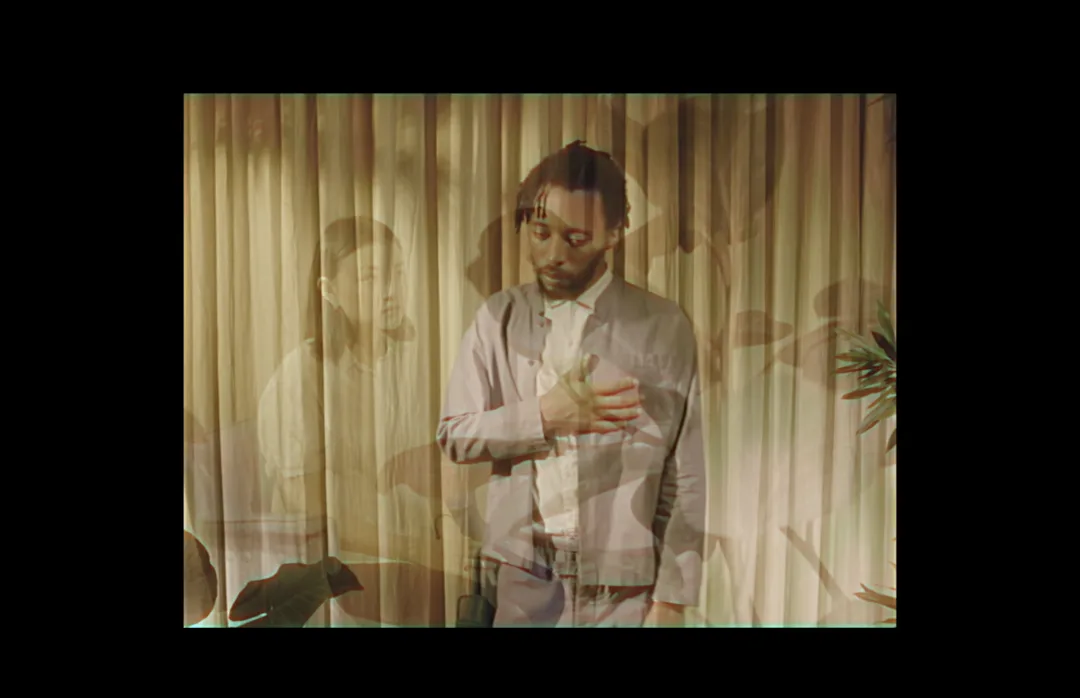
克里斯蒂安·尼安佩塔《序言——关于在危险时空中的恋人》影像静帧
2021—24年,影像(单频、彩色、有声),40分33秒
图片鸣谢艺术家
“一种意想不到的东西出现在同时代人与不适时的人之间”,罗兰·巴特曾如此构想着如马克思(1818–1883)和马拉美(1842–1898)这样同时代却迥异之人的组合。出生在卢旺达的艺术家克里斯蒂安·尼安佩塔(Christian Nyampeta)也在电影《有时是美的》(Sometimes It Was Beautiful, 2018)中想象了一场从未发生但本有可能的友人相聚(大约七八人,还有人中途溜走)。这些人包括瑞典电影摄影师斯文·尼科维斯特(Sven Nykvist, 1922–2006)、电影导演安德烈·塔可夫斯基(Andrei Tarkovsky, 1932–1986)、反对种族隔离的南非社会活动家温妮·曼德拉(Winnie Mandela, 1936–2018)、津巴布韦前总统罗伯特·穆加贝(Robert Mugabe, 1924–2019)、危地马拉基切族的人权活动家里戈韦塔·门楚(Rigoberta Menchú, 1959–)……他们唯一的共同点在于,他们都曾到访过斯德哥尔摩的民族学博物馆,而博物馆中存储着大量原住民制作、使用的器物。
在昏暗的电影院里,这群友人以年轻的模样相聚,一边看着尼科维斯特在1949年夏天的刚果拍摄的电影《巫医的脚步》(I fetischmannens spår),一边发表着各自观点——作为瑞典传教士之子的尼科维斯特拍下有关原住民生活的电影,那些追求平衡的精妙光影,是暴力本身,还是对暴力的逃遁?再现被刻意导演的民族志影像是第二次暴力吗?还是像尼科维斯特的辩驳所言,抹去、雪藏这样的影像也是一种暴力?
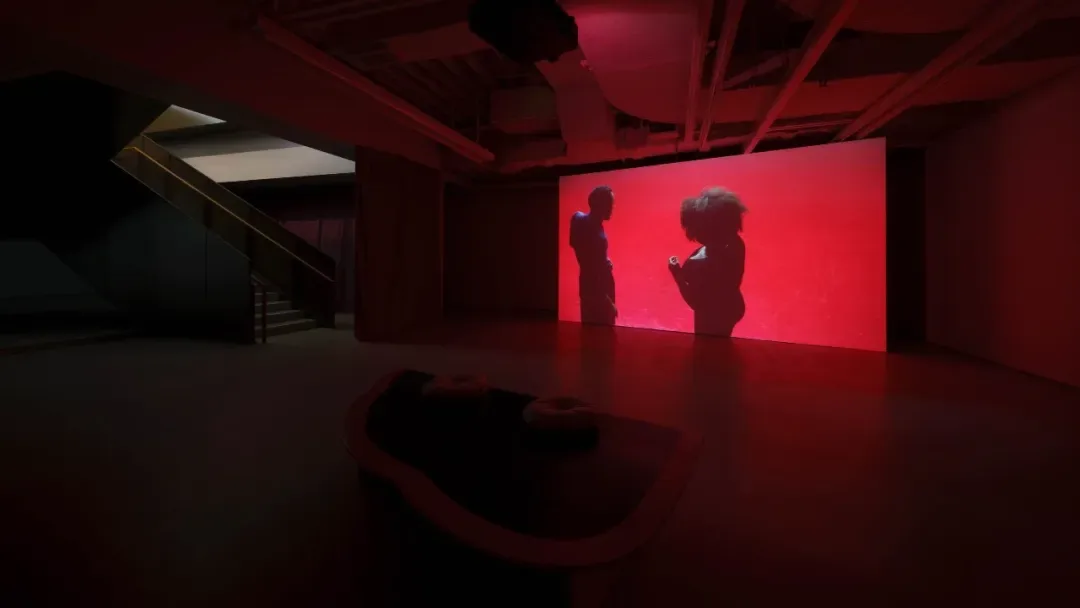
克里斯蒂安·尼安佩塔《有时是美的》展览现场图
2018年,影像(单频、彩色、有声),37分43秒
图片鸣谢艺术家,由斯德哥尔摩的坦斯塔艺术中心委任创作
对话在这些友人之间流转,而影片中的虚构场景,一方面像巴特所说的“对于某些日常空间的小说性模拟”,同时也展现了塞内加尔作家兼电影导演乌斯曼·塞姆班(Sembène Ousmane)对电影院的想象——“夜校”(cours du soir)。这是一个亲密、感性、强调非洲口传传统的地方,也会组织易于理解的艺术教育与共同学习活动。而电影作为媒介的启发意义在于,屏幕中复数的脸孔与观众席中复数的脸孔彼此映照,世界各地、相异时空的不同经验因放映而交织。塞姆班构想的这种多重的、共振的、交织的情境,被尼安佩塔借用并发起了“夜校”。而其中对知识生产协商的强调,也让我猜想借用电影这种大众传播的媒介,是否也在回应着1994年发生在卢旺达的胡图族对图西族的大屠杀里,意识形态和广播等媒介的煽动作用?这里传递着激进的信号:电影院可以被重新夺回,作为共识与相处之地。话语也可以从个体和个体之间的理解(或不理解)出发,由新的词汇和意义编织。虽然在尼安佩塔的创作里,大屠杀一直被隐秘地回避着。艺术家似乎在寻找一种更为建设性的、开放的方式,去回应连接着历史与未来的问题——“如何共同生活?”但尼安佩塔并未要寻找唯一的、正确的“共同生活”方法论,相反,他曾说“只有‘通过生活’才能把握如何共同生活”,这种对生活和过程的肯定,势必要求让他创作的空间向未知打开,成为人们聚会的场所。
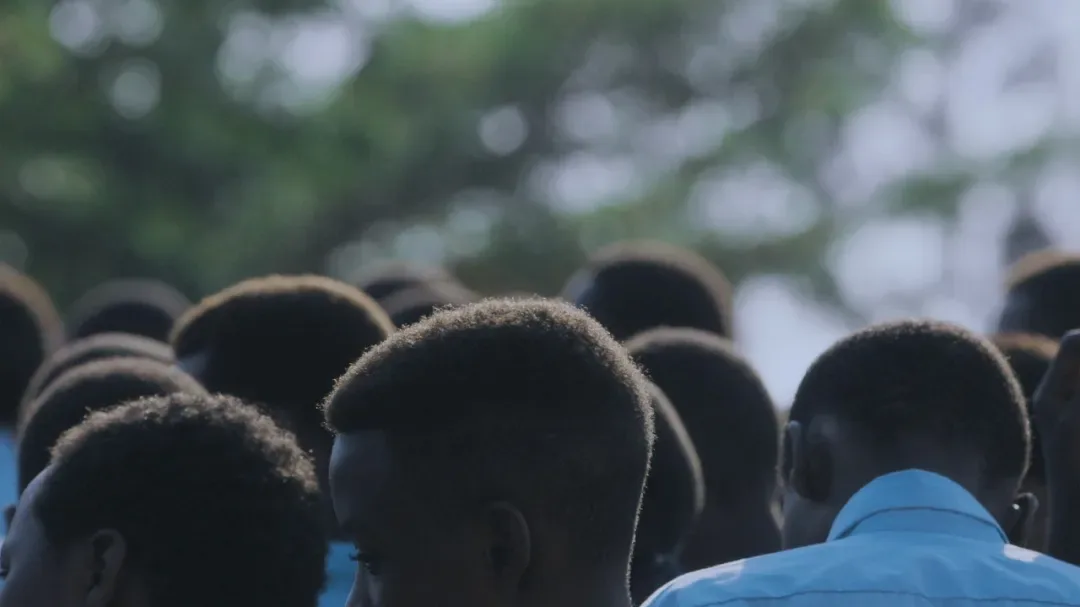
克里斯蒂安·尼安佩塔《世界之后的文字》影像静帧
2017年,影像(单频、彩色、有声),21分钟
由卡姆登艺术中心委任创作,图片鸣谢艺术家
作为一个临时的接待空间(hosting structure),“夜校”曾经发生在阿姆斯特丹、达喀尔、约翰内斯堡、伊斯坦布尔、纽约、伦敦等等不同地方(大多数是艺术机构,当然也涉及到全球北方对文化资源再分配),此次则在上海纽约大学当代艺术中心(上纽ICA)发生。在这里,需要提醒中文观众,这里的“夜校”并非20世纪50年代在中国发起的扫除文盲的识字班,或者到了20世纪80和90年代的英文班和技能培训。在上纽ICA,“夜校”组织了类似木刻工作坊、放映、对谈、接触即兴等等的活动,接待了许多本地和来访的创作社群;而其静态的道具部分,既包括传统意义上的艺术作品——上纽ICA负一层的黑暗空间被留作了电影院,交替放映尼安佩塔的录像《有时是美的》与《世界之后的文字》(Words After the World, 2017)——也有许多无法归类的材料。在无人时,上纽ICA的一楼就像一个周末时的幼儿园,半空飘着蜡笔和彩铅画出的鲜艳花朵,地上用橙色、蓝色线条划下跳格子的游戏,最惹眼的则是一张横陈在中厅、不规则的巨大深蓝色台面,站上去之后你才会意识到它也是一朵花(花朵都由卢本巴希“夜校”工作坊的参与者画出)。一旁的墙面上,是一行手写字“画出你喜欢的童年记忆和你见过最美的花”——尼安佩塔在另外路径艺术教育学校(非洲集群)(Another Roadmap School Africa Cluster)的同事、来自瓦扎艺术中心(WAZA)的菲扎·卡英古·拉马扎尼(Feza Kayungu Ramazani)和波迪希·凯文·通巴·马孔加(Prodige Kevin Tumba Makonga),从卢本巴希来到上海的“夜校”做工作坊时,留下了这样的痕迹。房间再靠里一些放着可爱、低矮的木制座椅和图书角(一些深绿色,偶尔跳出粉红色和橙黄色的对撞),上面就摆着工作坊中孩子、大人一起画下的画,还有用刚果当地的铜丝和碎布头做成的人形玩偶。
我参加了菲扎和马孔加的工作坊,玩得不亦乐乎,认识了他们,和他们去了已经拆迁的定海桥,还听了他们在刚果自我组织、运营艺术中心的的故事。这之后,我才回过头来,开始想去多阅读一些有关非洲的材料。其实,只要在展览一楼那些可爱的家具(叫雕塑也可以)周围多逗留一会儿,在图书角随便翻开一本薄薄的册子,就会发现本地观众多半觉得陌生的、(比幼儿园读本要难很多的)非洲近现代思想家的哲学文本。在中国“思考非洲”当然是困难的,毕竟会首先碰到这样的问题——为什么要在非洲之外思考非洲?认识来自非洲的朋友,分享食物、一起闲聊好像是我的第一步。后来我再次独自去看展览时,阅读了图书角的一篇文章,哲学家赛维琳·柯乔·格朗沃(Séverine Kodjo- Grandvaux)的《反思非洲,思考世界》(Reflections: Thinking Africa, Thinking the World)[1]。我碰到了这样的句子,“哲学必须向他者开放。思考非洲哲学已经成为思考我们自己、并学会从他人的视角认识自己的方式……把哲学实践当作漫游,就是把思想理解为‘通过他者与自身相遇、以自身为中介与他者相遇的旅程’。” 格朗沃文中提及的“漫游”和“相遇”,以及“穿越”(cross)和游荡(err)为“为何思考非洲”提供了提示,即在与他者、与自身之外的世界遭遇时,认识自身。
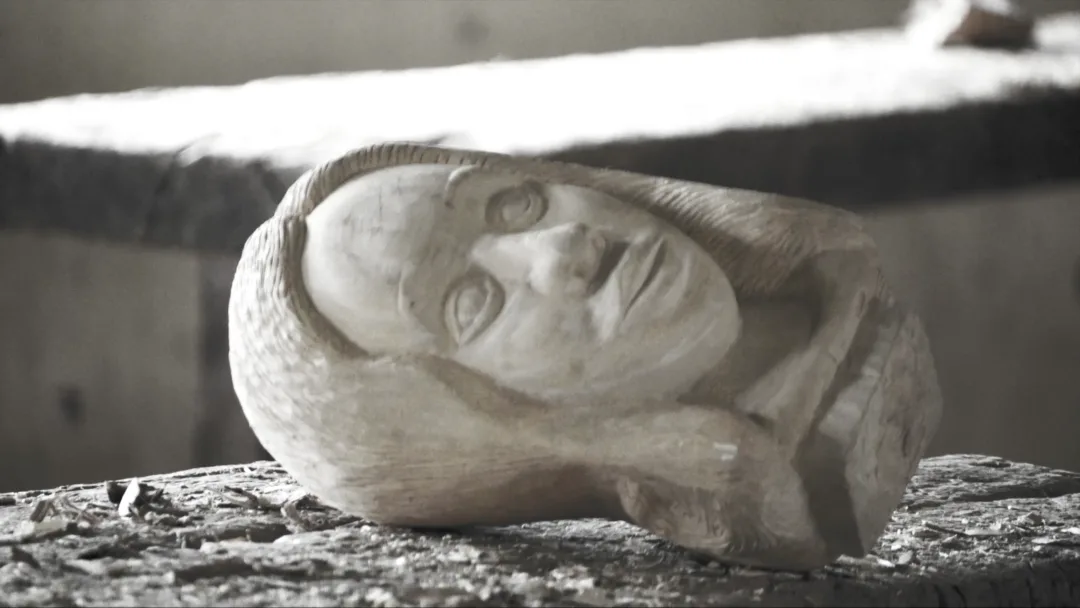
克里斯蒂安·尼安佩塔《有一切美好事物而没有悲伤的花园》影像静帧
2018—2024年,影像(单频、彩色、有声),27分36秒
图片鸣谢艺术家
带着自身的经验,我发现从非洲到了伦敦学习、如今在纽约生活的尼安佩塔也在录像中展现了他的“漫游”和“相遇”。巨大花朵台面的不同角落上放着三台显示器,它们播放着由档案、材料、视觉、采访、对话等等剪辑在一起形成的视觉录像,也被尼安佩塔称为“播放列表”“明信片”或“研究传记”——这些都是他与不同人和材料相遇后,共同进行的的视听编织。《有一切美好事物而没有悲伤的花园》(A Flower Garden of All Kinds of Loveliness without Sorrow, 2018–2024)记录了2018年以来尼安佩塔和哲学家以赛亚·尼泽依马纳(Isaïe Nzeyimana)对许多卢旺达艺术家、思想家的采访,而这些采访彼此呼应和回应着,围绕“非洲”,也围绕在一片传统被损毁的土地上,艺术如何帮助人们重塑历史和记忆。作为有比利时殖民者父亲和卢旺达母亲的混血儿(métis),电影导演乔治·卡马纳约·根古(Georges Kamanayo Gengoux)说道“我是两种文化、两种肤色的私生子……”以赛亚问道,“非洲可以有多重记忆吗?……如何有更为肯定性的记忆,帮助非洲动员自身、朝向未来?”(more affirmative memories to help Africa mobilise itself towards the future)尼安佩塔其他的录像展现了几乎向外敞开的流动,而将这些碎片般的记忆、情感(affection)、联合(alliances)连接在一起的,是所有录像中都在弥漫的音乐。这些缓慢、松动的节奏或许让一些片子看起来像音乐录影带,比如《序言——关于在危险时空中的恋人》(A Long Trailer for a Film about Lovers in a Dangerous Spacetime, 2021–2024),也在《有时是美的》里化作直接的推动力量:在不可能的人物之间发生的对话似乎僵住后,镜头切换到尼安佩塔和朋友即兴的、自然的律动,那似乎是一种提示——音乐可以容纳人们各自不同的身体节奏,而他们又同时是在一起的,共享着、交换着对世界的理解。尼安佩塔与广泛的人、材料、组织、机构的遭遇、连接和合作,在“夜校”中常常确切体现在录像材料的末尾,并书写在放在所有显示器旁边、记录了贡献者的册页中。共享的作者权(authorship)、复数的创造者,和展览入口墙上展览个展的名字“夜校”、艺术家的名字“克里斯蒂安·尼安佩塔”对照着,显出组织和合作推进的项目和目前艺术展览体制之间的紧张——或者,“夜校”也可以被视为对艺术系统的暂时寄生,从美术馆获得可以接入社群的资源?
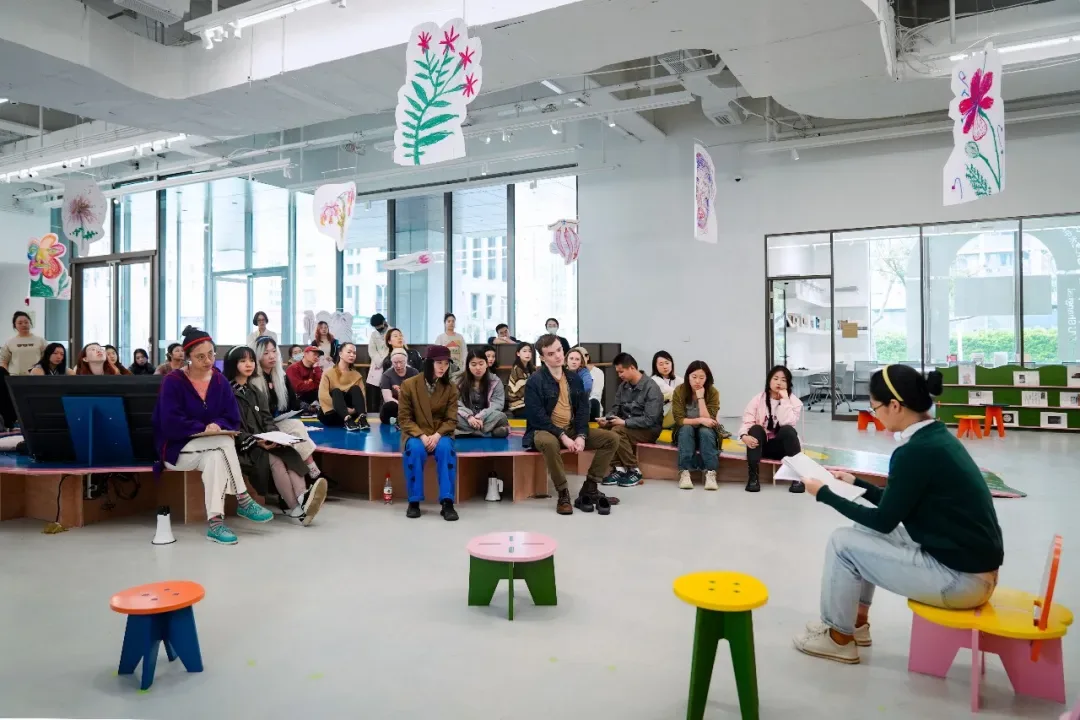
陈怡宁、黄诗芸、曹书韵、杨子逾、赵伊人于上纽ICA“文本工作间”
活动现场,2024年
图片鸣谢艺术家与上纽ICA
“夜校”还有另外一个常规组成部分“文本工作间”(scriptorium,通常被译作“缮写室”),通常由尼安佩塔召集当地的艺术家、行动者、知识分子,一起合作翻译非洲哲学和思想家的文本,而讨论也会衍生出比原始文本更丰富的对话、感受、议题。此次尼安佩塔没有到达上海,上纽ICA邀请了陈怡宁、黄诗芸、曹书韵、杨子逾和赵伊人发起了“有身书”(flesh and ink)工作小组。她们通过数次闭门和开放的工作坊,探索语言中的权力结构如何在语境中产生。我第一次参加的“夜校”工作坊,便是“有身书”的公开表演。表演中,怡宁和诗芸交替用中英文念着她们翻译的文本《用一种语言去思考另一种语言》[2]。从语言到身体,穿着西装外套的怡宁更正着诗芸磕磕绊绊的英文、驼背的姿势,逐渐变成对诗芸身体的摸索和钳制,赵伊人在一旁,用喇叭说明,“纠正对方时,请遵循以下流程:1. 纠正对方 2. 向对方说对不起”,“如果你觉得这是为对方好的纠正,可以不用说‘对不起’”。被忍受的暴力开始被反抗,诗芸前去抢下喇叭,椅子被推翻,两具身体扭打在一起,直至两人最终精疲力尽,冲突平息。话语,也不知何时消失了。
这次表演是我第一次在现实中看到了对《房思琪的初恋乐园》里“巧言令色”下的性暴力与知识暴力的再现。而现场讨论中,一位自小被美国家庭收养,如今重回上海读书、学习中文的华人女生说,她在表演中感受到了自己不管身在美国还是中国都会有的无归属感。在那个人们相聚、被表演打动,坦然讲述自身脆弱的时刻,不同语境竟因为萦绕其中的暴力而共振。尼安佩塔一直探讨的、罗兰·巴特曾经研究和书写的问题“如何共同生活”,被陈怡宁视为“对不同语境的校准”,而在工作坊的“具身翻译”实践中,她提醒,仅仅语言的翻译远远不够,构建“我与你紧密相连”(I am because you are)的乌班图(Ubuntu)状态需要更为深刻的共情,以及持续的、融入日常的身心解殖实践,从而转化暴力的相遇模式。而这或许可以解释,为何菲扎和马孔加在上海、北京、广州的旅行和交流[3],在本地艺术社群里引发了比尼安佩塔的展览更多、更广泛的回响——这是同时代者、不适时之人的相遇,而那些“意想不到的东西”由我们自身产生。
注释:
[1] 赛维琳·柯乔·格朗沃,《反思非洲,思考世界》,选自《对非洲今日的思考和书写》,阿兰·马班库编,(巴黎:Seuil,2017年),第60-71页。尼安佩塔将其从法语翻译为英文,译者苏子滢根据尼安佩塔的英文翻译,又将该文本转译成中文。
[2] 塞内加尔哲学家苏莱曼尼·贝希尔·迪亚涅 (Souleyman Bachir Diagne)的文章《用一种语言去思考另一种语言》(“Thinking from Language to Language”)。
[3] 为了丰富菲扎和马孔加的中国的行程,创造更多的对话与联结,上纽ICA邀请MACA美凯龙艺术中心与时代美术馆,支持他们在北京和广州的短暂停留,并参与到“和瓦扎(Waza)一起学习”的跨区域聚会当中。这也是“浪涌南境”的第一次项目。“浪涌南境”将机构所在的空间和区域,视作南向方法论和流动性的一个栖息地,以此耕耘不同区域的机构之间,机构与作为游牧者的艺术家之间,机构及其附近的社会实践和独立项目之间的对话与生态,促进彼此的信任、了解和协作。作为一个接待空间,项目将继续记录南方化进程中的离散经验,为全球南方议题的讨论和呈现提供语境、资源和容身之所。
克里斯蒂安·尼安佩塔:“夜校”展至6月1日。
Machine translation (AI) of the Chinese original, not yet reviewed by the author. Please cite the original.
Resonance
✦❝To practise philosophy as wandering is to understand thought as ‘a journey in which one meets oneself through the other, and meets the other through oneself’.❞
Christian Nyampeta, A Long Trailer for a Film about Lovers in a Dangerous Spacetime, video still
2021–24, video (single-channel, colour, sound), 40 min 33 sec
Courtesy the artist
‘Something unexpected appears between the contemporary and the untimely’ – so Roland Barthes imagined pairings of people who lived at the same time yet were utterly unlike each other, such as Marx (1818–1883) and Mallarmé (1842–1898). In his film Sometimes It Was Beautiful (2018), the Rwandan-born artist Christian Nyampeta likewise imagines a gathering of friends that never happened but might have (about seven or eight of them, with someone slipping out halfway through). They include the Swedish cinematographer Sven Nykvist (1922–2006), the film director Andrei Tarkovsky (1932–1986), the South African anti-apartheid activist Winnie Mandela (1936–2018), the former Zimbabwean president Robert Mugabe (1924–2019) and the Guatemalan K’iche’ human rights activist Rigoberta Menchú (1959–)… The one thing they have in common is that they all once visited the Museum of Ethnography in Stockholm, which holds a vast number of objects made and used by Indigenous peoples.
In a darkened cinema, the friends meet as their younger selves. As they watch In the Footsteps of the Witch Doctor (I fetischmannens spår), which Nykvist shot in the Congo in the summer of 1949, they each put forward their views. Nykvist, the son of Swedish missionaries, filmed the lives of Indigenous people: is his exquisite, carefully balanced play of light and shadow violence itself, or an escape from violence? Is re-showing a deliberately staged ethnographic film a second act of violence? Or, as Nykvist argues in his own defence, is erasing and shelving such images also a form of violence?
Christian Nyampeta, Sometimes It Was Beautiful, installation view
2018, video (single-channel, colour, sound), 37 min 43 sec
Courtesy the artist; commissioned by Tensta konsthall, Stockholm
The conversation passes among the friends, and the film’s fictional scene is, on the one hand, what Barthes called a ‘novelistic simulation of some everyday spaces’. At the same time, it reflects the Senegalese writer and film-maker Ousmane Sembène’s vision of the cinema as a ‘night school’ (cours du soir). This is an intimate, sensuous place that foregrounds Africa’s oral traditions, and it can also host accessible art education and collective learning. What makes cinema instructive as a medium is that the many faces on the screen mirror the many faces in the audience, so that different experiences from around the world, from different times and places, are woven together through the screening. Nyampeta has borrowed this multiple, resonant, interwoven situation imagined by Sembène to launch “École du soir”, his own night school. Its emphasis on negotiating the production of knowledge also made me wonder whether his use of cinema, a mass medium, is a response to the role that ideology and media such as radio played in inciting the 1994 genocide of the Tutsi by the Hutu in Rwanda. A radical signal is being sent here: the cinema can be reclaimed as a place of consensus and of being together. Speech, too, can start from understanding (or misunderstanding) between one individual and another, and be woven from new words and meanings. Yet in Nyampeta’s work, the genocide has always been quietly avoided. The artist seems to be looking for a more constructive, open way of responding to a question that links history and future – ‘How to live together?’ But Nyampeta is not looking for a single, correct methodology of ‘living together’. On the contrary, he once said that ‘only “through living” can one grasp how to live together’. This affirmation of life and process inevitably requires the space of his work to open itself to the unknown, and become a place where people gather.
Christian Nyampeta, Words After the World, video still
2017, video (single-channel, colour, sound), 21 min
Commissioned by Camden Art Centre; courtesy the artist
As a temporary hosting structure, “École du soir” has taken place in Amsterdam, Dakar, Johannesburg, Istanbul, New York, London and elsewhere (mostly at art institutions – which of course also involves the Global North redistributing cultural resources). This time it is happening at the Institute of Contemporary Arts at NYU Shanghai (ICA NYU Shanghai). Chinese readers should be reminded that this ‘night school’ is not the literacy classes launched in China in the 1950s to wipe out illiteracy, nor the English classes and vocational training of the 1980s and 90s. At the ICA, “École du soir” has organised woodcut workshops, screenings, talks, contact improvisation and the like, and hosted many local and visiting creative communities. Its static props include artworks in the traditional sense – the dark space on the ICA’s basement level has been set aside as a cinema, alternately screening Nyampeta’s videos Sometimes It Was Beautiful and Words After the World (2017) – as well as a great deal of material that defies classification. When no one is around, the ICA’s ground floor looks like a kindergarten at the weekend. Bright flowers drawn in crayon and coloured pencil float in mid-air, and a game of hopscotch is marked out on the floor in orange and blue lines. Most eye-catching of all is a huge, irregular, deep-blue platform lying across the central hall; only when you step onto it do you realise that it, too, is a flower (all the flowers were drawn by participants in the “École du soir” workshops in Lubumbashi). On a nearby wall is a handwritten line: ‘Draw your favourite childhood memory and the most beautiful flower you have ever seen.’ It was left behind by Nyampeta’s colleagues in the Another Roadmap Africa Cluster, Feza Kayungu Ramazani and Prodige Kevin Tumba Makonga of Centre d’art Waza, when they came from Lubumbashi to run a workshop at the Shanghai “École du soir”. Further into the room are sweet, low wooden seats and a reading corner (mostly dark green, with the occasional clash of pink and orange-yellow). On them sit the pictures that children and adults drew together in the workshops, and human-shaped dolls made from Congolese copper wire and scraps of cloth.
I took part in Feza and Makonga’s workshop and had a whale of a time. I got to know them, went with them to Dinghaiqiao, a Shanghai neighbourhood that has since been demolished, and listened to their stories of self-organising and running an art centre in the Congo. Only after that did I look back and start wanting to read more about Africa. In fact, if you linger a little around those lovely pieces of furniture on the ground floor (you could call them sculptures, too) and open any of the slim booklets in the reading corner, you’ll find philosophical texts by modern and contemporary African thinkers that most local visitors would find unfamiliar (and that are much harder than kindergarten readers). ‘Thinking Africa’ in China is of course difficult, not least because you first run into the question: why think about Africa outside Africa? Getting to know friends from Africa, sharing food and chatting together seemed like my first step. Later, when I went back to see the exhibition on my own, I read an essay in the reading corner by the philosopher Séverine Kodjo-Grandvaux, Reflections: Thinking Africa, Thinking the World [1]. I came across sentences like these: ‘Philosophy must open itself to the other. Thinking about African philosophy has become a way of thinking about ourselves, and of learning to see ourselves from the perspective of others… To practise philosophy as wandering is to understand thought as “a journey in which one meets oneself through the other, and meets the other through oneself”.’ The ‘wandering’ and ‘encounter’ that Kodjo-Grandvaux mentions, along with ‘crossing’ (cross) and ‘erring’ (err), offer a hint as to ‘why think Africa’: we come to know ourselves in encountering the other, the world beyond ourselves.
Christian Nyampeta, A Flower Garden of All Kinds of Loveliness without Sorrow, video still
2018–2024, video (single-channel, colour, sound), 27 min 36 sec
Courtesy the artist
Coming at it with my own experience, I found that Nyampeta – who left Africa to study in London and now lives in New York – also shows his own ‘wandering’ and ‘encounters’ in his videos. Three monitors stand at different corners of the huge flower platform. They play videos edited together from archives, materials, visuals, interviews, conversations and more, which Nyampeta also calls ‘playlists’, ‘postcards’ or ‘research biographies’ – audiovisual weavings made jointly after his encounters with different people and materials. A Flower Garden of All Kinds of Loveliness without Sorrow (2018–2024) records interviews that Nyampeta and the philosopher Isaïe Nzeyimana have conducted since 2018 with many Rwandan artists and thinkers. The interviews echo and answer one another, circling around ‘Africa’, and around how, on a land whose traditions have been damaged, art can help people reshape history and memory. The film director Georges Kamanayo Gengoux, a métis with a Belgian colonial father and a Rwandan mother, says: ‘I am a bastard of two cultures, two skin colours…’ Isaïe asks: ‘Can Africa have multiple memories?… How can there be more affirmative memories to help Africa mobilise itself towards the future?’ Nyampeta’s other videos show a flow that is almost wide open to the outside, and what binds these fragments of memory, affection and alliances together is the music that pervades every one of them. These slow, loose rhythms can make some of the films look like music videos – A Long Trailer for a Film about Lovers in a Dangerous Spacetime (2021–2024), for example. In Sometimes It Was Beautiful, the music becomes a direct driving force: after the conversation between these impossible companions seems to stall, the camera cuts to Nyampeta and his friends moving to the music, improvised and natural. It seems like a hint – music can hold people’s different bodily rhythms while they are still together, sharing and exchanging their understandings of the world. Nyampeta’s encounters, connections and collaborations with a wide range of people, materials, organisations and institutions are often made concrete in “École du soir” at the end of each video, and written into the booklets placed beside every monitor that record the contributors. Shared authorship and plural makers stand in contrast to the name of the solo exhibition, “École du soir”, and the artist’s name, ‘Christian Nyampeta’, on the wall at the entrance. This reveals a tension between a project driven by organising and collaboration and the current system of art exhibitions – or perhaps “École du soir” can be seen as a temporary parasite on the art system, drawing from the museum resources that give it access to communities?
Chen Yining, Huang Shiyun, Cao Shuyun, Yang Ziyu and Zhao Yiren at the “Scriptorium”, ICA NYU Shanghai
Event view, 2024
Courtesy the artist and ICA NYU Shanghai
“École du soir” has another regular component, the ‘scriptorium’ (a word usually rendered in Chinese as ‘copying room’). Nyampeta usually convenes local artists, activists and intellectuals to translate texts by African philosophers and thinkers together, and the discussions give rise to conversations, feelings and issues richer than the original texts. This time Nyampeta did not make it to Shanghai, and the ICA invited Chen Yining, Huang Shiyun, Cao Shuyun, Yang Ziyu and Zhao Yiren to form the flesh and ink working group. Through several closed and open workshops, they explored how power structures in language arise in context. The first “École du soir” workshop I attended was a public performance by flesh and ink. In it, Yining and Shiyun took turns reading, in Chinese and English, their translation of ‘Thinking from Language to Language’ [2]. From language it moved to the body. Yining, in a blazer, corrected Shiyun’s halting English and her hunched posture, and this gradually turned into groping and gripping Shiyun’s body. Zhao Yiren stood to one side, announcing through a loudhailer: ‘When correcting the other person, please follow this procedure: 1. Correct them. 2. Say sorry to them’, and ‘If you think the correction is for their own good, you don’t need to say “sorry”.’ The violence that had been endured began to be resisted. Shiyun went to snatch the loudhailer, a chair was knocked over, and the two bodies grappled with each other until both were exhausted and the conflict subsided. Words, too, had disappeared at some point.
This performance was the first time I had seen, in real life, a re-enactment of the sexual and intellectual violence hidden behind ‘fine words and an ingratiating face’ in Lin Yi-han’s novel Fang Si-Chi’s First Love Paradise. In the discussion afterwards, a young woman of Chinese heritage who had been adopted by an American family as a child, and who has now come back to Shanghai to study and learn Chinese, said that in the performance she felt the sense of not belonging that she has whether she is in the US or in China. At that moment, when people had gathered, been moved by a performance and were openly speaking of their own vulnerability, different contexts resonated – of all things, through the violence that haunted them. The question Nyampeta has long explored, and that Roland Barthes once studied and wrote about – ‘how to live together’ – was seen by Chen Yining as ‘a calibration of different contexts’. And in the workshop’s practice of ‘embodied translation’, she reminded us that translating language alone is far from enough: building the state of Ubuntu – ‘I am because you are’ – requires deeper empathy, and an ongoing practice of decolonising body and mind that is woven into daily life, so as to transform violent modes of encounter. This might explain why Feza and Makonga’s travels and exchanges in Shanghai, Beijing and Guangzhou [3] sparked more, and wider, resonance in the local art community than Nyampeta’s exhibition did – this was an encounter between contemporaries and the untimely, and that ‘something unexpected’ came from ourselves.
Notes:
[1] Séverine Kodjo-Grandvaux, ‘Reflections: Thinking Africa, Thinking the World’, in Penser et écrire l’Afrique aujourd’hui, ed. Alain Mabanckou (Paris: Seuil, 2017), pp. 60–71. Nyampeta translated it from French into English, and the translator Su Ziying rendered it into Chinese from Nyampeta’s English translation.
[2] ‘Thinking from Language to Language’, an essay by the Senegalese philosopher Souleymane Bachir Diagne.
[3] To enrich Feza and Makonga’s itinerary in China and create more dialogue and connections, the ICA NYU Shanghai invited MACA Art Center and Times Museum to support their short stays in Beijing and Guangzhou and their participation in the cross-regional gathering “Learning with Waza”. This was also the first project of “Waves Across the South”. “Waves Across the South” treats the spaces and regions where the institutions are based as a habitat for southward methodologies and mobility, cultivating dialogue and ecologies between institutions in different regions, between institutions and artists as nomads, and between institutions and the social practices and independent projects around them, to foster mutual trust, understanding and collaboration. As a hosting structure, the project will continue to document diasporic experiences in the process of southernisation, providing context, resources and a home for discussing and presenting the issues of the Global South.
Christian Nyampeta: “École du soir” runs until 1 June.