Writing / criticism · 2024 · 中文
Review of "Nomads in the South: Rivers, Tunnels, Dampness and Constellations"游牧在南方,调研还是凑局?:评坪山美术馆"游牧在南方:河流、隧道、湿热、星群"
展评:坪山美术馆「游牧在南方:河流、隧道、湿热、星群」。「南方」成了焦点模糊的修辞,掩盖了对具体区域、情境和问题的分析。

南方?A Wind from the South?✦ ❝‘南方’成了焦点模糊的修辞,掩盖了对具体区域、情境和问题的分析。这样先高高举起某个概念,又浑水摸鱼地将其放走,只能让这个词语失去其穿透力及潜能。
❞
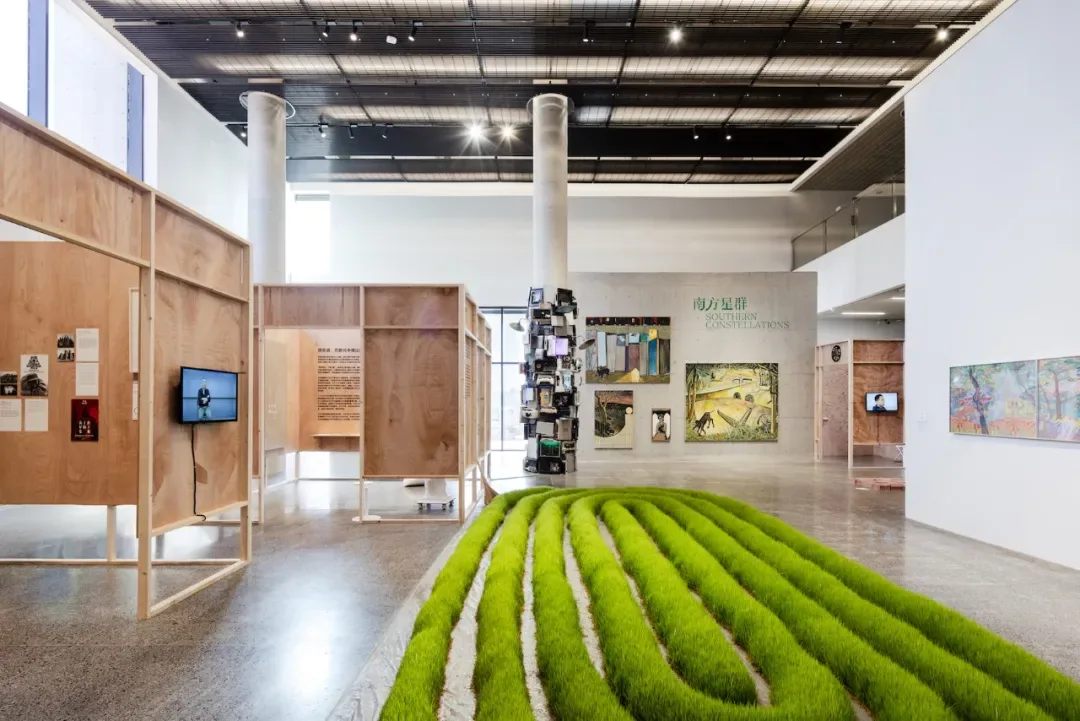
“游牧在南方:河流、隧道、湿热、星群”第一单元展览现场
全文图片鸣谢坪山美术馆
游牧在南方:河流、隧道、湿热、星群
坪山美术馆,深圳
2023年12月23日至2024年年中
从深圳市中心坐地铁,穿行约40分钟,再步行穿过巨大的坪山区中心公园,在很远处就能看到坪山美术馆外墙悬挂的巨幅海报,上面一排排大字激越如口号——“游牧在南方”。
2019年开馆后,刘晓都作为首任馆长推出了几个大型展览和项目,其中最具野心的便是与常驻北京的策展人崔灿灿合作的系列展览“九层塔”(2021—2022)。“九层塔”邀请艺术家、建筑师、平面设计师共同工作,形成数个回合。这一次,美术馆与崔灿灿再次合作,在野心上不减当年。然而,这次的展览却并非不同身份个体在同一空间中的博弈。博弈相对实在,但做大型群展,艺术家之间不需要太多联动。给策展人提交作品集,交流、讨论,把被选中的作品提交上去,在艺术家这边的工作基本就结束了。
翻开坪山美术馆的导览册,崔灿灿执笔的策展前言里,第一句这样写道:“ 这是中国当代艺术第一次将南方连接起来。”我有些困惑,是否这次展览面临着跻身中国当代艺术史的压力,也细想这一豪言壮语从何而出:“中国当代艺术”是否指坪山美术馆和崔氏,而“南方”指的是展览中来自中国八省一市的90位/组艺术家吗?先让我们接受策展人的隐形前提,这里的“南方”指的是中国北纬30度以南的地区(这一信息出自开幕座谈),也且不说这里忽略“南方”其他地区的草率、“将”字轻视了“南方”所指之人之物的自身能动性,句子中问题最大的一处是这个原本就很模糊的动词,“连接”。
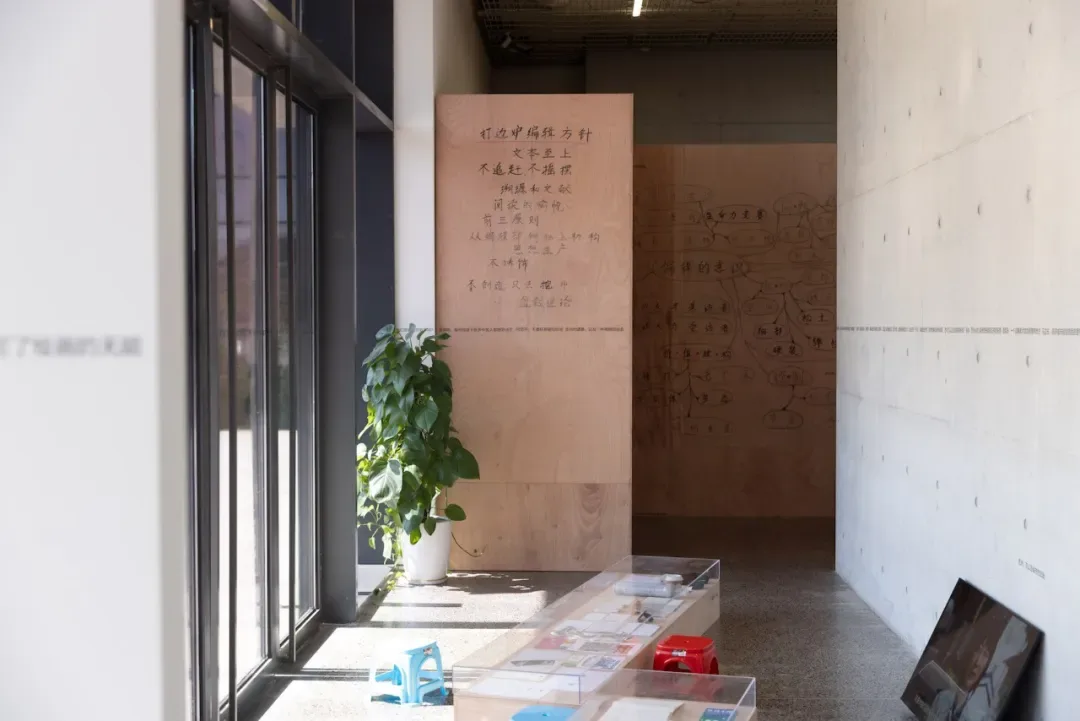
“打边炉”的现场展示 “游牧在南方:河流、隧道、湿热、星群”第一单元展览现场
展厅的墙上贴着策展人的行程地图与时刻表,总计13天、四次往返深圳的旅行让我想起1990年代国际策展人来中国走访时的逸闻。那些语言不通的外国人想了解中国广袤大地上的艺术家,要一周内依靠向导、马不停蹄地直奔几个艺术家工作室;策展人的行程单也成了抢手的内部消息。但大多数展览现场里,策展人仍需后撤,艺术家的作品要放到前面。而在这次展览里,策展人的旅程,而非艺术家的实践,成了最明显的“游牧”。策展人作为社群连接者的现象,在广义的当代艺术领域和作为例外状态的“中国当代艺术”领域都有前例。依靠走访、跨地区旅行、强调工作强度的方式,让人回想起上世纪全国大串联的一腔热情。然而,看看年历,现在是2024年,懂中文、可以本地长时间工作的策展团队为何仍然要把如此原始的工作方法摆在最明显的位置?
展览分为六个单元。一楼开篇,厉槟源和李燎健硕的赤膊背影并列,余果的出山之路(《从山脉到海岸》,2022)、程新皓的送水之旅(《你不要到南方去,你不要到北方去》,2022)相对播放,仿佛是对“行动”的实际写照(行动者的形象以男性为主,而披着草皮的童文敏 [《草坪》,2018] 似乎是人类中心主义奇观制造的反面——她的皮肤隐匿在草坪下、身体仿佛是大地的隆起)。拐入主展厅,海南艺术家团体“找房团”、昆明当代美术馆、器·空间等组织的过往资料铺陈在各自的格子间。展厅虽然拥挤,但这些区域性文化艺术组织的自身梳理为观众提供了丰富的理解路径。不过,在展览的第二单元“深圳时间”,这些线索消失了。这一单元的逻辑是,在此展出的艺术家都曾在深圳生活——但可惜,这些彼此紧挨的作品之间并没有太多共鸣。展览单元既没有从深圳这一角度挖掘作品和艺术家经历、揭示作品之间的关联,也没有以作品揭示出深圳的更多面向。第三单元以自然为题旨,是不同作品在内容和视觉上最可彼此呼应的展览区块。袁野的《大万植物识别手册》(2022)用图片拼贴和充满奇趣的文本展示了坪山当地植物的“小传”,例如大王椰如何成为人类权力的象征。第四单元有关城市化,啾小组以幽默、重复性动作的录像为这层定调。
跨过五楼的放映厅,第六单元的作品在展示时相对独立、趣味横生,白瓷复刻的数十件搓衣板(柳溪《妈妈》,2015—2022)的对面,就是马丙的水墨画《奥特曼伏虎图》(2023)还有奥特曼“发腮”后的肖像。但看到在广东出生、上海发展的艺术家蔡坚的标志性系列“水平”(2020—)时,这一单元的标题“比地域重要”让人疑惑重要的究竟是什么——策展人在前言中提及他们“放弃了上海辐射的浙江、安徽”,且“不做什么,理应是我们做什么的第一步”,但又如何解释这个对上海的回马枪呢?虽然蔡坚的故乡是潮汕,但上海对他事业发展的作用策展人应该不难知晓。在这次展览里,出现在上海发展的艺术家绝不是问题,问题在于策展人对“南方”在不同时刻的随意解释。
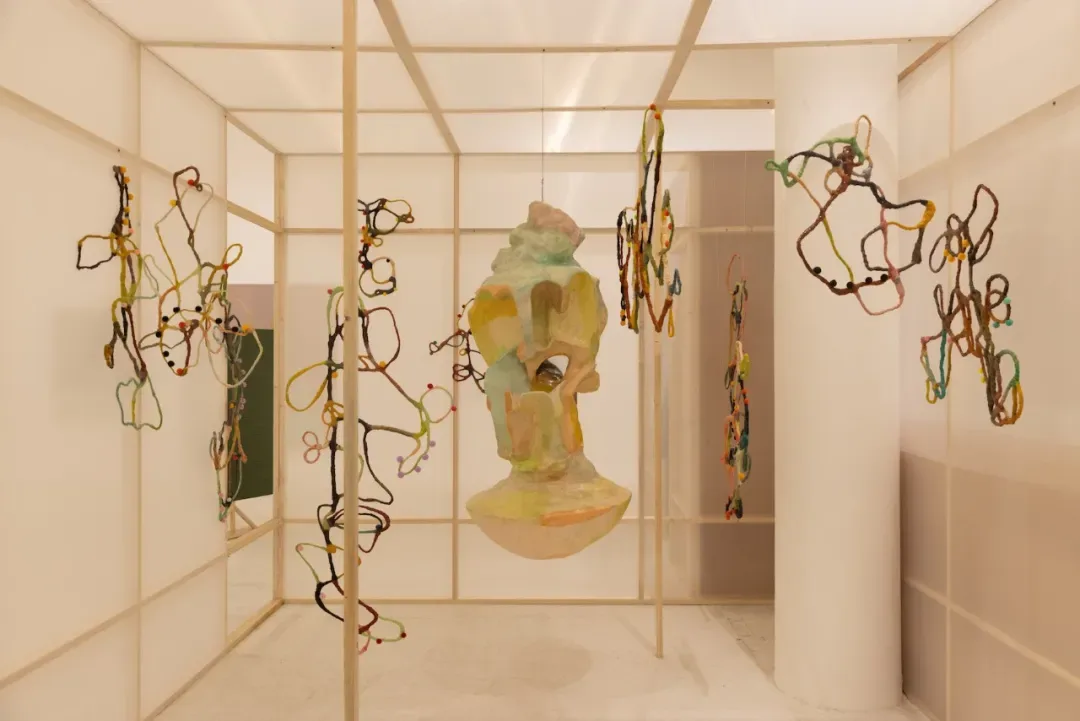
陈牧甜《时间是一个谜团》《跳舞的藤蔓》《房间》《情书》《花园的微风吹落阳台》 2023年,综合材料
“游牧在南方:河流、隧道、湿热、星群”第六单元展览现场
我同意,第一步的确应该是划掉不该做什么。那么一个以“南方”为题眼的当代艺术展览,是否应该不要让“南方”成为一个虚空混沌、轻易滑动的概念?是否该明确“南方”是如何被不同人理解的,它从一个地理方位如何成为政治、社群等层面的概念,人们的艺术创作在不同时间段如何与之有关?崔灿灿在采访中说道:“南方作为一个载体,重要的不是土地本身,而是在土地上空漂浮着的对于艺术的不同理解,或者是一种调研,或者是一种未经驯化的原始语言。”在这一串排比中,“南方”这一概念不仅被撇除了复杂现实和历史、缩减为“艺术”,更被放置在与文明对立的“原始”位置上,所谓的“调研”不仅更近乎凑局(”中国当代艺术“的传统工作方法),更带着一种外部性的视角,将南方视为考察对象来凝视。“调研”二字,展开是“调查研究”,然而展览现场里更多是对艺术家作品拉清单式的陈列,欠缺对基础资料的转化(打边炉是其中少有的对其日常实践有所转化的组织)。虽然策展人在前言中强调跨越地域的联系以及人的流动性,但是这种连接和流动主要通过对101位艺术家、研究者的专题采访呈现,展览并未更加深入地提炼线索——艺术家们到北京上海的闯荡意味着什么,在国外受过的教育是一种什么意义上的“游牧”,在社会和艺术行业里,“北方”和“南方”的关系,本都是可以挖掘、提炼的问题。与此同时,艺术家的名字后面紧跟着的自身籍贯的括注,反映出身份代表制的刻板展览逻辑。
虽然“游牧在南方”生产了大量一手采访影像,邀请了五位观察员举荐艺术家并撰写长文,另有一系列书籍出版计划,但这似乎无法掩饰“南方”并未成为理解当下艺术创作的某种揭示性视角,艺术家也缺乏对这“南方”的讨论以及这一概念与自身创作关系的自觉。在展览现场的单元文字里,策展人写道,“‘南方’的概念并不恰当” 、“总是相对的”。这不免让对“南方”认真的人寒心:“南方”成了焦点模糊的修辞,掩盖了对具体区域、情境和问题的分析。这样先高高举起某个概念,又浑水摸鱼地将其放走,只能让这个词语失去其穿透力及潜能。
Machine translation (AI) of the Chinese original, not yet reviewed by the author. Please cite the original.
A Wind from the South? ✦ ❝‘The South’ has become a blurry piece of rhetoric that covers up any analysis of specific regions, situations and problems. Holding a concept up high only to let it slip away in the murk can only rob the word of its penetrating force and potential.
❞
Installation view, Section One, “Nomads in the South: Rivers, Tunnels, Dampness and Constellations”
All images courtesy Pingshan Art Museum
Nomads in the South: Rivers, Tunnels, Dampness and Constellations
Pingshan Art Museum, Shenzhen
23 December 2023 – mid-2024
From central Shenzhen you take the metro for about forty minutes, then walk across the vast Pingshan District Central Park. From a long way off you can see the giant poster hanging on the façade of Pingshan Art Museum, its rows of big characters as rousing as a slogan: ‘Nomads in the South’.
After the museum opened in 2019, its first director, Liu Xiaodu, launched several large exhibitions and projects. The most ambitious was the exhibition series “Nine-Tiered Pagoda” (2021–2022), a collaboration with the Beijing-based curator Cui Cancan. “Nine-Tiered Pagoda” invited artists, architects and graphic designers to work together over several rounds. This time the museum has teamed up with Cui Cancan again, with no less ambition than before. This exhibition, however, is not a contest between people of different backgrounds in the same space. A contest is at least something concrete; but in a big group show, artists hardly need to interact. You submit your portfolio to the curator, talk it over, send in the selected works, and your job as an artist is basically done.
Open Pingshan Art Museum’s visitor guide, and the first sentence of the curatorial introduction, written by Cui Cancan, reads: ‘This is the first time Chinese contemporary art has connected the South.’ I was a little puzzled. Was the exhibition under pressure to secure a place in the history of Chinese contemporary art? I also wondered where this grand claim came from. Does ‘Chinese contemporary art’ refer to Pingshan Art Museum and Mr Cui, and ‘the South’ to the ninety artists and groups in the show from eight provinces and one municipality? Let us first accept the curator’s unstated premise that ‘the South’ here means the part of China south of 30 degrees north (a detail given at the opening talk). Let us also set aside the carelessness of ignoring other ‘Souths’, and the way the construction of the sentence – with Chinese contemporary art as the one doing the connecting – belittles the agency of the people and things that ‘the South’ refers to. The biggest problem in the sentence is its verb, already vague to begin with: ‘connect’.
Presentation by Dabianlu (打边炉) Installation view, Section One, “Nomads in the South: Rivers, Tunnels, Dampness and Constellations”
On the gallery wall are the curator’s travel map and schedule: thirteen days in total, four round trips from Shenzhen. It reminded me of anecdotes about international curators visiting China in the 1990s. Those foreigners, who didn’t speak the language, wanted to get to know artists across China’s vast territory, and would rush non-stop through several artists’ studios in a week with the help of a guide; a curator’s itinerary became a sought-after piece of insider information. But in most exhibitions, the curator still has to step back and put the artists’ work in front. In this show, it is the curator’s journey, rather than the artists’ practice, that has become the most visible ‘nomadism’. The curator as a connector of communities has precedents both in contemporary art broadly and in ‘Chinese contemporary art’ as a state of exception. Working through visits, trips across regions and an emphasis on sheer intensity of labour recalls the fervour of the ‘great exchange of revolutionary experience’ of the last century, when young Red Guards criss-crossed the country. But look at the calendar: it is 2024. Why would a curatorial team that knows the language and can work locally for long stretches still put such a primitive method of working front and centre?
The exhibition is divided into six sections. It opens on the ground floor with the muscular, bare backs of Li Binyuan and Li Liao side by side, while Yu Guo’s journey out of the mountains (From Mountains to the Coast, 2022) and Cheng Xinhao’s water-carrying trip (Don’t Go to the South, Don’t Go to the North, 2022) play opposite each other, like literal portraits of ‘action’. (The figures of action are mostly male, while Tong Wenmin, draped in turf [Lawn, 2018], seems the opposite of the anthropocentric spectacle – her skin hidden under the grass, her body like a swelling of the earth.) Turning into the main gallery, the archives of organisations such as the Hainan artist group House-Hunting Group (找房团), Contemporary Gallery Kunming and Qi Space (器·空间) are laid out in their own cubicles. The gallery is crowded, but these regional art organisations’ own accounts of themselves offer viewers rich routes to understanding. In the second section, “Shenzhen Time”, however, these threads disappear. The logic of this section is that all the artists shown here have lived in Shenzhen – but unfortunately the closely packed works have little resonance with one another. The section neither digs into the works and the artists’ experiences from the angle of Shenzhen to reveal connections between them, nor uses the works to reveal more sides of Shenzhen. The third section, themed on nature, is the part of the show where the works echo each other most in content and visuals. Yuan Ye’s Dawan Plant Identification Handbook (2022) uses image collages and whimsical texts to present ‘short biographies’ of local plants in Pingshan – how the royal palm became a symbol of human power, for instance. The fourth section is about urbanisation, and JIŪ Society’s humorous videos of repetitive actions set its tone.
Past the screening room on the fifth floor, the works in the sixth section are displayed more independently and are full of fun. Opposite dozens of washboards replicated in white porcelain (Liu Xi, Mother, 2015–2022) hangs Ma Bing’s ink painting Ultraman Subduing a Tiger (2023), along with portraits of Ultraman with puffed-up, swollen cheeks. But on reaching the signature series Horizon (2020–) by Cai Jian, an artist born in Guangdong who built his career in Shanghai, the section’s title, “More Important than Region”, leaves you wondering what exactly is important. In the introduction the curators say they ‘gave up Zhejiang and Anhui, which lie within Shanghai’s orbit’, and that ‘what we don’t do should be the first step of what we do’ – so how to explain this sudden U-turn back to Shanghai? Cai Jian’s hometown may be Chaoshan, but the curators could hardly be unaware of the role Shanghai has played in his career. Including artists who built their careers in Shanghai is certainly not a problem in this exhibition. The problem is the curators’ arbitrary interpretation of ‘the South’ at different moments.
Chen Mutian, Time Is a Mystery, Dancing Vines, Room, Love Letter, The Garden Breeze Blows onto the Balcony 2023, mixed media
Installation view, Section Six, “Nomads in the South: Rivers, Tunnels, Dampness and Constellations”
I agree that the first step should indeed be to cross out what shouldn’t be done. In that case, shouldn’t a contemporary art exhibition that takes ‘the South’ as its keyword avoid letting ‘the South’ become an empty, muddled, easily slippery concept? Shouldn’t it make clear how ‘the South’ is understood by different people, how it turned from a geographical direction into a concept on political, community and other levels, and how people’s art-making has related to it in different periods? In an interview, Cui Cancan said: ‘The South as a vehicle – what matters is not the land itself, but the different understandings of art floating in the air above it, whether a kind of research or a kind of untamed, primitive language.’ In this string of parallel phrases, the concept of ‘the South’ is not only stripped of its complex realities and histories and reduced to ‘art’, but also placed in the position of the ‘primitive’, as opposed to civilisation. The so-called ‘research’ is not only closer to rounding up a crowd (the traditional working method of ‘Chinese contemporary art’), but also carries an outsider’s perspective, gazing at the South as an object of fieldwork. The Chinese word for this ‘research’, diaoyan, is short for ‘investigation and study’. Yet what the exhibition mostly offers is a checklist-style display of artists’ works, with little transformation of the basic material (Dabianlu is one of the few organisations whose everyday practice was transformed into something in the show). The curators stress connections across regions and people’s mobility in the introduction, but these connections and flows come across mainly through dedicated interviews with 101 artists and researchers; the exhibition does not distil its threads any further. What it means for artists to go and try their luck in Beijing and Shanghai, in what sense an education abroad counts as ‘nomadism’, the relationship between ‘North’ and ‘South’ in society and in the art world – all of these were questions that could have been dug into and drawn out. Meanwhile, the brackets giving each artist’s native place right after their name reflect a rigid exhibition logic of identity representation.
“Nomads in the South” has produced a large amount of first-hand interview footage, invited five observers to recommend artists and write long essays, and has a series of books planned. Yet none of this seems able to hide the fact that ‘the South’ has not become a revealing perspective for understanding art-making today, and the artists show little awareness of any discussion of ‘the South’, or of how the concept relates to their own work. In the section texts in the galleries, the curators write that ‘the concept of “the South” is not quite appropriate’ and ‘is always relative’. This can only dishearten those who take ‘the South’ seriously: ‘the South’ has become a blurry piece of rhetoric that covers up any analysis of specific regions, situations and problems. Holding a concept up high only to let it slip away in the murk can only rob the word of its penetrating force and potential.