Writing / feature · 2023 · 中文
Editors’ Picks: Gallery Weekend Beijing 2023ARC 第一人称|画廊周北京2023画廊展编辑之选
因为画廊周,在北京围着798走了三天,突然觉得这里变化了好多。从前觉得798偏僻,吃食很少,现在798可谓繁华风流,游人如织——八年前里头一爿小小的广西米粉店,现在扩大了四倍,还开出了糖水铺和分店。如今,真需要“拓荒”的是二十公里外的国家对外文化贸易基地。
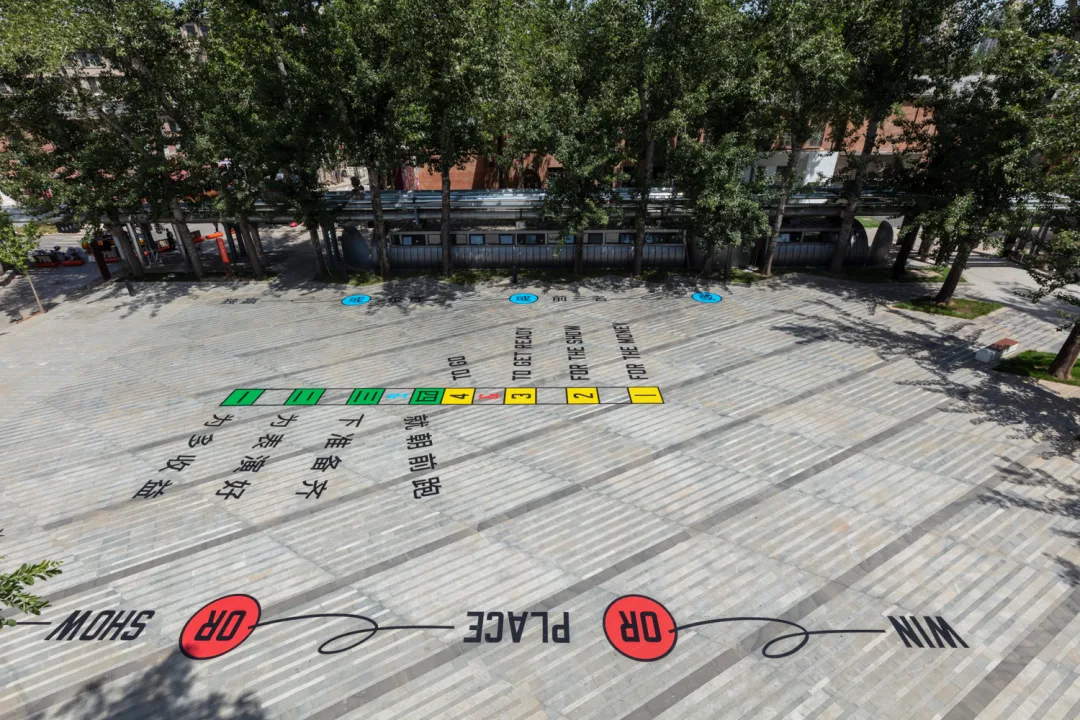
Lawrence Weiner, 1 FOR THE MONEY / 2 FOR THE SHOW / 3 TO GET READY & 4 TO GO
劳伦斯·韦纳《一为多收益 / 二为表演好 / 三下准备齐 & 四就朝前跑》
1991年/2008年
第七届画廊周北京公共单元现场
图片鸣谢画廊周北京
里森画廊就在顺义的国家对外文化贸易基地,它所在的那栋博乐德艺术中心名字里带着“Blanc”,似乎在调侃那儿干干净净的状态。如果按照劳伦斯·韦纳(Lawrence Weiner)相信的,艺术品直到观众看到的时候才存在,那我对他作品的理解必然要和当时一起看预览的媒体编辑和作者们联系起来(btr还穿着韦纳的业余色情片《A BIT OF MATTER AND A LITTLE BIT MORE》定制版T恤衫)。这是场投入的文字理解工作。墙面上,“PUSHED AS IF”和“LEFT AS IS”被译成中文“顺势而为”和“点到为止”。英文中的“PUSHED”那种被动态被说得更主动了,不过这也像画廊周里工作者的状态——大家是被推着奔波看展的,但也乐意。而在花了将近一个小时看完约翰·亚康法(John Akomfrah)围绕希腊破产危机和帝国遗产的诗意之作《机场》后,我很好奇,花了这么大力气配置的高规格单一作品放映厅会有多少人过来。工作人员让我别担心,这周围是中央别墅区,周末这里就会出现扶老携幼的景象。从展厅出来,天空低飞过硕大飞机,提醒我不远处就是见证祖国现代化历程的首都国际机场。当代唐人艺术中心总部的郭宇恒个展(非本次画廊周项目)满是缤纷灼眼的人偶,拥挤至身躯交融,远看如塑胶材料乱搅一气的调色盘,亮粉色笼罩一切。最近画廊总在流行讲“2000年出生的人也出道了”,但人们似乎还没准备好新的说辞迎接。崔灿灿在前言中如此解释这位2003出生的艺术家的创作:“SKIRUA的乐园就是SKIRUA的乐园。”保税区园区门口就立着一块标牌,汉字是“乐园”,英文很绝妙:“so real”。
回到798,我的路线大概是以UCCA为中心逆时针螺旋扩散。UCCA由容思玉策划的“幻/灯”从幻灯片媒介出发梳理‘85前后的大陆当代艺术发展条件,结合郑胜天、费大为档案,重温珠海会议和黄山会议,为今日画廊周胜景铺陈前史。户尔画廊呈现的瑞贝卡·霍恩(Rebecca Horn)此次一点儿也不厚重,偏向抒情小品;邻居魔金石空间整体晦暗安静,观众要用放大镜看秦一峰拍摄明代素工家具残件的大画幅负片,而四周墙面上则是他亲手放大的相纸,其上一片灵动的墨色而无具体形状——从某种程度上看,秦氏是通过十分摄影本体论的方式(甚至有杜塞多夫学派的感觉),通过拍摄家具,通过调整明暗、焦距、光晕,模糊具象抽象、表现再现之间的界限。这种古典文人气息,在刘彦湖的站台个展里变得俏皮了一些。一切皆可入对,比如“金钱豹”对“美人鱼”;而他不用卷轴装裱,是把纸张如帆布一样紧俏地绷在框上。在常青画廊,汉斯·欧普·德·贝克(Hans Op de Beeck)将宽敞欧洲沙龙内景一律涂上均质灰色,包括桌椅、花卉、人物、书卷。一片纯净中也让人想起陈箴用泥浆包裹中国千禧年代日常用品的《净化室》(2000)。再走几步到马刺画廊,趁着最近的抄袭风波以及AI挑战艺术家存在意义的热点,策展人鲁明军在群展“原创在天……上”中邀请了30多位(组)艺术家,回答有关原创焦虑的问题。我的浅薄印象是,对于并不靠卖图卖插画给图库赚钱的艺术家,“原创”问题似乎仍有关从创作生涯伊始时便要面对的相似性问题。这便是各人早已有答案的事,而非迫在眉睫的劳动价值贬值危机。
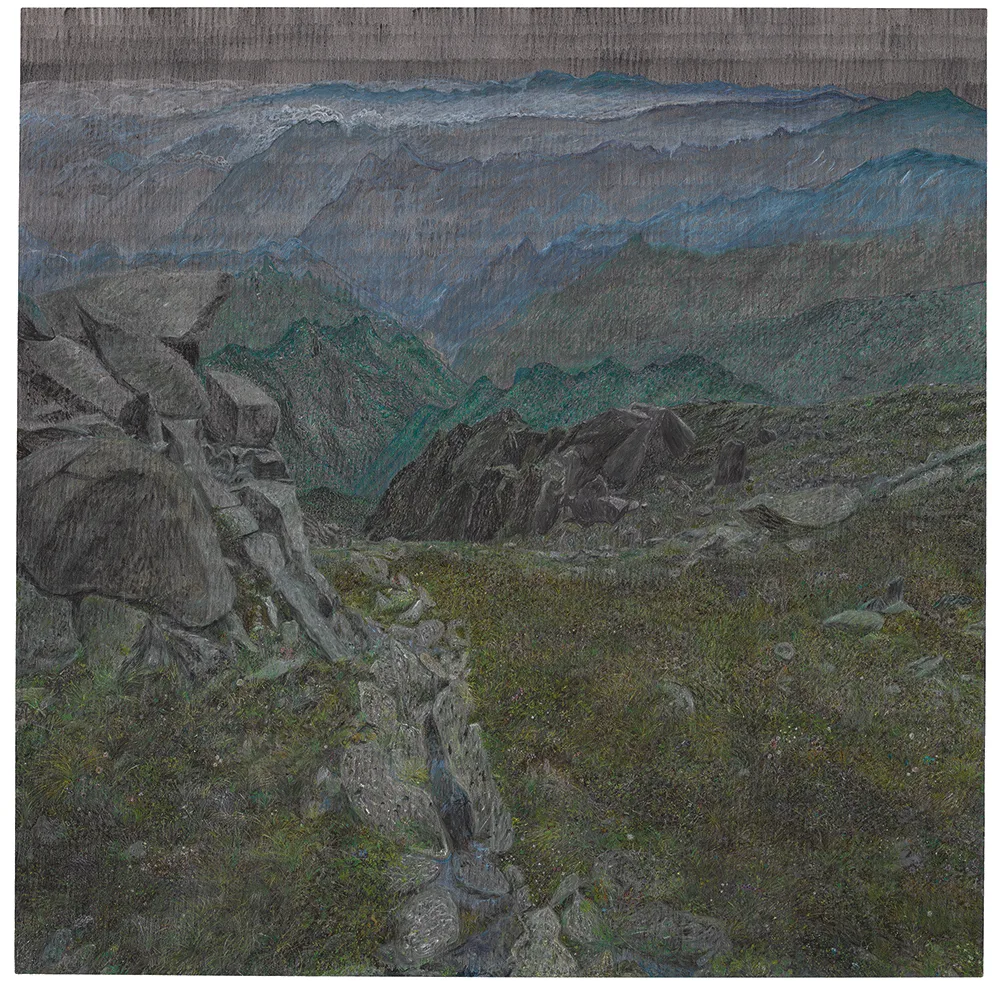
欧阳春《空谷幽兰 二》
2015年,布面油画,250 × 250 厘米
图片鸣谢艺术家及空白画廊
绕去美凯龙的路上,意外发现了空白空间在临时场地搭建的欧阳春个展“空谷幽兰”。临时结构通体白色,人一进入便面对一条狭长甬道,顺着望见远处高挂的一张画。等到后面近距离看时才发现是瀑布。沿着甬道侧旁的开口,顺楼梯上升,每换一室便有一张画出现,也仅仅只有一张——不久便懂得这旅程是模仿欧阳春入山时沿小径登攀的经验,忽而幽狭,忽而开阔。画面上也常常如日光灿烂下的山色,描绘草地和花甸的笔触松弛而生机勃勃,若“草色遥看近却无”的初春。有画家朋友讲,这画得太“literal”,似乎失去了艺术家该做的消化和创造;我却很感激在这里有暂时远离词语和叙事的片刻。美凯龙艺术中心的双个展延续了机构对影像艺术的关注。袁中天的展览在黑暗中以反光雨衣窗帘分隔出空间,四组录像中的人声、鼓点、音乐如潮水般涌向彼此。消失和逝去的友人、挥之不去的创伤记忆、人与人之间关系的脆弱,自传式地交织在一起。影像反复剪切拼贴,如辗转反侧的生命经验,声潮也漫过展厅中3D打印的建筑模型。空间从不空无。楼上的胡伟展览中,录像和观众一齐进入装置。蝴蝶君、沙巴小岛上的渔民、中国南方岛屿的采石场里的移民等等跨越地缘、不同时代政治下的遭遇在录像中展开。审问室的红色光线为展览定调。
“马秋莎:琉璃厂东街52号”展览现场,2023年
图片鸣谢艺术家及北京公社
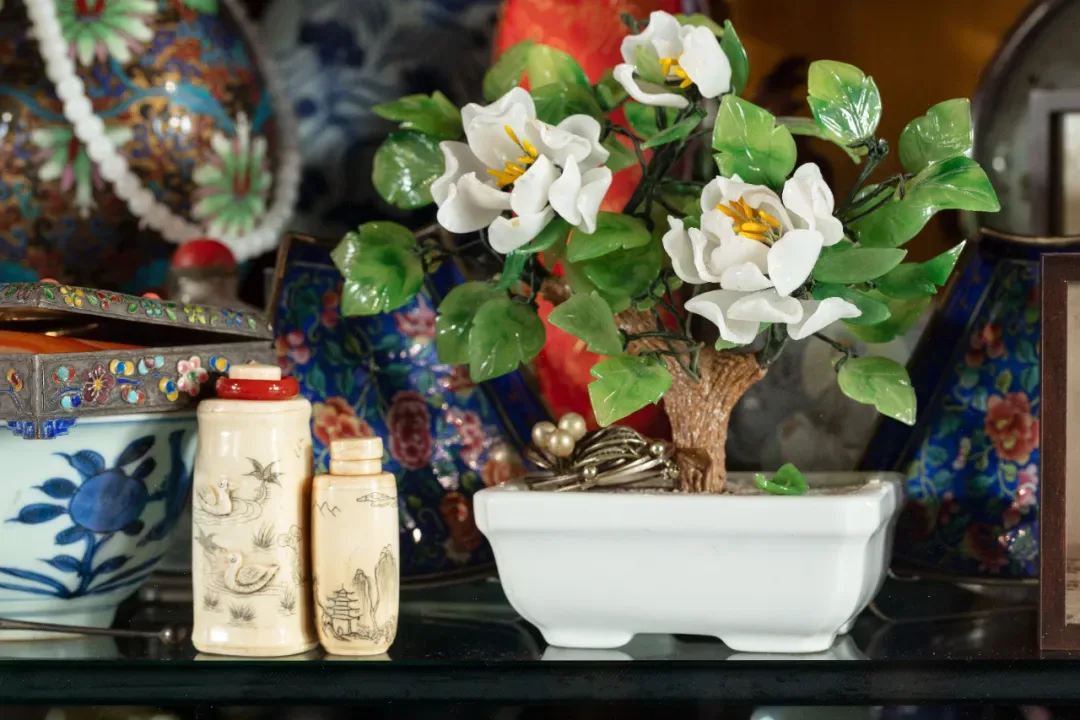
对记忆和叙事的怀疑、错位的虚构也浮动在北京公社的马秋莎个展中。此次新作不是她之前创作中常见的录像或织物。在公社的长方形空间中,只有中央立着一面如影壁般的墙体,中间嵌入了一架塞得满满当当的老式橱窗——像纪念碑,又像异时空入口。这是在北京长大的马秋莎虚构出的“琉璃厂东街52号”门面。透过玻璃,能看到柜子里的瓷雕像、唐三彩、琉璃盆景花,当然还有老照片(马秋莎姥爷家的旧照和她自己身着清代旗人服饰拍摄的湿版照片)。这橱窗离地,前后皆是空地,空地上围着观众。这空间政治中,虚构之所被夯实得如此确凿。在门口碰到周翊,跟着他去了CLC,余果正在画廊里,面前的四台旧监视器播放的正是他以身体和外部媒介装配后的四次现场行动:收音机信号在他步入深山时渐渐消失;夜色里穿戴斯坦尼康录像机的他将蓝色手电筒扫向劳碌者;白昼时手持录像机收入镜头的光线在夜晚照耀同一地点;仍然是夜晚,激光水平仪投射在拆迁房上的红色十字不断颤抖。正如石青说的,余果“对‘正常’有种超越性的认识”。他很坚决,又不多费口舌,透过观看机制让现实显形,(温柔而富有尊严地)曝露出被遮蔽的存在。对面的C5CNM项目空间里,墙上挂着塑料瓜果蔬菜,地上摆着燕京啤酒,内墙投影着郑源的录像《该怎么做》。片子的英文“What is to be done?”和列宁在1901年写过的那本小册子同名(更早前车尔尼雪夫斯基的书也同名,不过它们在大陆通常都被翻译为《怎么办》,列宁之作的副标题是“Burning Questions of Our Movement”)。我看到的那个片段里,一个人正在房间里沉默收拾着生活必需品(包括口罩和酒精湿巾)。似乎是为了利用所有空间,他正把真空包装的培根片放在平常用来固定书页的木质阅读架上。该怎么做,莫非是要耐心清理(物品和自己)、坚决消失?
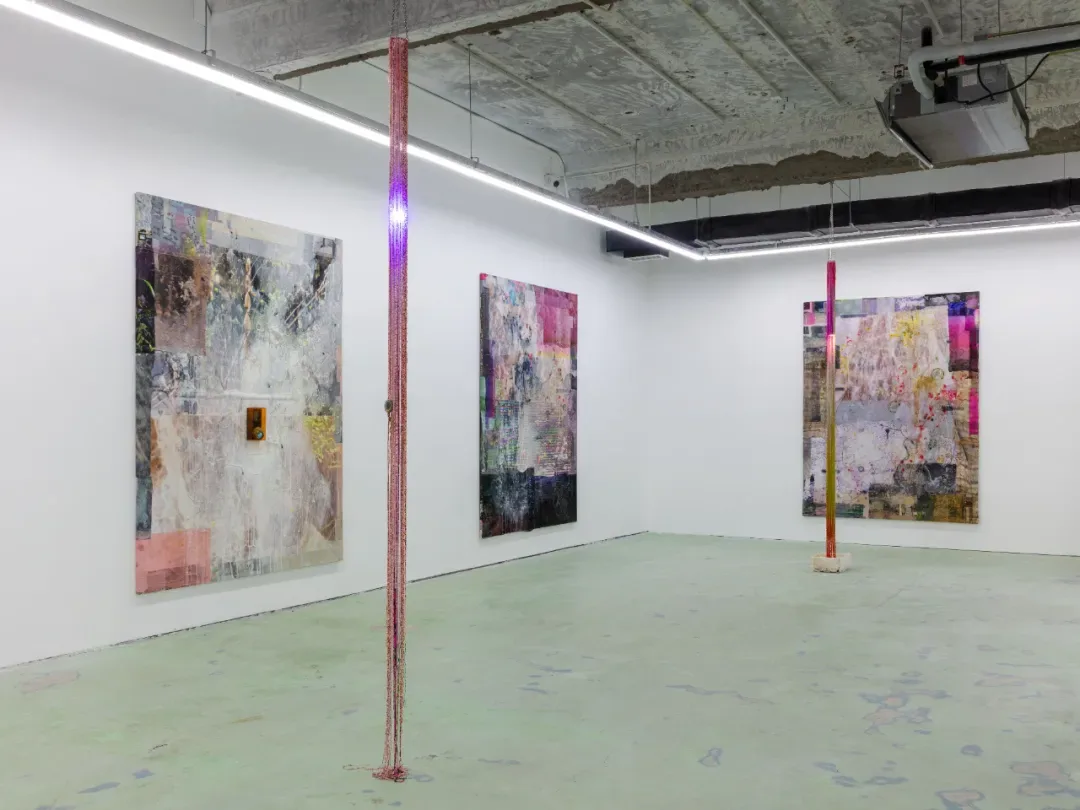
米莫萨·埃查尔德个展展览现场,2023年
图片鸣谢艺术家及桑塔画廊
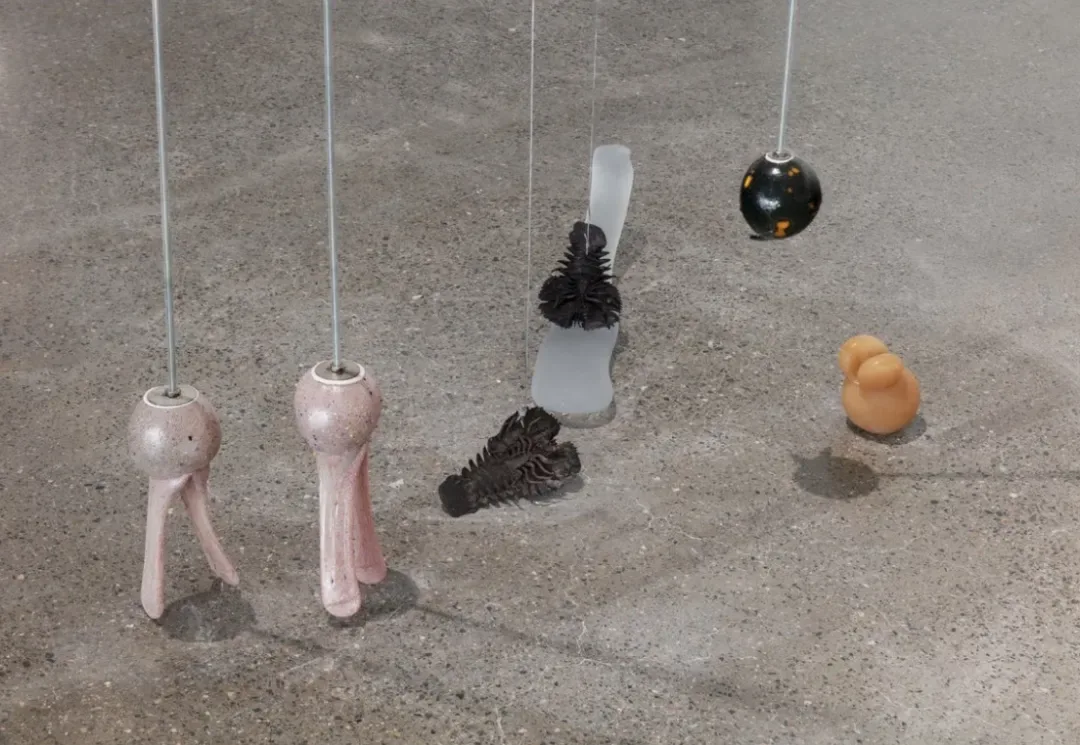
张移北《Sophia》(局部)
2023年,青铜、玻璃、陶,105 × 67 × 41 厘米
图片致谢艺术家及BANK画廊
我不得不离开这个798里最安静的空间,因为要去看“艺访单元”。今年5月的798园区里已经没有多少人戴口罩了,还戴着口罩的我显得有点扎眼。对于画廊周开幕日密集的行程和社交来说,口罩是我的保护色,也帮我掩盖住了吞在肚中、气息却久久不散的藿香正气水(夏天奔波的救命良药)。在这个意义上,张移北这次在画廊周BANK展位呈现的“Sophia”系列几乎是开幕社恐人士的灵兽化身了。张移北用青铜、玻璃、陶等材料制作了一系列形状奇异的海洋生物,它们从798艺术中心一楼的天花板悬坠而下直至地面。表面上看似是对时下流行的海洋生态学的思辨,这些雕塑的灵感实际上来源于艺术家友人的真实经历:他曾被因病导致的口腔异味困扰,继而对交流中对方细小的动作和反应十分敏感,双方微妙的情绪在心照不宣中慢慢拉锯。深海中的安康鱼和小龙虾会有类似烦恼吗?开幕活动伴随酒精、一片祥和的人际交往下有多少自我和他者之间无法调和的矛盾暗涌呢?这大概也是近几年艺术世界里被广泛强调的“多物种共存”的魅力。密集的社会应酬和人际交往之后,小动物、植物甚至孢子都让人觉得更亲近。北京之行前后,数人问起桑塔画廊的米莫萨·埃查尔德(Mimosa Echard)个展。她作品鲜丽湿润的质感,既来自数码印花、怀旧珠串,又因为她播撒植物的种子、与菌群合作。在A07大楼里印象最深的是施博尔画廊带来的大卫·克拉耶博(David Claerbout)的影像装置《野火》(Wildfire)。在高清影像里,青翠林木被大火吞噬,浓烟腾起,如有肉身。我看了一会儿,发现这并非有关澳洲森林大火的环保宣传片,而是用笔和CGI描画出的绿红交接、凉热对峙时的感官状态。克拉耶博用铅笔、丙烯画下的静帧中,不仅有爆裂燃烧,也有大火映出的如晚霞的绮丽。而空中腾起的黑色烟雾,肿胀如蘑菇云,凝成白尘时,飘散为烟带。我在黑暗中呆了一会儿。火光里缓缓溢出的灰烬,不做判断,任人静观,是艺术家耐心辟出的逃逸之所,在时代中将我收容。
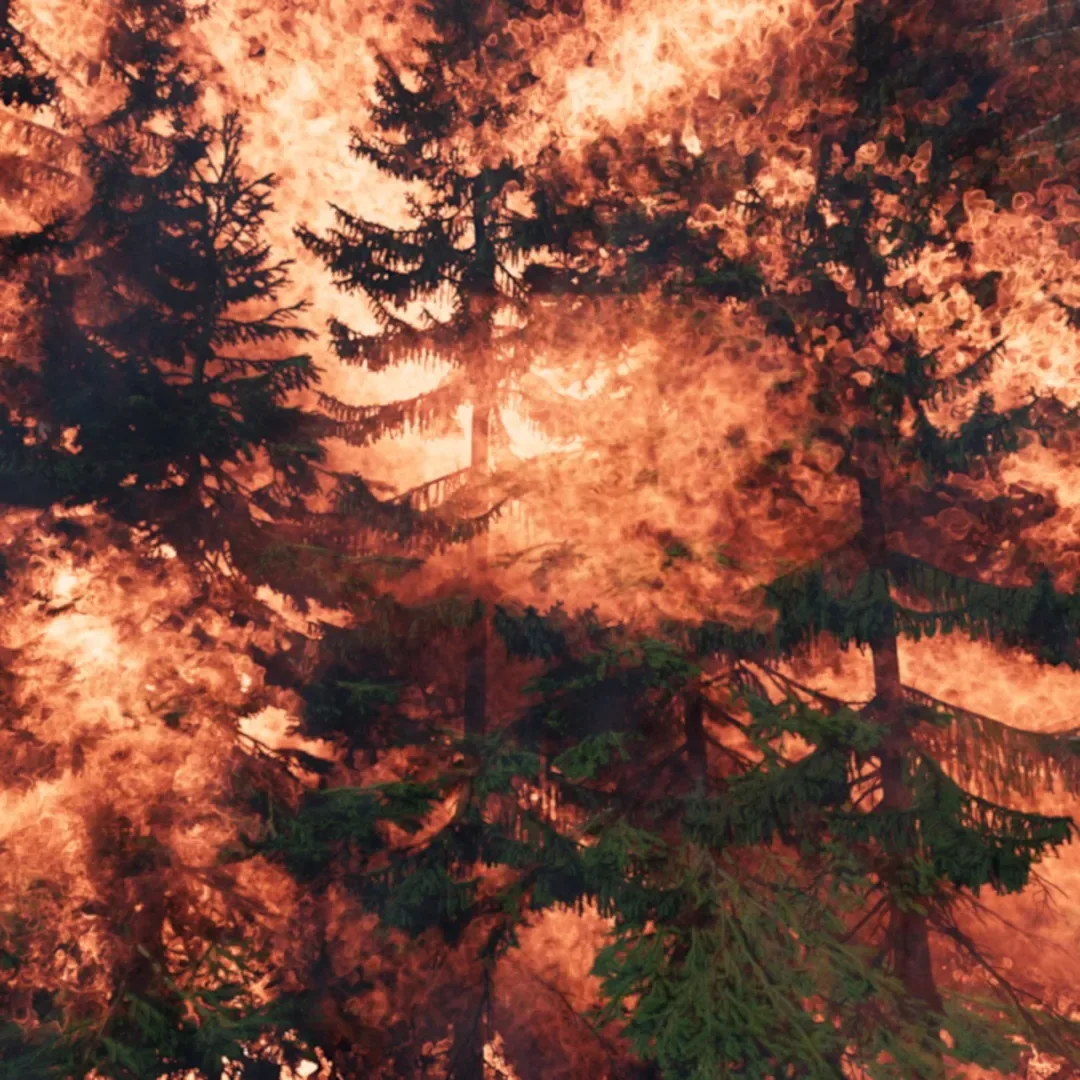
David Claerbout,Wildfire(meditation on fire)
大卫·克拉耶博《野火(关于火的冥想)》
2019–20年,单频影像,24分钟
图片鸣谢艺术家及施博尔画廊
✦
撰文|聂小依,编辑部亦有贡献
Machine translation (AI) of the Chinese original, not yet reviewed by the author. Please cite the original.
Thanks to Gallery Weekend, I spent three days walking around 798 in Beijing, and suddenly felt how much the place has changed. I used to think of 798 as out of the way, with hardly anywhere to eat. Now it is positively bustling and glamorous, thronged with visitors – the tiny Guangxi rice-noodle shop that was there eight years ago has grown to four times its size and opened a dessert shop and a second branch. These days, the place that really needs “pioneering” is the National Base for International Cultural Trade, twenty kilometres away.
Lawrence Weiner, 1 FOR THE MONEY / 2 FOR THE SHOW / 3 TO GET READY & 4 TO GO
(Chinese title: 《一为多收益 / 二为表演好 / 三下准备齐 & 四就朝前跑》)
1991/2008
Installation view, Public Sector, 7th Gallery Weekend Beijing
Courtesy Gallery Weekend Beijing
Lisson Gallery sits right in that cultural trade base in Shunyi. The building it occupies, the Blanc Art Center, has “Blanc” in its name, as if teasing the place for how spotless and empty it is. If, as Lawrence Weiner believed, an artwork doesn’t exist until a viewer sees it, then my understanding of his work is bound to be tied up with the media editors and writers I saw the preview with (btr was even wearing a custom T-shirt of Weiner’s amateur porn film A BIT OF MATTER AND A LITTLE BIT MORE). It was an absorbing exercise in reading words. On the walls, “PUSHED AS IF” and “LEFT AS IS” had been translated into Chinese as shunshi er wei (“go with the flow”) and dian dao wei zhi (“stop at a light touch”). The passive voice of “PUSHED” in English became something more active in Chinese – but that is also rather like the state of everyone working during Gallery Weekend: we are all being pushed around from show to show, but we’re happy to be. After spending nearly an hour on John Akomfrah’s The Airport, his poetic work about the Greek debt crisis and the legacy of empire, I wondered how many people would actually come to this high-spec screening room, set up with so much effort for a single work. The staff told me not to worry: this is the central villa district, and at weekends you see whole families here, young and old. As I left the gallery, an enormous plane flew low overhead, a reminder that close by is Beijing Capital International Airport, witness to the nation’s march to modernisation. At Tang Contemporary Art’s headquarters, the Guo Yuheng solo show (not part of Gallery Weekend) was full of dazzlingly colourful dolls, crammed together until their bodies merged; from a distance it looked like a palette on which plastic had been churned up at random, everything drenched in hot pink. Galleries lately keep saying “people born in the 2000s are debuting now”, but nobody seems to have prepared a new way of talking about them. In his preface, Cui Cancan explains the work of the artist, born in 2003, like this: “SKIRUA’s paradise is SKIRUA’s paradise.” At the gate of the bonded zone stands a sign reading, in Chinese, leyuan (“paradise”), with a brilliant English rendering: “so real”.
Back at 798, my route spiralled out anticlockwise with UCCA roughly at its centre. At UCCA, “Slide / Show: Light Images in Chinese Contemporary Art”, curated by Holly Roussell, starts from the medium of the slide to trace the conditions for mainland contemporary art around the ’85 New Wave. Drawing on the archives of Zheng Shengtian and Fei Dawei, it revisits the Zhuhai and Huangshan conferences, laying out a prehistory for today’s splendid Gallery Weekend. At HUA International, Rebecca Horn was not weighty at all this time, leaning towards small lyrical pieces. Next door, Magician Space was dark and quiet throughout. Viewers had to use a magnifying glass to look at Qin Yifeng’s large-format negatives of fragments of plain Ming-dynasty furniture, while on the surrounding walls hung prints he had enlarged by hand, covered in a lively spread of ink-like tones with no definite shape. In a sense, Qin works in a very photographic-ontological way (there is even something of the Düsseldorf School about it): by photographing furniture, and by adjusting light and dark, focus and halation, he blurs the boundaries between figuration and abstraction, expression and representation. This classical literati air became a little more playful in Liu Yanhu’s solo show at Platform China. Anything can be paired in a couplet – “leopard”, say, with “mermaid” – and rather than mounting his work as scrolls, he stretches the paper taut over frames like canvas. At Galleria Continua, Hans Op de Beeck has painted the interior of a spacious European salon entirely in a uniform grey – tables and chairs, flowers, figures, books and all. The pristine effect also brings to mind Chen Zhen’s Purification Room (2000), which coated the everyday objects of millennial China in mud. A few steps further on at SPURS Gallery, taking advantage of the recent plagiarism scandal and the hot topic of AI challenging the very point of artists, the curator Lu Mingjun has invited more than thirty artists and groups to the group show “Up in the Air, V.A.” (its Chinese title plays on “originality is up in the sky”) to answer questions about originality anxiety. My superficial impression is that, for artists who don’t make money selling pictures or illustrations to stock libraries, the question of “originality” still has to do with the problem of resemblance that they have had to face since the very start of their careers. It is something each of them has long since answered for themselves, not an imminent crisis of their labour losing its value.
Ouyang Chun, Orchid in an Empty Valley II (《空谷幽兰 二》)
2015, oil on canvas, 250 × 250 cm
Courtesy the artist and WHITE SPACE
On my way round to Macalline, I stumbled on Ouyang Chun’s solo show “Road to Heaven”, which WHITE SPACE had built on a temporary site. The temporary structure is white throughout. As soon as you step inside, you face a long, narrow passage, and look straight down it to a painting hung high in the distance. Only later, seeing it up close, did I realise it was a waterfall. Through an opening at the side of the passage you climb a staircase, and in each new room a painting appears – just one, and only one. Before long you understand that the journey imitates Ouyang Chun’s experience of climbing the narrow paths into the mountains, now close and narrow, now suddenly open. The paintings, too, are often like mountain scenery in bright sunshine; the brushwork depicting grass and flowering meadows is loose and full of life, like the early spring of the Tang poet Han Yu’s line “the colour of the grass, seen from afar, vanishes up close”. A painter friend said it was painted too “literally”, as though it had lost the digesting and inventing an artist is supposed to do; but I was grateful for a moment here away from words and narrative. The pair of solo shows at Macalline Art Center continued the institution’s focus on moving-image art. Chris Zhongtian Yuan’s exhibition divides the darkened space with curtains made of reflective raincoats, and the voices, drumbeats and music of four videos surge towards one another like tides. Friends who have vanished or died, traumatic memories that won’t go away, the fragility of relationships between people – all are woven together autobiographically. The footage is cut and collaged again and again, like the experience of a life spent tossing and turning, and the wave of sound also washes over the 3D-printed architectural models in the gallery. The space is never empty. Upstairs, in Hu Wei’s exhibition, the videos and the viewers enter the installation together. M. Butterfly, the fishermen on a small island off Sabah, migrants in a quarry on an island in southern China – encounters that cross geographies and unfold under different political eras play out in the videos. The red light of an interrogation room sets the tone for the show.
Installation view, “Ma Qiusha: No. 52 Liulichang East Street”, 2023
Courtesy the artist and Beijing Commune
Doubt about memory and narrative, and displaced fictions, also float through Ma Qiusha’s solo show at Beijing Commune. The new work this time is not the video or textiles common in her earlier practice. In the Commune’s long, rectangular space, there is only a wall standing in the centre, like a spirit screen, with an old-fashioned display cabinet set into it, crammed full – like a monument, or like a portal to another time and place. This is the shopfront of “No. 52 Liulichang East Street”, a fiction invented by Ma Qiusha, who grew up in Beijing. Through the glass you can see porcelain figurines, Tang sancai glazed pottery, glass bonsai flowers and, of course, old photographs (old pictures from her maternal grandfather’s home, and wet-plate photographs of Ma herself in Qing-dynasty Manchu banner dress). The cabinet is raised off the ground, with empty space in front and behind, and the viewers gather in that space. In this spatial politics, a place of fiction is rammed down so firmly it becomes solid fact. At the door I ran into Zhou Yi and followed him to CLC Gallery Venture, where Yu Guo was in the gallery. In front of him, four old monitors were playing four live actions he had carried out by assembling his body with external media: a radio signal gradually fading as he walks deep into the mountains; at night, wearing a Steadicam video rig, he sweeps a blue torch across people at work; light that he took in with a handheld camera during the day shining on the same spot at night; and, again at night, the red cross of a laser level trembling on a building marked for demolition. As Shi Qing has said, Yu Guo “has a transcendent understanding of the ‘normal’”. He is resolute, without wasting words; through the mechanisms of looking, he makes reality visible and (gently, and with dignity) exposes what has been hidden. Opposite, in the C5CNM project space, plastic fruit and vegetables hung on the walls, Yanjing beer stood on the floor, and Zheng Yuan’s video What Is To Be Done was projected on the inner wall. The English title is the same as the pamphlet Lenin wrote in 1901 (and, earlier, Chernyshevsky’s novel, though on the mainland both are usually translated as Zenmeban, while Zheng’s Chinese title is Gai zenme zuo – “How should it be done”; Lenin’s subtitle is “Burning Questions of Our Movement”). In the section I saw, a man was silently packing up the necessities of life in a room (including face masks and alcohol wipes). As if to make use of every bit of space, he was putting vacuum-packed bacon on a wooden reading stand normally used to hold a book open. What is to be done – is it to patiently clear things out (objects and oneself) and resolutely disappear?
Installation view, Mimosa Echard solo exhibition, 2023
Courtesy the artist and Galerie Chantal Crousel
Zhang Yibei, Sophia (detail)
2023, bronze, glass, ceramic, 105 × 67 × 41 cm
Courtesy the artist and BANK
I had to leave the quietest space in 798, because I needed to see the Visiting Sector. By May this year hardly anyone in the 798 district was still wearing a mask, so I stood out a bit in mine. Given the packed schedule and socialising of Gallery Weekend’s opening day, the mask was my camouflage. It also helped hide the herbal huoxiang zhengqi tincture I had gulped down, whose smell lingered long after (a lifesaver when you’re rushing around in summer). In that sense, the “Sophia” series Zhang Yibei showed on BANK’s stand at Gallery Weekend was practically the spirit animal of anyone with opening-night social anxiety. Using bronze, glass, ceramic and other materials, Zhang has made a series of strangely shaped sea creatures that hang from the ceiling of the ground floor of the 798 Art Center all the way down to the floor. On the surface they look like a reflection on the marine ecology that is so fashionable right now, but the sculptures were in fact inspired by a real experience of a friend of the artist: troubled by bad breath caused by an illness, he became highly sensitive to the tiny movements and reactions of the people he talked to, and the subtle feelings on both sides slowly played out in a tacit tug-of-war. Do anglerfish and crayfish in the deep sea have similar worries? Beneath the alcohol-fuelled, harmonious socialising of an opening, how many irreconcilable conflicts between self and other are churning? Perhaps this is also the appeal of the “multispecies coexistence” so widely emphasised in the art world in recent years. After a dense round of social obligations and networking, small animals, plants and even spores feel closer to you. Before and after my Beijing trip, several people asked me about Mimosa Echard’s solo show with Galerie Chantal Crousel. The bright, moist textures of her work come from digital prints and nostalgic beadwork, but also from the way she scatters plant seeds and collaborates with microbial colonies. What stayed with me most in Building A07 was David Claerbout’s video installation Wildfire, brought by Esther Schipper. In high-definition images, green forest is devoured by fire and thick smoke rises as if it had a body. After watching for a while, I realised this was not an environmental campaign film about the Australian bushfires, but the sensory state of the moment when green and red meet and cool and heat face off, drawn in pencil and CGI. In the stills Claerbout drew in pencil and acrylic, there is not only explosive burning but also a gorgeousness, like a sunset, cast by the blaze. The black smoke rising into the air swells like a mushroom cloud, and as it condenses into white dust, it drifts apart into bands of smoke. I stayed in the dark for a while. The ash slowly spilling out of the firelight makes no judgement and leaves you to contemplate it quietly. It is a place of escape the artist has patiently carved out, and in these times it took me in.
David Claerbout, Wildfire (meditation on fire)
(Chinese title: 《野火(关于火的冥想)》)
2019–20, single-channel video, 24 min
Courtesy the artist and Esther Schipper
✦
Text | Nie Xiaoyi, with contributions from the editorial team