Writing / criticism · 2019 · 中文
Limiting Conditions, and Wang Ziyue’s ‘The Sixth Day’《限制条件》与《王子月的"第六天"》
两篇相互对照的文字:先是对王子月在Tabula Rasa画廊的展览「第六天」的展评,再是带着对「限制条件」的理解重写的同一个展览。
王子月的“第六天”

8月31日下午四点,王子月在Tabula Rasa画廊的展览“第六天”进行了开幕表演,演员是六位非专业演员。表演结束后,我跟着观众和演员一起涌到画廊门口的空地上,找到了表演里喊得最大声的一位演员老冯聊天。老冯说起自己中年时重拾画画的热情,后来从东北到宋庄做一位艺术家,开始尝试各种媒介。但被问及这次表演时,他似乎有些怕自己说错,跟我讲“导演应该有她想表达的东西”。
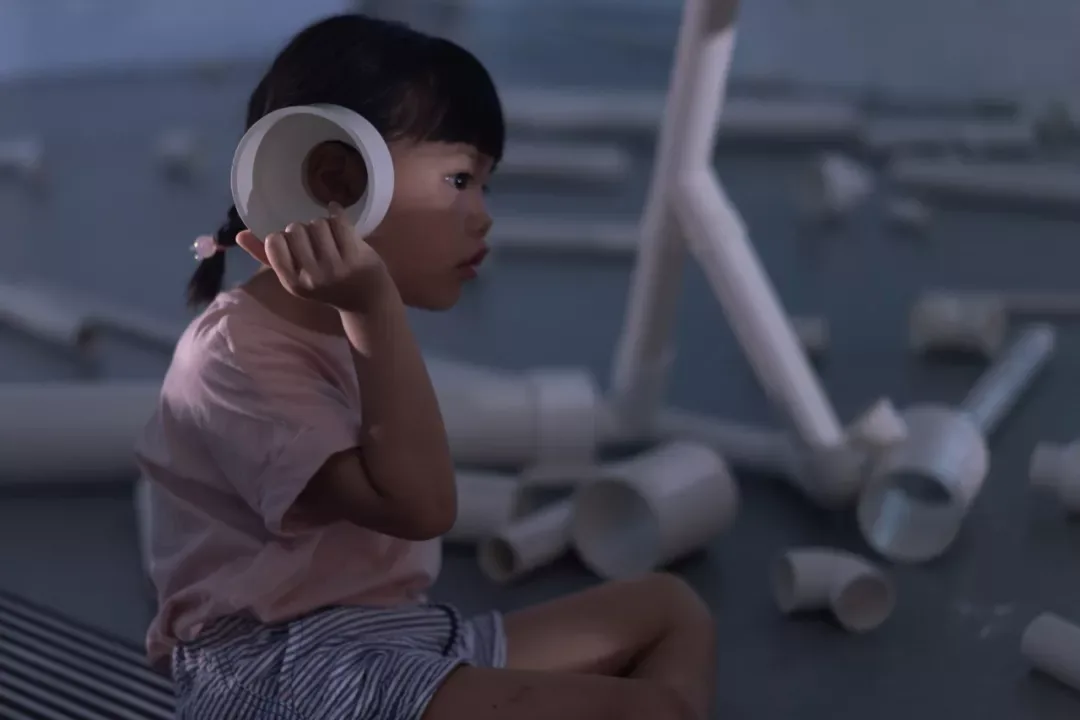
展览主厅是一个四面漏风的舞台,一节一节的白色砖墙像虚线一样地围出一片正方形,粗粗细细的白色PVC(一种硬质的塑料)管乱糟糟地摊在地上,一部分像柴火堆一样彼此支撑着立在舞台当中。四周墙上则支出许多转弯道上会用的圆形反光镜,组成了观望着舞台的镜群。
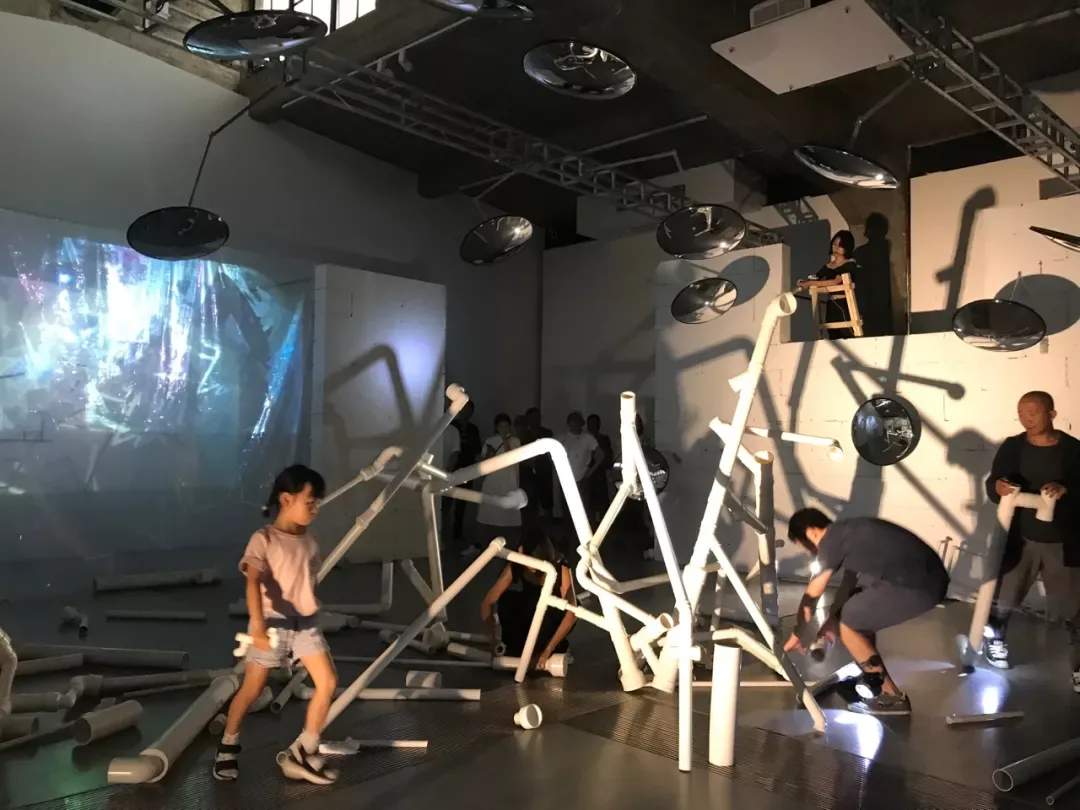
8月31日下午四点,王子月在Tabula Rasa画廊的展览“第六天”进行了开幕表演
表演者在这片地方做了大概二十多分钟的表演,结束后,几个工作人员立即拖着三块黑色的液晶屏进场,安置进塑料水管的阵地,屏幕上是演员们在这个画廊外、在798艺术区周围、在街头的行动,有一个镜头是一位参与者像踩高跷一样踩着PVC水管过了马路,让我想起Paul Klee说“绘画是带着一段线条去散步”(drawing is taking a line for a walk),但录像的气氛显然没有“散步”那么轻松。和许多表演作品类似,这里表演结束,舞台留下,录像上场(投影到空间里的一块防尘塑料布上);但不太一样的是,现下这个无人的舞台并不冷清,原本的舞台布景转换成了装置《镜子》的主体。
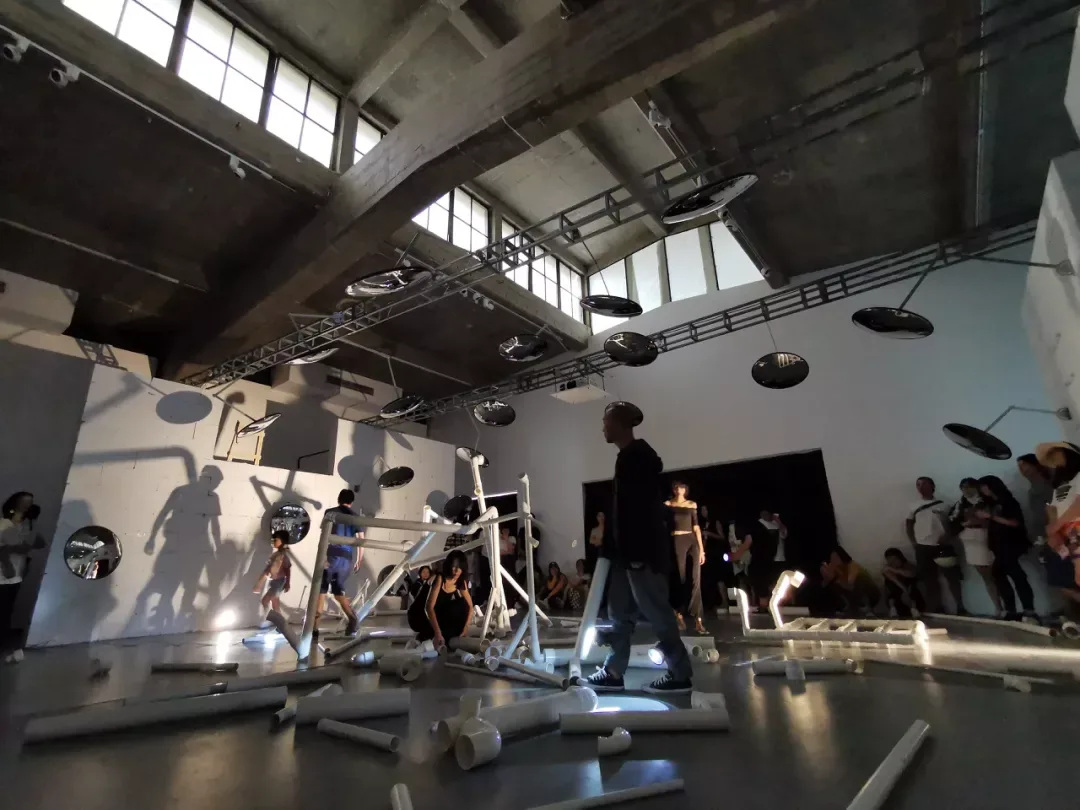
8月31日下午四点,王子月在Tabula Rasa画廊的展览“第六天”进行了开幕表演
人们的表演和装置之间的关系是什么,而素人表演者作为作品的材料应该如何被处理,这是开幕表演留给我的问题。这次主厅里的作品《第六天》是王子月的“问题剧场计划”的北京站的结果,她希望以剧场形式去采集不同地点的人们的生活经验、呈现社会的样貌。和反光镜、PVC塑料管、工地上的塑料布等等现成品被召集进入剧场一样,画廊工作人员的五岁孩子、医院的年轻护士、宋庄的艺术家等等没有参加过表演训练的人们参加了工作坊,其中一些进入了最后的演出。
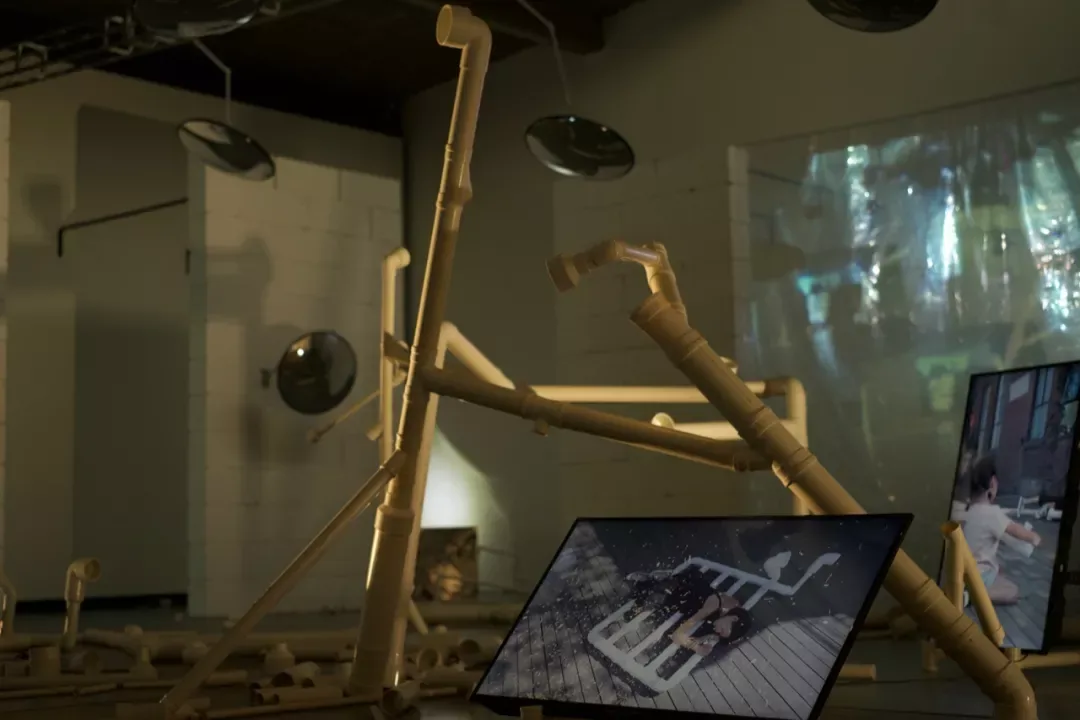
Tabula Rasa画廊 王子月《第六天》展览现场
在演出中,六位演员在舞台里走动(两个男演员的脚腕上绑着照亮周围的强光灯),各自说着“你”“我”“我们”“你们”“他们”,偶尔齐声。他们在反光镜中审视自己,拼接、拆解塑料水管的部件,拿一根长杆边敲打边前行,吹奏水管组装成的大号,缓缓呜鸣。这些被喊出的词语、人们的行动和直接取自当下生活里正发挥功用的物件,自然能一起撑开一片意义:人们被随时窥视、建设临时而野生、社群不断分裂、孤独的个体之间渴望能有交织。
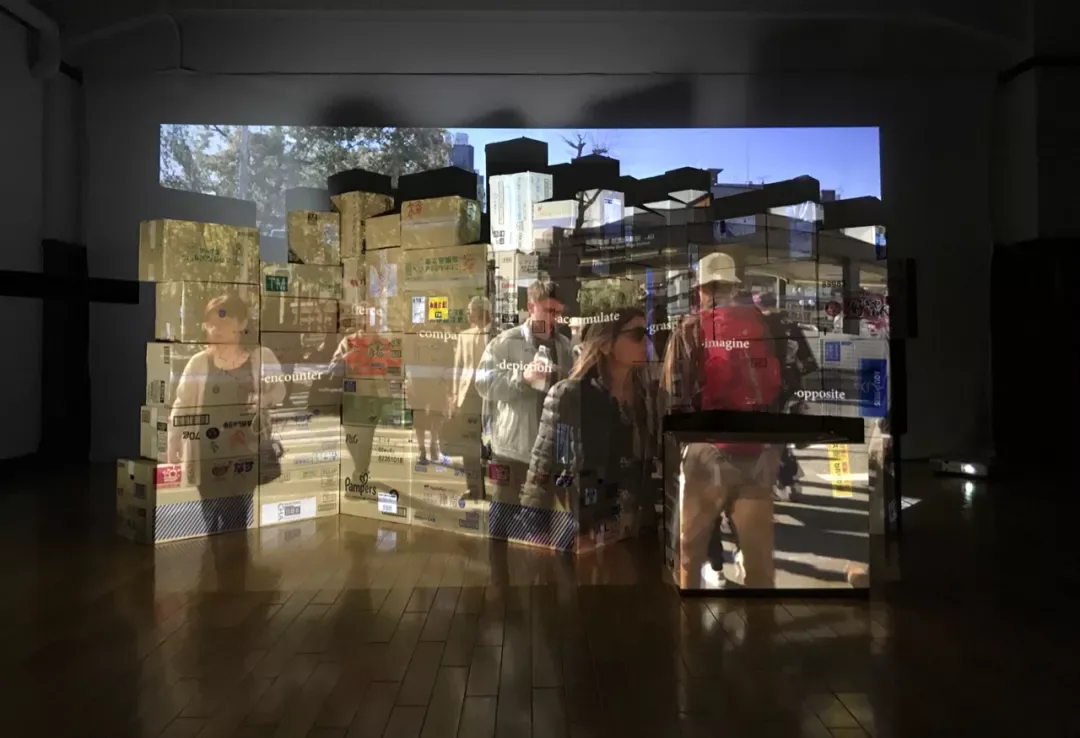
Tabula Rasa画廊 王子月《第六天》展览现场
但在持续了二十分钟的演出里,除去五岁的小朋友能“自得其乐”并保持和周遭观众的疏离,成年参加者仍带着显而易见的紧张。
而因为相似的语言和行动,演员之间的行动逻辑也很难区分;当表演临近结尾,演员们背靠背一起加速移动并将两位站在一旁的观众裹挟进场,观众脸上的笑容在演员们释放愤怒和焦虑的喊声也显得突兀。当表演是人的自我展演,人的经验、人的心理状态、人的身体都被带上到舞台、被注视。这些材料真实、自然、动人,也十分不稳定,如果要将它们带入作品,也需要更精确的转化——当客观条件无法保证让演员有足够力量支撑起现场时,录像,反而成为一个更容易采集表演者最佳状态的媒介。
展览的小厅呈现了王子月在京都的创作。王子月在京都也做了素人工作坊,还做了一个试验——街上人们被随机问了大概是这样的问题,“你想成为诗还是小说”。工作坊产出的表演录像、陌生人面对问题的回答等等五重动态画面,在逼仄的黑室里,在投影、监视器里,朝不同方向出现。许多小快递纸盒搭出的折扇一样的一米二高左右的屏风立在眼前,上面投射着京都街头的高楼,而屏风背面的影像是人们在街巷中穿梭。
人的录影和装置的重叠,在互相干扰中成了互相注释,反而达成了平衡。街上随机问答的过程里,走在京都街头的当地人被突然问到对自己人生的期许时,他们露出惊讶、好玩、放松和专注思索的神情,而我们也能借此管窥他们生活中快乐和遗憾。与在北京的表演相比,这些人们进入作品的部分,是自然的反应,是被采撷出的生活样本。而在展览小厅这个狭窄而有序的空间里,被交错设置去承接影像而搭建起的装置和人们小心翼翼摆放自己的神态和偶尔的松弛,恰当地传递出京都这个城市的空间和生活于其中的人们,在略显压抑的拘谨下潜藏的浪漫。
Tabula Rasa画廊 王子月《第六天》展览现场
艺术其实需要暂停意义的阐释,而去发展新的感知。展览的主厅里在演出结束之后归于安静,白墙背面藏着的一个不锈钢立方体发出的“咕咚、咕咚”声此时冒出了头。这个展览的表演里有喊声、有在水管上用黑色马克笔写下的口号,带出了人们生活在北京的焦虑,以及概念和意象被焦虑附着之后的凝滞。而这个持续稳定撞击的声响,像心脏、时钟、节奏,终于铺陈出一些生活必须往前走、往前走下去的希望。
限制条件
九月初,当我把写好的展览“第六天”的评论发给展览的艺术家王子月时,多说了一句请她“海涵”。因为写文章的时候,我可以忽略了已经知道的、妨碍展览完成的限制条件, 只当自己是一个恰巧看到了展览的观众。这样去写,不仅意味着省略了“尽管”、“虽然”和“但是”这些让时空和语气一起转折的词语,还包括舍弃对艺术家创作过程的理解,只做对结果的判断。
那之后我在想,如果是带着对“限制条件”的理解去写,这文章会变成什么样?我可能会从开展前二十天的探访写起。“Tabula Rasa画廊的主厅,此刻像正在搭建舞台、灯光还未开启的剧场。我和王子月坐在散落在地上的一堆白色PVC塑料管中间,它们中的一些正在试着互相连接,支撑着彼此从地面上爬起来。她说起挪用这些物件的想法来自在城中村里看到的悬挂在房屋外墙的水管们,那景象就像内脏和血管翻到了皮肤外面,但在追求效率的小镇上,这才是平常。它们粗暴,但有生命力。‘第六天’这名字怎么来的呢,我问她。‘展览开幕你来吧?’她问,那本来会是参与工作坊的演员们的第六次相见,但798艺术区对九月份的活动批准十分谨慎,开幕表演被提前到八月的最后一天,原本六次的相聚被缩减到了五次。第六天永远不会到来。”
而我在那篇文章里,是这么开头的:
“8月31日下午四点,王子月在Tabula Rasa画廊的展览“第六天”进行了开幕表演,演员是招募来的六位生活在北京、没有表演经历的普通人。二十分钟的表演结束时,我跟着观众和演员一起涌到画廊门口的空地上,找到了演出时喊得最大声的一位演员老冯聊天。老冯是东北人,他说起自己中年时重拾画画的热情,后来在上网搜索到宋庄这个地方就来了,在这儿做一位艺术家 。但被问及这次表演时,他似乎有些怕自己说错,跟我讲‘导演应该有她想表达的东西。’”
两种写法都会从第一视角的见闻写起,但前者会从外部社会环境迂回着潜入展厅,后者则让我决心从展览和表演的效果入手做出评判——如果这些表演者和这些PVC水管一样是现实中的材料在‘作为展览的剧场’中展演自身,那表演者应当对自己有更多信心;而这次近似“社会剧场”的实践又发生在画廊里,表演最终会成为录像作品,这让我对眼前作品的期待,是它应该给我一个新的理解现实和自我的坐标系,而不是我现在在做的,试图去理解表演者们的所处状态。
我重新回到刚才表演所在的主厅,这是一个四面漏风的舞台,一节一节的白色砖墙像虚线一样地围出一片正方形,粗细不一的白色PVC 管乱糟糟地摊在地上,有一些像柴火堆一样彼此支撑着立在舞台当中,四周墙上则支出许多转弯道上会用的圆形反光镜,组成了观望着舞台的镜群。几个工作人员正拖着三块黑色的液晶屏进场,安置进塑料水管的阵地,屏幕上是演员们在这个画廊外、在街头的行动,有一个镜头是一位参与者像踩高跷一样踩着PVC水管过了马路,让我想起Paul Klee说“绘画是带着一段线条去散步”(drawing is taking a line for a walk),但录像的气氛显然没有“散步”那么轻松。现下,这个无人的舞台并不冷清,原本的舞台布景加上三屏录像,构成了装置《镜子》。
而刚刚发生的表演《第六天》里, 和反光镜、PVC塑料管、工地上的塑料布等等现成品被一同召唤进剧场的,还有画廊工作人员的五岁孩子、医院的年轻护士、宋庄的艺术家等等。在演出中,六位演员在舞台里走动(两个男演员的脚腕上绑着照亮周围的强光灯),各自说着“你”“我”“我们”“你们”“他们”,偶尔齐声。他们在反光镜中审视自己,拼接、拆解塑料水管的部件,拿一根长杆边敲打边前行,吹奏水管组装成的大号,缓缓呜鸣。这些被喊出的词语、人们的行动和直接取自当下生活里正发挥功用的物件,自然能一起撑开一组意义:茫然的人们被随时窥视、建设临时而野生、社群不断分裂、孤独的个体之间渴望能有交织——这也符合艺术家在“问题剧场计划”里试图去呈现当下城市中的真实情绪的意图。
但这样图像学式的(iconographical)和基于象征的创作,与画廊外的政治现实之间的联系太过强烈,反而让我犹豫——艺术家、表演者、观众是否都在将自己因为扁平化为一种情绪?这种危险是一个概念压倒具体,集体压倒个体。对我来说,更珍贵的或许恰恰是在八月夏日里,当这个空间里只有这些演员时,他们彼此聊自己生活中的琐碎的焦虑、聊对未来的烦恼、聊对艺术的困惑,那些更为具体的内心动机。虽然王子月说,当演员们在喊出同样的“你”“我”这样的词汇时,他们内心展开的想法是各自具体而不同的。但在演出里,除去五岁的小朋友能“自得其乐”并保持和周遭观众的情绪距离,成年参加者在相似的语言、行动和情绪中,状态的紧张渐渐转变为激烈的行动 。但四周的观众并未一起紧张起来,当表演临近结尾,演员们背靠背一起加速移动并将两位站在一旁的观众裹挟进场,观众脸上的笑容在演员们的喊声显得突兀。当我结束后和艺术家说,二十分钟时间太短,节奏变化应该更多时,子月说,她也觉得应该时间更长,但久了之后演员们会慌。这些还需要上班的表演者,只有四次排练机会,而且,每次凑上的人还不太一样。
我摸不清应该用什么心态看待这场表演,一方面我理解眼前这一切的缺陷是因为客观限制,但同时又希望自己能忘却这些,直截了当地去做出批评。我仍然相信,艺术需要暂停意义的阐释,而去发展新的感知,就像一篇小说不能让观众靠想象去补上文笔俭省的不足。当作品将普通人的经验和身体带上到舞台,这些真实、自然、动人的材料也很不稳定,需要长时间的训练,让表演者充分掌握自身和表演试图到达的状态。这当然很难,但如果不做到,观众只能从“普通人”的身份这一概念出发去体会作品的用意。
展览的主厅在演出结束之后归于安静,白墙背面藏着的一个不锈钢立方体发出的“咕咚、咕咚”声此时冒出了头,打出更稳定的心跳和节奏。展览里还有一间小厅,是王子月在京都的相似实践。在这间暗室,许多小快递纸盒搭出的折扇般的一米二高左右的屏风立在当中,上面投射着京都街头的高楼,而屏风背面的影像是人们在街巷中穿梭,人的录影和装置的重叠,在互相干扰中成了互相注释,反而达成了平衡。剧场实践因为是参与者们与蓝色手电筒的游戏,它的录像在此处的黑暗中成了萤火般的光芒,让观者的目光也轻盈飘动。而另一个屏幕上,街上随机问答的过程里,走在京都街头的当地人被突然问到对自己人生的期许,“是想成为诗还是小说”?他们露出惊讶、好玩、放松和专注思索的神情,而我们也能借此管窥他们生活中快乐和遗憾。与在北京的表演相比,京都人们进入作品的部分,是自然的反应,是被采撷出的生活样本。看着这些片段的我,也被逗得笑出了声。
决定去从一个普通观众的视角写评论的时候,我想起自己很喜欢的评论人Brian Dillon说过的话,”艺术批评不应与作品共谋,而得和读者共谋”,还有,”要保持无知和愚蠢”。这对我来说意味着,不去理解眼前的事物何以会发生,抛开我优先于他人所知的“客观限制”,只去尝试理解眼前正在发生的事情。
Machine translation (AI) of the Chinese original, not yet reviewed by the author. Please cite the original.
Wang Ziyue’s “The Sixth Day”
At four in the afternoon on 31 August, Wang Ziyue’s exhibition “The Sixth Day” at Tabula Rasa Gallery opened with a performance by six non-professional actors. When it ended, I spilled out with the audience and performers onto the open ground in front of the gallery, and found Lao Feng – the actor who had shouted loudest during the performance – for a chat. Lao Feng told me how, in middle age, he had rediscovered his passion for painting, and later came from the northeast to Songzhuang to become an artist, trying out all kinds of media. But when I asked him about the performance, he seemed a little afraid of saying the wrong thing. “The director must have something she wants to express,” he told me.
The main hall of the exhibition is a stage open to the wind on all sides. Sections of white brick wall mark out a square like a dotted line; white PVC pipes (a kind of rigid plastic) of every thickness lie in a mess on the floor, and some of them prop each other up like a woodpile in the middle of the stage. On the surrounding walls, lots of round convex mirrors – the kind you see on sharp bends in the road – jut out, forming a crowd of mirrors watching over the stage.
At four in the afternoon on 31 August, Wang Ziyue’s exhibition “The Sixth Day” at Tabula Rasa Gallery opened with a performance
The performers worked in this space for twenty-odd minutes. As soon as they finished, several staff members dragged in three black LCD screens and set them up among the plastic pipes. The screens showed the actors outside the gallery, around the 798 Art District, out in the street. In one shot a participant crosses the road on PVC pipes as if on stilts, which reminded me of Paul Klee’s line that drawing is taking a line for a walk – though the mood of the video is clearly not as relaxed as a “walk”. As in many performance works, the performance ends, the stage remains and the video takes over (projected onto a sheet of plastic dust cloth in the space). What is different is that the now-empty stage doesn’t feel deserted: the set has been turned into the main body of the installation Mirror.
At four in the afternoon on 31 August, Wang Ziyue’s exhibition “The Sixth Day” at Tabula Rasa Gallery opened with a performance
What is the relationship between the people’s performance and the installation, and how should amateur performers be handled as the material of a work? These were the questions the opening performance left me with. The work in the main hall, The Sixth Day, is the outcome of the Beijing leg of Wang Ziyue’s Question Theater Project, in which she hopes to use theatre to gather the life experiences of people in different places and present a picture of society. Just as ready-mades – convex mirrors, PVC pipes, plastic sheeting from building sites – were summoned into the theatre, so were people with no performance training: a gallery employee’s five-year-old child, a young hospital nurse, an artist from Songzhuang and others took part in workshops, and some of them made it into the final performance.
Installation view, Wang Ziyue, The Sixth Day, Tabula Rasa Gallery
During the performance, the six actors move around the stage (two of the men have strong lamps strapped to their ankles, lighting up their surroundings), each saying “you”, “I”, “we”, “you all”, “they”, occasionally in unison. They examine themselves in the convex mirrors, fit together and take apart sections of plastic pipe, advance while beating the ground with a long pole, and blow into a tuba assembled from pipes, which lets out a slow moan. The shouted words, the people’s actions and the objects taken straight from their working lives in the present naturally open up a field of meaning together: people constantly spied on, construction that is makeshift and wild, communities endlessly splintering, lonely individuals longing for some kind of connection.
Installation view, Wang Ziyue, The Sixth Day, Tabula Rasa Gallery
But over the twenty minutes of the performance, apart from the five-year-old, who was able to “amuse themselves” and keep their distance from the audience around her, the adult participants were visibly nervous.
And because their words and actions were so similar, it was hard to tell the logic of one actor’s movements from another’s. As the performance neared its end, the actors moved faster and faster, back to back, and swept two onlookers standing at the side into the action; the smiles on those audience members’ faces seemed out of place amid the actors’ shouts of anger and anxiety. When a performance is people performing themselves, their experience, their state of mind and their bodies are all brought on stage to be looked at. These materials are real, natural and moving, but also very unstable, and bringing them into a work calls for a more precise transformation. When circumstances can’t guarantee that the actors have the strength to carry the live moment, video becomes, if anything, the easier medium for capturing performers at their best.
The smaller hall of the exhibition presents work Wang Ziyue made in Kyoto. There too she ran workshops for amateurs, and also tried an experiment: people in the street were asked, at random, something like, “Would you rather be a poem or a novel?” Five channels of moving image – videos of the workshop performances, strangers’ answers to the question and so on – appear in the cramped dark room, on projections and monitors, facing in different directions. A folding screen about 1.2 metres high, built from lots of small cardboard delivery boxes and shaped like a folding fan, stands in front of you. Onto it are projected the tall buildings of Kyoto’s streets, while on the back of the screen is footage of people threading their way through lanes and alleys.
The overlapping of video of people and installation turns mutual interference into mutual annotation, and in the end strikes a balance. In the random street interviews, when locals walking through Kyoto are suddenly asked what they hope for from their lives, they look surprised, amused, relaxed, deep in thought – and through this we get a glimpse of the joys and regrets in their lives. Compared with the Beijing performance, these parts where people enter the work are natural reactions, samples picked from life. And in the narrow, orderly space of the small hall, the installation, set up in a staggered way to catch the images, together with people’s careful self-composure and their occasional moments of ease, conveys very aptly the city of Kyoto and the romance hidden beneath the slightly repressed reserve of the people who live there.
Installation view, Wang Ziyue, The Sixth Day, Tabula Rasa Gallery
Art in fact needs to suspend the interpretation of meaning and develop new perceptions instead. After the performance, the main hall fell quiet, and a “thud, thud” sound came to the surface from a stainless-steel cube hidden behind a white wall. The performance in this exhibition had shouting, and slogans written on the pipes in black marker; it brought out the anxiety of living in Beijing, and the stagnation of concepts and images once anxiety has attached itself to them. This steady, continuous knocking – like a heart, a clock, a rhythm – finally laid out a little hope that life has to go on, go on and keep going.
Limiting Conditions
In early September, when I sent my review of “The Sixth Day” to the artist, Wang Ziyue, I added a line asking for her forbearance. That was because, while writing it, I had allowed myself to ignore the limiting conditions I already knew had held the exhibition back, and to act as if I were just a visitor who happened to see the show. Writing this way meant not only leaving out words like “despite”, “although” and “but”, which turn time, space and tone all at once; it also meant setting aside my understanding of the artist’s process and judging only the result.
Afterwards I wondered: if I wrote with an understanding of those “limiting conditions”, what would the piece become? I might start with my visit twenty days before the opening. “The main hall of Tabula Rasa Gallery is like a theatre where the stage is still being built and the lights have not yet been switched on. Wang Ziyue and I sit among a heap of white PVC pipes scattered on the floor; some of them are being tried out in combinations, propping each other up to climb off the ground. She tells me the idea of appropriating these objects came from the water pipes she saw hanging on the outside walls of houses in urban villages – a sight like innards and blood vessels turned out through the skin, yet in a small town chasing efficiency, that is simply normal. They are crude, but full of life. How did the title ‘The Sixth Day’ come about, I ask. ‘You’re coming to the opening, right?’ she asks. That would have been the sixth time the actors in the workshop met. But the 798 Art District was very cautious about approving events in September, and the opening performance was brought forward to the last day of August. The six meetings were cut to five. The sixth day will never come.”
But in that piece, this is how I began:
“At four in the afternoon on 31 August, Wang Ziyue’s exhibition ‘The Sixth Day’ at Tabula Rasa Gallery opened with a performance. The actors were six ordinary people living in Beijing, recruited for it, with no experience of performing. When the twenty-minute performance ended, I spilled out with the audience and performers onto the open ground in front of the gallery, and found Lao Feng – the actor who had shouted loudest during the performance – for a chat. Lao Feng is from the northeast. He told me how, in middle age, he rediscovered his passion for painting, then found a place called Songzhuang online and simply came, to be an artist here. But when I asked him about the performance, he seemed a little afraid of saying the wrong thing. ‘The director must have something she wants to express,’ he told me.”
Both versions start from what I saw and heard in the first person, but the first would slip into the gallery in a roundabout way through the social world outside, while the second made me determined to judge from the effect of the exhibition and the performance. If these performers, like the PVC pipes, were real-world materials performing themselves in a “theatre as exhibition”, then they ought to have had more confidence in themselves. And since this practice, close to a kind of “social theatre”, was taking place in a gallery, and the performance would end up as a video work, what I expected from the work in front of me was a new coordinate system for understanding reality and myself – not what I was actually doing, which was trying to understand the state the performers were in.
I went back into the main hall where the performance had just taken place. It is a stage open to the wind on all sides. Sections of white brick wall mark out a square like a dotted line; white PVC pipes of different thicknesses lie in a mess on the floor, and some prop each other up like a woodpile in the middle of the stage. On the surrounding walls, lots of round convex mirrors – the kind you see on sharp bends in the road – jut out, forming a crowd of mirrors watching over the stage. Several staff members were dragging in three black LCD screens and setting them up among the plastic pipes. The screens showed the actors outside the gallery and in the street. In one shot a participant crosses the road on PVC pipes as if on stilts, which reminded me of Paul Klee’s line that drawing is taking a line for a walk – though the mood of the video is clearly not as relaxed as a “walk”. Now the empty stage didn’t feel deserted: the set, plus the three screens of video, made up the installation Mirror.
In the performance The Sixth Day that had just taken place, summoned into the theatre along with ready-mades such as convex mirrors, PVC pipes and plastic sheeting from building sites, were a gallery employee’s five-year-old child, a young hospital nurse, an artist from Songzhuang and others. During the performance, the six actors moved around the stage (two of the men had strong lamps strapped to their ankles, lighting up their surroundings), each saying “you”, “I”, “we”, “you all”, “they”, occasionally in unison. They examined themselves in the convex mirrors, fitted together and took apart sections of plastic pipe, advanced while beating the ground with a long pole, and blew into a tuba assembled from pipes, which let out a slow moan. The shouted words, the people’s actions and the objects taken straight from their working lives in the present naturally opened up a set of meanings together: bewildered people constantly spied on, construction that is makeshift and wild, communities endlessly splintering, lonely individuals longing for some kind of connection. This also fits the artist’s aim, in the Question Theater Project, of presenting the real emotions of today’s cities.
But this kind of iconographical, symbol-based way of making work was so strongly tied to the political reality outside the gallery that it gave me pause. Were the artist, the performers and the audience all flattening themselves into a single emotion? The danger is that the concept overwhelms the concrete, and the collective overwhelms the individual. For me, what may be more precious is exactly what happened in those August summer days, when only the actors were in the space: they talked to one another about the petty anxieties of their lives, their worries about the future, their confusion about art – those more specific inner motives. Wang Ziyue says that when the actors shout out the same words, “you” and “I”, the thoughts unfolding inside each of them are concrete and different. But in the performance, apart from the five-year-old, who was able to “amuse themselves” and keep an emotional distance from the audience around her, the adult participants, sharing similar words, actions and emotions, gradually turned their nervousness into intense movement. Yet the audience around them did not grow tense along with them. As the performance neared its end, the actors moved faster and faster, back to back, and swept two onlookers standing at the side into the action; the smiles on those audience members’ faces seemed out of place amid the actors’ shouting. When I told the artist afterwards that twenty minutes was too short and there should have been more changes of rhythm, Ziyue said she also felt it should have been longer, but that if it went on too long the actors would panic. These performers, who still had jobs to go to, had only four chances to rehearse – and each time, a slightly different group of people managed to turn up.
I couldn’t work out what attitude to take towards the performance. On the one hand, I understood that its shortcomings came from objective limitations; at the same time I wished I could forget all that and simply criticise it directly. I still believe that art needs to suspend the interpretation of meaning and develop new perceptions instead – just as a novel can’t ask its readers to use their imagination to make up for thin writing. When a work brings ordinary people’s experiences and bodies onto the stage, these real, natural, moving materials are also very unstable, and they need long training so that the performers can fully master themselves and the state the performance is trying to reach. This is hard, of course, but without it, the audience can only grasp what the work is getting at by starting from the concept of the performers’ identity as “ordinary people”.
After the performance, the main hall fell quiet, and a “thud, thud” sound came to the surface from a stainless-steel cube hidden behind a white wall, beating out a steadier heartbeat and rhythm. The exhibition also had a small room showing a similar practice Wang Ziyue carried out in Kyoto. In this dark room, a folding screen about 1.2 metres high, built from lots of small cardboard delivery boxes and shaped like a folding fan, stood in the middle. Onto it were projected the tall buildings of Kyoto’s streets, while on the back of the screen was footage of people threading their way through lanes and alleys. The overlapping of video of people and installation turned mutual interference into mutual annotation, and in the end struck a balance. Because the theatre workshop there was a game the participants played with blue torches, its video became firefly-like points of light in the darkness, making the viewer’s gaze drift lightly too. On another screen, in the random street interviews, locals walking through Kyoto were suddenly asked what they hoped for from their lives – “Would you rather be a poem or a novel?” They looked surprised, amused, relaxed, deep in thought, and through this we could glimpse the joys and regrets in their lives. Compared with the Beijing performance, the parts where the people of Kyoto enter the work are natural reactions, samples picked from life. Watching these fragments, I laughed out loud.
When I decided to write the review from the point of view of an ordinary visitor, I thought of something said by Brian Dillon, a critic I like very much: “Art criticism should not be in league with the work, but with the reader” – and also, “Stay ignorant and stupid.” For me this meant not trying to understand how what was in front of me had come about, putting aside the “objective limitations” I knew about before other people did, and trying only to understand what was happening in front of me.