Writing / criticism · 2022 · 中文
The Boredom of the Powerless, the Power of the Bored无力者的无聊,无聊者的有力
评庞宽在北京星空间的14天现场直播行为"拜拜迪斯科",讨论封控语境下的无聊、观看与流量。
4月21日,周四,新裤子乐队的庞宽在微博上预告了他将从23日周六起,在北京的星空间画廊"举办一次为期14天的现场加直播的行为艺术展"。一并放出的活动海报是张照片——墙角摄像头视角下,庞宽站在灰色水泥地上"画地为牢",和装着物资的透明塑料箱一起被白色胶条划出的方形圈住。最显眼的装备,是随后直播中成为关注焦点的白色坐便器。
两天后,4月23日下午4点,展览如期开幕,但庞宽踏着的平面从海报中的水泥地上升为高出地面的一方木台。穿着宽大家居服的庞宽在台子上或躺或坐,沉默地刷着手机,和观众没有什么交谈和互动,他仿佛被单向玻璃围绕着,对投来的目光毫无察觉。
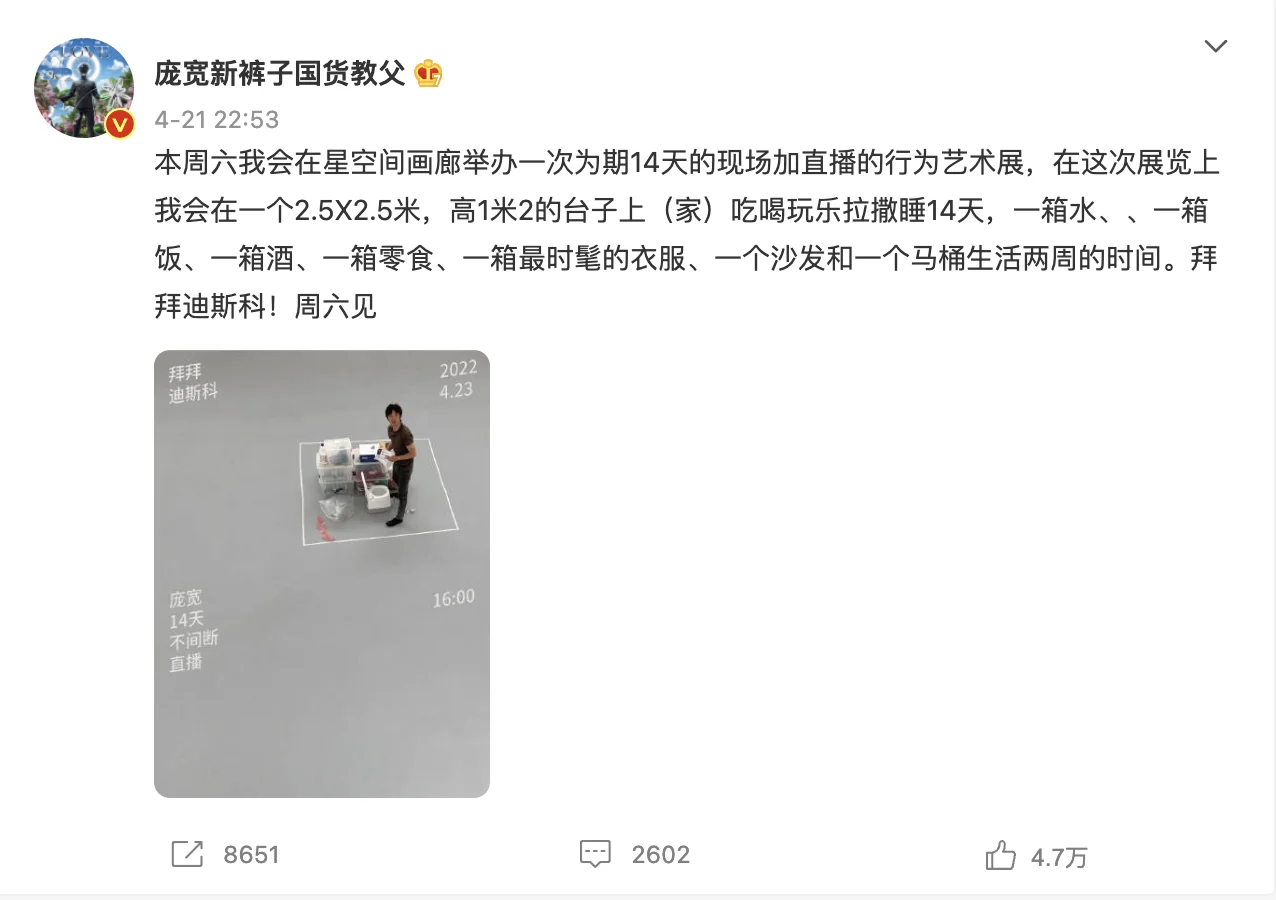
4月21日,庞宽发布的活动预告微博。截图时间为5月15日。
4月23日,庞宽的"拜拜迪斯科"在星空间开幕。图源微博 @庞宽新裤子国货教父。
庞宽是新裤子的乐手。新裤子在2019年冒独立音乐之大不韪参与线上综艺《乐队的夏天》后,迅速达成了乐队微博粉丝超过百万的目标。因为这场综艺,新裤子这支90年代末听着打口碟成长起来、被称为"北京新声"的新潮乐队在中年时成功沦陷,作为"土摇乐队"(主唱彭磊的戏称)进入大众视野。庞宽也被更多人认识。在新裤子的表演中,庞宽忘我、无厘头、神经质的表演常常催化着现场气氛。他远非优雅的舞蹈,邀请着观众一起狂欢。
我是新裤子的歌迷,却不记得有没有读到庞宽在微博发布的活动预告。当时我在上海,是封城中的"天选之子":有居所、有少量存款、没宠物、没孩子,父母在外地且健康无虞,小区还让下楼活动。但那阵子我几乎无法工作,随时被通知要下楼核酸,疲于微信群团购消息,也不能不看朋友圈,阅读有关方舱、转运、饥饿、急救的新情况。庞宽的活动介绍没有"隔离"二字,但"14天"立刻令人联想到席卷多地的新一轮封城(隔离多以7天或14天为单位计)。对入境者来说,14天就是落地之后在酒店隔离的第一个时段。庞宽的活动能引起这么大反响,和新冠大流行的第三年,隔离正成为人们普遍的切身经验有关。
直到四月底,我在社交媒体读到当代艺术和剧场艺术的从业者的尖锐批评,我才留意到庞宽这场名为"拜拜迪斯科"的行动。对庞宽的批评主要有两方面。一,认为"直播隔离"是作秀,哗众取宠,在疫情中浪费人们的注意力;二,认为庞宽在这14天中衣食无忧、懒散怠惰,从"行为艺术"来看,绝对算不上精彩之作。庞宽的确引发了很多关注:他的活动发布微博被转发超过8000次,乐迷们自发拉了微信群追踪直播中庞宽的动态,几日之后#庞宽上厕所#也冲上微博热搜。
在第二类批评中,庞宽的隔离被拿来与艺术家谢德庆的作品《One Year Performance 1978–1979》比较。1978年,谢德庆仍是美国的非法移民。他选择将自己关在笼子里整整一年,不与人交谈、不读书、不听音乐,比许多现代监狱的境况都要原始、赤裸、暴虐,只维持着低限度的生存。通过肉身与行动,谢德庆将"囚禁"这一概念转译为严苛的行为、精确的条件,并用一年时间将这一现代社会的特殊状态转化为个体的常态。与之相较,庞宽的行为当然"不够狠"。在中国1980年代后的行为艺术现场中,"狠"常常是当代艺术家在谈论作品时的重要语汇,可以指创作中的痛苦、风险、折磨以及材料的异常等等。"狠"将行为从日常生活中提炼出来,显示出作品中的观念。
谢德庆的作品《One Year Performance 1978–1979》在其个人网站上有四份文件作为记录,这是唯一一份有作者形象出现的文件/图片。图源www.tehchinghsieh.net。
假艺术节在4月24日的微博批评
但正如批评庞宽此次行为的"假艺术节"指出的,庞宽和谢德庆的作品并不在同一个语境中。谢德庆除了被称作行为艺术家,他在Wikipedia上首先被描述为观念艺术家——谢德庆的媒介除了自己的身体和行动,很重要的,还有观念(concept)。他的作品中行动与观念共构,作品的自足也与他仍可精确掌控自己的媒介有关:谢氏作品的生效并不需要与观众互动,也和谢氏艺术家之外的身份无关,人们无需了解谢德庆就能感知到作品的力量。他的作品自足、简洁,和西方六七十年代时观念艺术的美学一致。被拿来与庞宽比较的中国行为艺术家何云昌的作品虽然更加有机、柔和,但在叙述中也依然诗意——何氏2012年初春时在北京户外裸露的土地上躺在了一个睡袋上,直到土地长出青草,从开始到结束,他等待了28天。谢德庆和何云昌作品都是个体的行动,而这些行为的再现常常依靠少量的照片和一段凝练的叙述;而在庞宽这里,以这些经典行为艺术来作为衡量标准,"拜拜迪斯科"在美学上就失败了——24小时直播让人们可以观察到他每一个细微动作,"屎尿屁"成了被大众讨论的焦点,他的一举一动都被不断解构,直播截屏变成迅速流通的表情包。
庞宽从一开始就明确自己这场隔离一定要有直播,一定要有观众。4月20日,庞宽去星空间找朋友画廊主房方、设计师朱砂第一次聊自己的想法时,房方把这场讨论录了下来,并在22日将录音发布在了播客"不谈艺术"。这场谈话对我们理解庞宽的行动提供了许多原始信息。比如,庞宽很清晰地提出这件事中不可或缺的两点是独处与直播,最好也有现场观众。但如何独处、生存条件如何把握,庞宽没有确切想法,具体实施受到了房方与朱砂的许多影响。在讨论迅速推进至这一隔离的实施时,比如庞宽吃什么、是否可以带杂志、拉撒如何解决时,操着京片子的仨人都很明确,认为要小心把握分寸,不要让这场行动被解读为抗议。所以房方与朱砂说,"不能绝食",庞宽因此放弃了已经尝试过的、像电影《火星救援》中马特·达蒙一样每天只吃一个水煮土豆的想法。在疫情这个节点上,他们之间似乎有种共识,那就是在朋友圈"转公众号"的公共表态已经失效了。
这种对作品去政治化的想法,或许是为了安全,但我认为更多是出于对艺术的判断。他们要避免艺术成为另一种对政治的服务,不想被理解为宣言式的、与威权对抗的异议。或许对他们而言,那是不足以改变现实,只满足艺术家自我虚荣的创作。如果这场自导自演的隔离不是抗议,那是什么?庞宽说是一场"party"。谢德庆把人生看作一场囚禁,庞宽则觉得人生就是无数场"爬忒"组成的。他的party,轻松、傻愣、无伤大雅、自得其乐,一人也可成局。在讨论中,庞宽的隔离从宗教式的苦修和生存主义的实验变得更加"现实主义"(朱砂/房方语)、也更戏谑——庞宽可以带杂志、带时髦衣服、带酒带茶、带自热食物,像奔赴一场真正的party一样,尝试在隔离中苦中作乐,维持一个口味刁钻的文艺工作者的日常生活。(虽然,以"后现代"描述庞宽或许更加恰切——他的创作方式是向观众敞开的,形式则颇为流动。)
4月20日的谈话中,房方问庞宽什么时候可以开始做,庞宽回答,"越快越好"。21日,庞宽发布微博,23日,直播便开始了。在庞宽发布的微博里,他称自己要做的是一个"行为艺术展",这也是他的行为引起争议的导火索之一,比如"界面"在报道时,就以"躺着玩手机何以成为行为艺术?"为题。然而,"行为艺术"这一词汇在最初的讨论中其实从未出现,庞宽当时的用语更加准确——"艺术事件"。或许是因为这一行动要在画廊发生,"事件"就迅速变成了"展览";也或许,庞宽只是带着戏谑来宣告他的"行为艺术展"。当代艺术、尤其是行为艺术中常常涉及的对社会和艺术系统的批判,在庞宽最初兴奋地想要直播一场隔离时,其实并不重要。庞宽多数时间里刷手机抠脚挠头、时而荒腔走板的表演,对于希望其透露批判立场的人来说,如果不是全然犬儒,至多也只能算皮里阳秋。
网友截图直播镜头下的庞宽,时间可能为4月30日19点30分。
庞宽所在的星空间画廊的最大展厅,四周墙上是艺术家潘琳的绘画。
不过,庞宽的行动发生的语境和当代艺术、行为艺术完全无关吗?限制庞宽行动的高1.2米的台子被一些观众称为"孤岛","孤岛"所在、摄像头无法捕捉到的物理空间却是结结实实的画廊——这方木台位于一间典型的白盒子(white cube)展厅的中央,四周的白墙上还挂着另外一位艺术家潘琳的油画。星空间位于北京的798艺术区、主要经营当代艺术,在这样一间画廊里,庞宽脚下的木台甚至可以被解读为一件雕塑的基柱、一幅绘画的画框(好吧,我可能发挥过头了,不过台子的高度1.2米也常常作为作品悬挂高度的参照)。有位观众在"不谈艺术"播客的平台提问,一开始仨人讨论的是"画地为牢","为什么后来又做了台子呢?",主播的回复是,"形式感很重要。"
如果打造木台的框架是为了让庞宽的行为更有"作品感",木台所在的实体和无形的艺术体制框架,却在作品的考虑中欠奉了。被拿来与庞宽比较的另一位行为艺术家Chris Burden曾在1972年举办展览,展期中Burden在一张单人床上不吃不喝、待了22天,这一行为带有对画廊、展览体制以及现代艺术的强烈批判;与之相比,庞宽不是不够"狠",而是忽视了作品发生的语境。或者,他注意到了却不在意。庞宽对"拜拜迪斯科"的考量范围如直播摄像头的视野,画廊没有被摄像头捕捉,画廊语境也未进入庞宽的考虑。
这场隔离从一开始,就有两种不同的语境交叠着——一边是娱乐为先的大众传播和流行文化,另一边是强调批判的当代艺术体制。星空间一直在这两种语境中。带着对青年风潮的兴趣,画廊早年推广1970年代出生的"卡通一代"艺术家,近期邀请模特cici项偞婧加入合伙人、发售新裤子彭磊的nft作品。但这次庞宽的隔离,星空间大约没有打算在当代艺术行业里宣扬——它的微博和公众号没有在开幕前发布消息,直到4月30日在微信公众号才推送说明预约现场观看"庞宽行为艺术展"的方式。(值得玩味的是,后来的一条推送里,星空间将这一称呼改为"庞宽个展"。)这场展览没有策展前言,也没有艺术家访谈。对其作品在当代艺术语境中的价值,画廊没有显示出足够的信心。
对庞宽来说,画廊不宣传没有什么影响,他事前就相信这事儿一定会"爆"——他自己就可以带来这样的效果。庞宽想象自己的行动时的语境,其实不是行为艺术,不是当代艺术,而是通俗流行文化里的艺术。在"拜拜迪斯科"结束之后,庞宽在《大内密探》播客中回应了自己被与行为艺术家谢德庆和阿布拉莫维奇比较:"这俩人看《我爱我家》吗?这俩人看《我爱我家》笑出来才是行为艺术。"庞宽行动中与当代艺术体制关系的不精确引发了艺术专业人士的批判和误读。在被紧急事态和底层困境填满的信息流中,他的小布尔乔亚隔离的确显得无足轻重。这场反诗意、反宣言、反英雄主义、反理想主义的隔离,如其所愿,未演变成对摄像头下隔离生活里对监视和审查的讨论。
4月28日,博主赛车星冰乐扮成《星球大战》里的暴风兵,在工作人员没注意的情况下闯入了庞宽所在的展厅。庞宽"配合他演了一下Skywalker用原力干掉了他"(庞宽微博语)。赛车星冰乐在自己的视频中,称画廊主虽然毫无预料、但很欢迎他这样的参与。截图源自赛车星冰乐发布的视频。
而我们也可以借《我爱我家》这一1990年代充满政治智慧的情景喜剧去理解,庞宽的自我隔离为什么没有像陈冠希的《我吃和拉都在这》那样带有对大众的讽刺意味。2018年,陈氏在离星空间不远的UCCA搭出一间透明玻璃屋,三天的时间里,他任人围观。如果庞宽调用的当下媒介是直播,2018年时流行的则是拍照和社交网络——在拍与被拍之间,是私人和公共生活间模糊的边界、也是大众对名人生活的窥私。而庞宽呢,他面对人们对他如何上厕所的强烈好奇,并未觉得被冒犯,只是背过身、小心翼翼地用毯子遮住自己。
这种温和或许缘于他一旦进入角色就投入演出,也或许因为他对目光的善意理解。庞宽作为一个乐观的表演者,在意的似乎仅仅是被观看。这些观看会导向什么?庞宽无法预知,也就此打住。像许多人谈到的,庞宽的隔离无力介入现实(也和许多人的当下境况相似),甚至像1990年代初的玩世现实主义一样避免撞上政治,但庞宽创作中的材料除却这个堆满了杂物的舞台和他自己,还有他和人群中一些个体早已存在的连接——ta们分布在中国不同地方,并不是当代艺术从业者,但早就认识了新裤子,理解庞宽是谁。ta们在庞宽的百无聊赖里看见了自己的困窘,在他的隔离中看见了隔离着的自己。庞宽直播开始,歌迷们一起谈论熟悉的乐手和他滑稽的抠脚,常常在灾难里被用作统计救援信息的线上文档,被网友们用以接力写作《庞宽14天行为艺术观察记录》。在常常有几百人同时在线的编辑者里,不乏被封校的学生,也像庞宽一样没有油盐酱醋、明火热水,只好一顿接一顿吃着方便面、自热锅。在这些毫不严肃的讨论里,人们一起开着玩笑,彼此安慰——是这般目光、这样的无意义转化了庞宽的行动。
网友"大王"发起、使用腾讯线上文档编辑的《庞宽14天行为观察记录》。这份记录有500多位主动留名的"观察者"。同期还有其他一些同主题线上文档,后来更多人汇聚到了这份文件上。
如果像庞宽说的,他最初想传递一些"治愈",那么他的方式并不是作为关怀者、而是作为被关怀者承接住了人们投来的目光。学者Donna Haraway在讨论人类和信鸽的关系时,曾经引用科学家Tanya Berkoff的话,"其实是我们的鸽子在做着真正的爱的工作"(Our pigeons are actually doing the work of real love),因为"'真正的爱的工作'并不是想要去爱谁,而是真诚地被爱着"(the "work of real love" is "not about an emotional need to fall in love but to be genuinely loved by another")。人类需要喂食和训练鸽子,但在具体的关系中,鸽子接受驯养也需要许多自发的创造和理解。庞宽在直播中不与镜头互动,在看平淡无聊的直播时,人们也投射着自己的情绪和想法,他因此成为了部分人共同的"电子宠物"。庞宽躲避政治、贴近日常生活,原本让其行动欠缺锐利,但他的无所事事恰好安慰了同样无所事事的陌生人,陌生人交汇的目光,又创造出天涯共此时的空间。在这场无聊的直播里,政治的缺席,幸运地被一场因关心而起的政治填补。但这预料之外的动人之处,是否会被当代艺术、行为艺术的关心者纳入考虑,以至下一次扩大对行为艺术的定义?
5月11日,庞宽的隔离即将结束时,网友们纷纷在文档上留言,其中一条写到,"这是疫情期间我能离展览、离众人最近的一次"。更多人说,"一定要在音乐现场相见。"
微博网友爱画画的冬寂对庞宽的写生,2022年4月27日。
参考资料
庞宽, 房方, 朱砂,《4. 话赶话就有了画廊十四天》,"不谈艺术"播客,2022年4月22日。
庞宽, 房方, 朱砂, 相征,《Vol.984 听庞宽说说这14天是怎么过来的》,大内密谈播客,2022年5月12日。
《庞宽14天行为艺术观察记录》,https://docs.qq.com/sheet/DT25Rb2hPZ1ZBaWxC ,2022。
赛车星冰乐,"新裤子庞宽在箱子上连续直播十四天,我太喜欢这个行为艺术了,于是自己亲自去搞了个快闪……",https://weibo.com/7586977214/Lrl33usrR ,2022年5月3日。
《庞宽14天隔离直播,是艺术的反思还是虚假的作秀?》,Hi艺术,2022年4月27日。
尹清露,《躺着玩手机何以成为行为艺术?庞宽14天无间断直播的无力与陈旧》,界面文化,2022年5月7日。
作者:聂小依 | 内容编辑:黄梓耘、刘伟田 | 特约文字编辑:向阳 | 封面图片:爱画画的冬寂 | 封面制图:黄梓耘
Machine translation (AI) of the Chinese original, not yet reviewed by the author. Please cite the original.
On Thursday 21 April, Pang Kuan of the band New Pants announced on Weibo that from Saturday the 23rd he would be ‘holding a 14-day live and livestreamed performance art exhibition’ at Star Gallery in Beijing. The poster he released with it was a photograph: seen from a CCTV camera in the corner of a room, Pang Kuan stands on a grey concrete floor, ‘drawing a circle on the ground as his prison’ – fenced in, along with transparent plastic crates of supplies, by a square marked out in white tape. The most conspicuous piece of equipment was the white toilet that would later become the focus of attention during the livestream.
Two days later, at 4pm on 23 April, the exhibition opened as planned, but the surface Pang Kuan stood on had risen from the concrete floor in the poster to a wooden platform raised above the ground. Dressed in baggy loungewear, Pang Kuan lay or sat on the platform, silently scrolling on his phone, barely talking or interacting with the audience. It was as if he were surrounded by one-way glass, utterly unaware of the eyes turned on him.
Pang Kuan’s Weibo post announcing the event, 21 April. Screenshot taken on 15 May.
On 23 April, Pang Kuan’s Bye Bye Disco opened at Star Gallery. Image from Weibo @庞宽新裤子国货教父.
Pang Kuan is a musician in New Pants. In 2019, New Pants defied the unwritten rules of indie music by taking part in the online variety show The Big Band, and quickly reached their goal of more than a million followers on the band’s Weibo account. Thanks to the show, this trendy band – which grew up in the late 1990s on dakou CDs (surplus Western discs, notched and dumped as waste, that were smuggled into China) and was hailed as part of the ‘New Sound of Beijing’ – successfully sold out in middle age, entering the public eye as a ‘rustic rock band’ (as the frontman Peng Lei jokingly calls them). More people came to know Pang Kuan too. In New Pants’ shows, Pang Kuan’s abandoned, nonsensical, twitchy performances often whip up the atmosphere. His dancing, which is anything but elegant, invites the audience to join the revelry.
I’m a New Pants fan, but I can’t remember whether I read Pang Kuan’s Weibo announcement at the time. I was in Shanghai, one of the ‘chosen ones’ of the lockdown: I had somewhere to live, a little savings, no pets, no children; my parents lived in another city and were healthy; and our residential compound even let us go downstairs. But in those weeks I could barely work. I could be summoned downstairs for a PCR test at any moment, I was worn out by group-buying messages in WeChat groups, and I couldn’t stop reading my WeChat Moments feed either, with its updates on makeshift quarantine hospitals, transfers, hunger and emergencies. Pang Kuan’s description of the event didn’t contain the word ‘quarantine’, but ‘14 days’ immediately brought to mind the new wave of lockdowns sweeping through many places (quarantines were mostly counted in units of seven or fourteen days). For anyone entering the country, 14 days was the first stretch of hotel quarantine after landing. That Pang Kuan’s event could cause such a stir had to do with the fact that, in the third year of the Covid-19 pandemic, quarantine was becoming a widespread, first-hand experience.
It wasn’t until the end of April, when I read sharp criticism from people working in contemporary art and theatre on social media, that I noticed Pang Kuan’s action, titled Bye Bye Disco. The criticism of Pang Kuan fell into two main camps. First, that ‘livestreaming quarantine’ was showing off, a publicity stunt that wasted people’s attention during the pandemic. Second, that Pang Kuan spent these fourteen days well fed and clothed, idle and lazy, and that as ‘performance art’ it certainly couldn’t count as an outstanding work. Pang Kuan did attract a great deal of attention: his Weibo post announcing the event was shared more than 8,000 times, fans spontaneously set up WeChat groups to track what he was doing on the livestream, and a few days later #PangKuanGoesToTheLoo# (#庞宽上厕所#) shot onto Weibo’s trending list.
Within the second camp, Pang Kuan’s quarantine was compared with Tehching Hsieh’s One Year Performance 1978–1979. In 1978 Tehching Hsieh was still an undocumented immigrant in the United States. He chose to lock himself in a cage for a whole year – not talking to anyone, not reading, not listening to music – in conditions more primitive, bare and brutal than many modern prisons, sustaining only a minimal level of survival. Through his body and his action, Tehching Hsieh translated the concept of ‘imprisonment’ into rigorous behaviour and precise conditions, and over the course of a year turned this special state in modern society into an individual’s normal condition. By comparison, Pang Kuan’s performance was of course ‘not hardcore enough’. In Chinese performance art since the 1980s, hen – ‘ruthless’, ‘hardcore’ – has often been a key word when contemporary artists talk about work. It can refer to pain, risk and torment in the making of a work, to unusual materials, and so on. Hen distils an action out of everyday life and reveals the concept in the work.
Tehching Hsieh’s One Year Performance 1978–1979 is documented by four documents on his personal website; this is the only document/image in which the artist himself appears. Image from www.tehchinghsieh.net.
Fake Art Festival’s criticism on Weibo, 24 April
But as Fake Art Festival (假艺术节), one of the critics of Pang Kuan’s performance, pointed out, Pang Kuan’s work and Tehching Hsieh’s do not belong to the same context. Besides being called a performance artist, Tehching Hsieh is described first and foremost on Wikipedia as a conceptual artist – besides his own body and actions, a crucial medium for him is the concept. In his work, action and concept are built together, and the self-sufficiency of the work has to do with the fact that he can still precisely control his medium: Hsieh’s work doesn’t need interaction with an audience to take effect, nor does it depend on any identity of his beyond that of artist. You don’t need to know anything about Tehching Hsieh to feel the force of the work. His work is self-contained and concise, in keeping with the aesthetics of Western conceptual art of the 1960s and 70s. The Chinese performance artist He Yunchang, whose work was also held up against Pang Kuan’s, makes work that is more organic and gentle, but still poetic in the telling: in early spring 2012 He lay in a sleeping bag on a patch of bare earth outdoors in Beijing until grass grew from the ground, waiting 28 days from start to finish. Tehching Hsieh’s and He Yunchang’s works are both individual actions, and their representation usually relies on a few photographs and a concise description. With Pang Kuan, however, measured against these classic works of performance art, Bye Bye Disco fails aesthetically – the 24-hour livestream let people observe his every tiny movement, ‘poo, pee and farts’ became the focus of public discussion, his every move was endlessly picked apart, and screenshots from the livestream became memes that circulated at speed.
From the start, Pang Kuan was clear that his quarantine had to be livestreamed and had to have an audience. On 20 April, when Pang Kuan went to Star Gallery to talk through his idea for the first time with his friends, the gallerist Fang Fang and the designer Zhu Sha, Fang Fang recorded the discussion and on the 22nd released the recording on the podcast Not Talking About Art (《不谈艺术》). The conversation offers a lot of raw information for understanding Pang Kuan’s action. For instance, Pang Kuan states very clearly that the two indispensable elements are solitude and livestreaming, ideally with an on-site audience as well. But how to be alone, and what the conditions for survival should be, Pang Kuan had no firm ideas; the actual execution was shaped a great deal by Fang Fang and Zhu Sha. As the discussion moved quickly to how the quarantine would be carried out – what Pang Kuan would eat, whether he could bring magazines, how he would go to the toilet – the three of them, all talking in thick Beijing accents, were very clear that they had to be careful to keep a sense of proportion, so that the action wouldn’t be read as a protest. So Fang Fang and Zhu Sha said, ‘No hunger strike,’ and Pang Kuan therefore gave up an idea he had already tried out: eating only one boiled potato a day, like Matt Damon in the film The Martian. At this juncture in the pandemic, there seemed to be a shared understanding among them that public statements of the ‘sharing an article on your WeChat Moments’ kind no longer worked.
This idea of depoliticising the work may have been for safety’s sake, but I think it came more from a judgement about art. They wanted to keep art from becoming yet another service to politics, and didn’t want it to be understood as a manifesto-like dissent squaring up to authority. Perhaps to them that kind of work can’t change reality and merely feeds the artist’s vanity. If this self-directed, self-performed quarantine wasn’t a protest, what was it? Pang Kuan said it was a ‘party’. Tehching Hsieh sees life as imprisonment; Pang Kuan feels that life is made up of countless ‘par-tays’. His party is light-hearted, goofy, harmless and self-amused – a party of one is still a party. In the discussion, Pang Kuan’s quarantine shifted from a religious-style ascetic practice and survivalist experiment to something more ‘realist’ (in Zhu Sha’s and Fang Fang’s words) and more playful – Pang Kuan could bring magazines, fashionable clothes, alcohol and tea, and self-heating meals, as if heading off to a real party, trying to find joy amid hardship during quarantine and to keep up the daily life of a cultural worker with fussy tastes. (Though perhaps ‘postmodern’ describes Pang Kuan better – his way of making work is open to the audience, and its form is quite fluid.)
In the conversation on 20 April, Fang Fang asked Pang Kuan when he could start, and Pang Kuan replied, ‘The sooner the better.’ On the 21st Pang Kuan posted on Weibo, and on the 23rd the livestream began. In his Weibo post, Pang Kuan called what he was going to do a ‘performance art exhibition’, and this was one of the sparks that set off the controversy around his performance: Jiemian, for instance, ran its report under the headline ‘How Is Lying Down and Playing on Your Phone Performance Art?’. Yet the term ‘performance art’ never actually came up in the original discussion; the word Pang Kuan used then was more accurate – ‘art event’. Perhaps because the action was to take place in a gallery, the ‘event’ quickly became an ‘exhibition’; or perhaps Pang Kuan was simply announcing his ‘performance art exhibition’ tongue in cheek. The critique of social and art systems that contemporary art, and performance art in particular, so often involves didn’t really matter when Pang Kuan first excitedly wanted to livestream a quarantine. For those hoping he would reveal a critical stance, Pang Kuan’s performance – spending most of his time scrolling on his phone, picking at his feet and scratching his head, with the odd off-key flourish – was, if not wholly cynical, at best a kind of veiled criticism.
A viewer’s screenshot of Pang Kuan on the livestream, possibly taken at 7.30pm on 30 April.
The largest exhibition hall at Star Gallery, where Pang Kuan stayed; on the surrounding walls are paintings by the artist Pan Lin.
But does the context in which Pang Kuan’s action took place really have nothing to do with contemporary art or performance art? The 1.2-metre-high platform that confined Pang Kuan was called a ‘desert island’ by some viewers, but the physical space around that ‘island’, which the camera couldn’t capture, was very solidly a gallery – the wooden platform stood in the middle of a typical white-cube exhibition hall, and on the white walls around it hung oil paintings by another artist, Pan Lin. Star Gallery is in Beijing’s 798 Art District and deals mainly in contemporary art. In a gallery like this, the platform under Pang Kuan’s feet could even be read as the plinth of a sculpture or the frame of a painting (all right, I may be getting carried away, but 1.2 metres is also a common reference height for hanging artworks). One listener asked on the Not Talking About Art podcast platform: at first the three of them had talked about ‘drawing a circle on the ground as a prison’ – ‘so why did you build a platform later?’ The host replied: ‘A sense of form is very important.’
If the frame of the wooden platform was built to make Pang Kuan’s performance feel more like ‘a work’, the physical frame the platform sat in, and the invisible frame of the art system, were missing from the work’s considerations. Chris Burden, another performance artist Pang Kuan was compared with, held an exhibition in 1972 during which he stayed in a single bed without eating or drinking for 22 days, an action carrying a strong critique of the gallery, the exhibition system and modern art. By comparison, it’s not that Pang Kuan wasn’t ‘hardcore’ enough; it’s that he ignored the context in which the work took place. Or he noticed it and didn’t care. The scope of Pang Kuan’s thinking about Bye Bye Disco was like the field of view of the livestream camera: the gallery wasn’t captured by the camera, and the gallery context didn’t enter Pang Kuan’s thinking.
From the very beginning, two different contexts overlapped in this quarantine – on one side, mass media and popular culture, where entertainment comes first; on the other, the contemporary art system, with its emphasis on critique. Star Gallery has always sat across both. With an interest in youth trends, the gallery promoted the ‘Cartoon Generation’ artists born in the 1970s in its early years, and recently it brought in the model Cici Xiang (项偞婧) as a partner and released NFT works by New Pants’ Peng Lei. But with Pang Kuan’s quarantine, Star Gallery probably had no intention of promoting it within the contemporary art world – its Weibo and WeChat official account posted nothing before the opening, and it wasn’t until 30 April that a WeChat post explained how to book a visit to see the ‘Pang Kuan Performance Art Exhibition’ in person. (Tellingly, in a later post Star Gallery changed the name to ‘Pang Kuan Solo Exhibition’.) There was no curatorial introduction to the exhibition, and no artist interview. The gallery showed no great confidence in the value of the work in a contemporary art context.
For Pang Kuan, the gallery’s lack of promotion made no difference; he was sure in advance that the thing would ‘blow up’ – he could produce that effect all by himself. The context in which Pang Kuan imagined his action was not really performance art, nor contemporary art, but art within popular culture. After Bye Bye Disco ended, Pang Kuan responded on the podcast Da Nei Mi Tan (《大内密谈》) to being compared with the performance artists Tehching Hsieh and Abramović: ‘Do those two watch I Love My Family? If those two watched I Love My Family and laughed, that would be performance art.’ The imprecision in how Pang Kuan’s action related to the contemporary art system triggered critiques and misreadings from art professionals. In a news feed filled with emergencies and hardship at the bottom of society, his petit-bourgeois quarantine did indeed seem inconsequential. This anti-poetic, anti-manifesto, anti-heroic, anti-idealist quarantine, just as it wished, did not turn into a discussion of surveillance and censorship in a quarantined life under the camera’s eye.
On 28 April the blogger Saiche Xingbingle (赛车星冰乐), dressed as a Star Wars stormtrooper, burst into the hall where Pang Kuan was staying while the staff weren’t looking. Pang Kuan ‘played along, doing a Skywalker and taking him out with the Force’ (in Pang Kuan’s words on Weibo). In his own video, Saiche Xingbingle said that although the gallerist hadn’t seen it coming at all, he was very welcoming of this kind of participation. Screenshot from the video posted by Saiche Xingbingle.
We can also borrow I Love My Family, a 1990s sitcom full of political wit, to understand why Pang Kuan’s self-quarantine didn’t carry the kind of satire of the public found in Edison Chen’s I Eat and Poop Right Here (《我吃和拉都在这》). In 2018, at UCCA, not far from Star Gallery, Chen had a transparent glass room built and let people gawk at him for three days. If the contemporary medium Pang Kuan drew on was livestreaming, in 2018 it was photography and social networks that were in vogue – between photographing and being photographed lay the blurred boundary between private and public life, and the public’s voyeurism about celebrities’ lives. And Pang Kuan? Faced with people’s intense curiosity about how he went to the toilet, he didn’t feel affronted; he simply turned his back and carefully covered himself with a blanket.
This gentleness may come from the fact that once he gets into character he throws himself into the performance, or perhaps from his generous reading of the gaze. As an optimistic performer, Pang Kuan seemed to care only about being watched. Where would all this watching lead? Pang Kuan couldn’t predict it, and left it there. As many people have said, Pang Kuan’s quarantine was powerless to intervene in reality (which is also like many people’s present circumstances), and it even steered clear of colliding with politics, much like the Cynical Realism of the early 1990s. But besides this stage piled with odds and ends and himself, the materials of Pang Kuan’s work also included connections he already had with certain individuals in the crowd – people spread across different parts of China who don’t work in contemporary art but have known New Pants for years and understand who Pang Kuan is. In Pang Kuan’s boredom they saw their own predicament; in his quarantine they saw themselves in quarantine. Once Pang Kuan’s livestream began, fans talked together about the familiar musician and his comical foot-picking, and an online document – the kind so often used in disasters to compile rescue information – was used by netizens to write, relay-style, Observational Record of Pang Kuan’s 14-Day Performance Art. Among the editors, often several hundred online at once, were plenty of students locked down on campus who, like Pang Kuan, had no cooking supplies, no stove and no hot water, and had to eat instant noodles and self-heating hotpots meal after meal. In these utterly unserious discussions, people joked together and comforted one another – it was this kind of gaze, this kind of meaninglessness, that transformed Pang Kuan’s action.
Started by the netizen ‘Dawang’ (大王) and edited in Tencent Docs: Observational Record of Pang Kuan’s 14-Day Performance (《庞宽14天行为观察记录》). More than 500 ‘observers’ voluntarily signed their names on this record. There were other online documents on the same theme at the time, but more and more people later converged on this one.
If, as Pang Kuan said, he initially wanted to offer some ‘healing’, his way of doing so was not to act as a carer but, as the one being cared for, to receive the gazes people cast at him. Discussing the relationship between humans and racing pigeons, the scholar Donna Haraway once quoted the scientist Tanya Berokoff: ‘Our pigeons are actually doing the work of real love’, because the ‘work of real love’ is ‘not about an emotional need to fall in love but to be genuinely loved by another’. Humans have to feed and train pigeons, but within the concrete relationship, a pigeon’s acceptance of domestication also takes a great deal of spontaneous invention and understanding. Pang Kuan didn’t interact with the camera during the livestream, and while watching this flat, boring stream, people projected their own emotions and thoughts onto it, so that he became a shared ‘electronic pet’ for some of them. Pang Kuan’s avoidance of politics and his closeness to everyday life had seemed to rob his action of its edge, but his idleness happened to comfort strangers who were just as idle, and the crossing gazes of those strangers in turn created a space where people far apart could share the same moment. In this boring livestream, the absence of politics was, fortunately, filled by a politics born of care. But will this unexpectedly moving quality be taken into account by those who care about contemporary art and performance art, so that next time the definition of performance art is widened?
On 11 May, as Pang Kuan’s quarantine was about to end, netizens left messages in the document one after another. One of them read: ‘This is the closest I’ve been able to get to an exhibition, and to other people, during the pandemic.’ Even more people wrote: ‘See you at a gig for sure.’
A sketch of Pang Kuan from life by the Weibo user ‘Wintermute Who Loves to Draw’ (爱画画的冬寂), 27 April 2022.
References
Pang Kuan, Fang Fang, Zhu Sha, ‘4. One Thing Led to Another and Now the Gallery Has Fourteen Days’ (《4. 话赶话就有了画廊十四天》), Not Talking About Art (不谈艺术) podcast, 22 April 2022.
Pang Kuan, Fang Fang, Zhu Sha, Xiang Zheng, ‘Vol. 984: Pang Kuan on How He Got Through These 14 Days’ (《Vol.984 听庞宽说说这14天是怎么过来的》), Da Nei Mi Tan (大内密谈) podcast, 12 May 2022.
Observational Record of Pang Kuan’s 14-Day Performance Art (《庞宽14天行为艺术观察记录》), https://docs.qq.com/sheet/DT25Rb2hPZ1ZBaWxC , 2022.
Saiche Xingbingle (赛车星冰乐), ‘New Pants’ Pang Kuan livestreamed nonstop on a box for fourteen days. I loved this performance art so much that I went and staged a flash mob myself…’, https://weibo.com/7586977214/Lrl33usrR , 3 May 2022.
‘Pang Kuan’s 14-Day Quarantine Livestream: Artistic Reflection or Fake Showing Off?’ (《庞宽14天隔离直播,是艺术的反思还是虚假的作秀?》), Hi Art, 27 April 2022.
Yin Qinglu, ‘How Is Lying Down and Playing on Your Phone Performance Art? The Powerlessness and Staleness of Pang Kuan’s 14-Day Non-Stop Livestream’ (《躺着玩手机何以成为行为艺术?庞宽14天无间断直播的无力与陈旧》), Jiemian Culture, 7 May 2022.
Author: Nie Xiaoyi | Content editors: Cindy Ziyun Huang, Weitian Liu | Copy editor: Xiang Yang | Cover image: ‘Wintermute Who Loves to Draw’ | Cover design: Cindy Ziyun Huang