Writing / criticism · 2025 · 中文
Finding One’s Own Site: On “Paint for Life”寻找各自的现场——评“出门写生!”
评阿那亚艺术中心群展“出门写生!”:一场约四成内容在最后时刻被迫撤出的展览,与艺术家们各自寻找的写生现场。
在这场展览中,艺术家‘写生’的出发点、对象、方法各有不同。无名画会这一题眼被迫隐匿之后,展览不仅被抹消了历史纵深,其贯穿线索也被打乱。观众必须在杂乱的信息中提醒自己,这是一场有关写生的试验,思考为何这场试验会发生,才能意识到策展小组在‘写生’中看到的厚重、紧迫与希望。
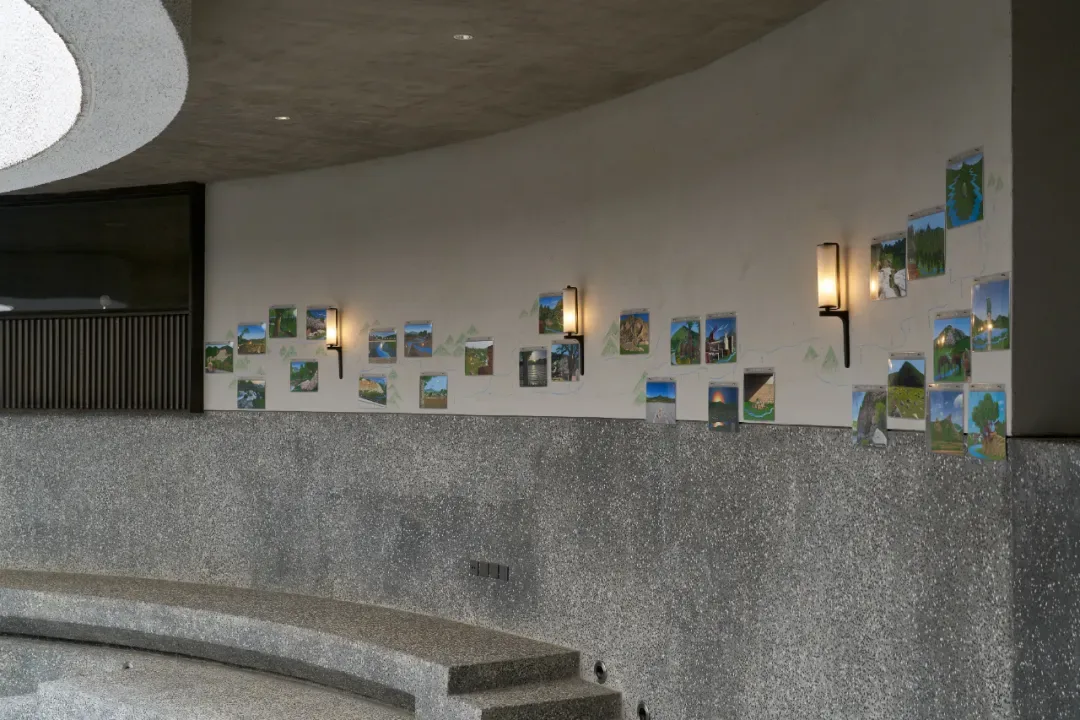
张东辉《走河》
2024年,纸本喷绘、丙烯、防水胶套、景区标识牌,尺寸可变
由阿那亚艺术中心委任创作
“出门写生!”展览现场,2024年
阿那亚艺术中心,秦皇岛
摄影:孙诗
全文图片鸣谢阿那亚艺术中心
出门写生!阿那亚艺术中心,秦皇岛10月27日至次年3月2日
按艺术家栾雪雁的说法,写生很简单,就是“照着看到的东西画画”,但是介绍她近期参加的群展“出门写生!”却有些困难。如何评价一场大约40%的内容在最后时刻被迫撤出的展览?这次展览策划的一个起因,是无名画会曾在1975年两度前往北戴河写生,而北戴河正是阿那亚艺术中心的所在地。在艺术创作一片“红光亮”之中去画并非政治命题的风景,本身便是危险之举。离开北京、去到北戴河的写生因此也具有了激进的政治性,海滨风景所在的时空也成了容纳个人表达的替代空间。但不仅无名画会相关的作品与介绍在展览中被悉数删减,剩下的一些作品也让人在观看时十分困惑。比如黎朗拍摄北戴河市区的录像《北戴河·致大海》(2024)中有将近20分钟的街景,但其中几乎没有任何情节或思绪的推进——我忍不住打听了一下,才知道录像里的字幕和旁白被删掉了。我们因此无法得知一个四川人曾经对北戴河的长久想象和他今日旅行的想法。这场展览因此形成了一个荒谬的闭环:出门写生尚且自由,回到美术馆便只能受着。
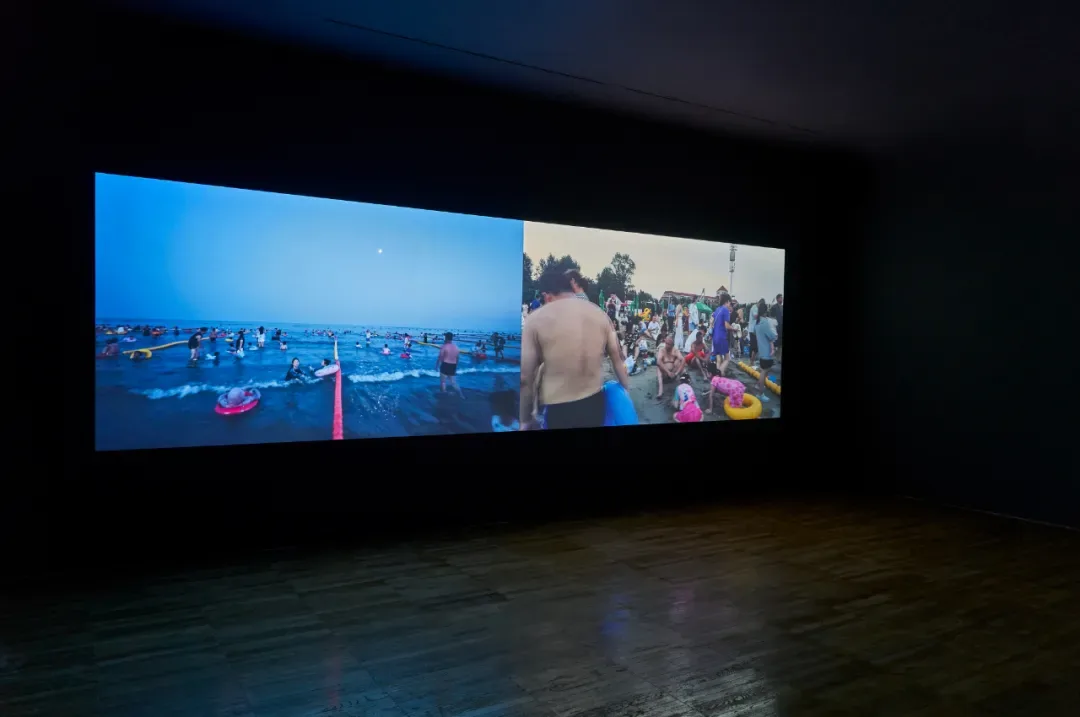
黎朗《北戴河·致大海》
2024年,双屏录像,18分58秒
由阿那亚艺术中心委任创作
“出门写生!”展览现场,2024年
阿那亚艺术中心,秦皇岛
摄影:孙诗
展览筹备工作耗时两年半,策展小组(张震中、陈萧伊和高良娇)邀请了10位艺术家、4个艺术小组来回应“写生”这一实践。使用“出门写生!”而非“出门田野!”或者“出门研究!”,它所回应的应该是这几年已被广为接纳的“研究型艺术”和田野调查,想提醒此时此地的艺术家,还可以用艺术内部的方式对待这广阔天地。而邀请一些艺术小组,或许一方面受到了无名画会的结社启发,另一方面也想从写生的角度讨论当下的社群实践。展览当中绝大多数作品诞生于委任,艺术家受邀到访北戴河或金山岭两处阿那亚社区。在20世纪,碧海长滩的北戴河常常是华北艺术家选择的写生地点,金山岭也因为靠近长城而不算籍籍无名。但显然,策展小组并未鼓励艺术家挖掘这里的人文地理或者隐秘历史,或者将北戴河议题化。相反,艺术家被鼓励去此时此地“写生”:在眼前之物变成作品前,艺术家先进入这一时空。“写生”因此变成了艺术家与外部世界的切身互动。这也就超出了狭义的艺术范畴,涉及了艺术家的生命线索,以及写生之必要。
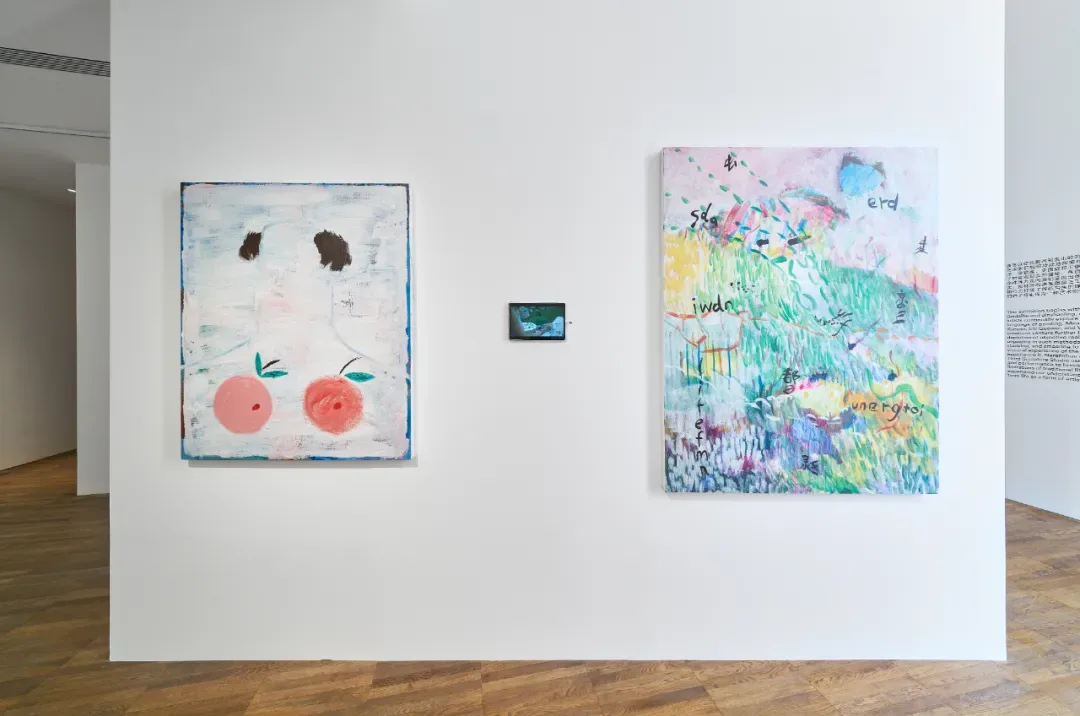
上图:ONS绘画小组作品
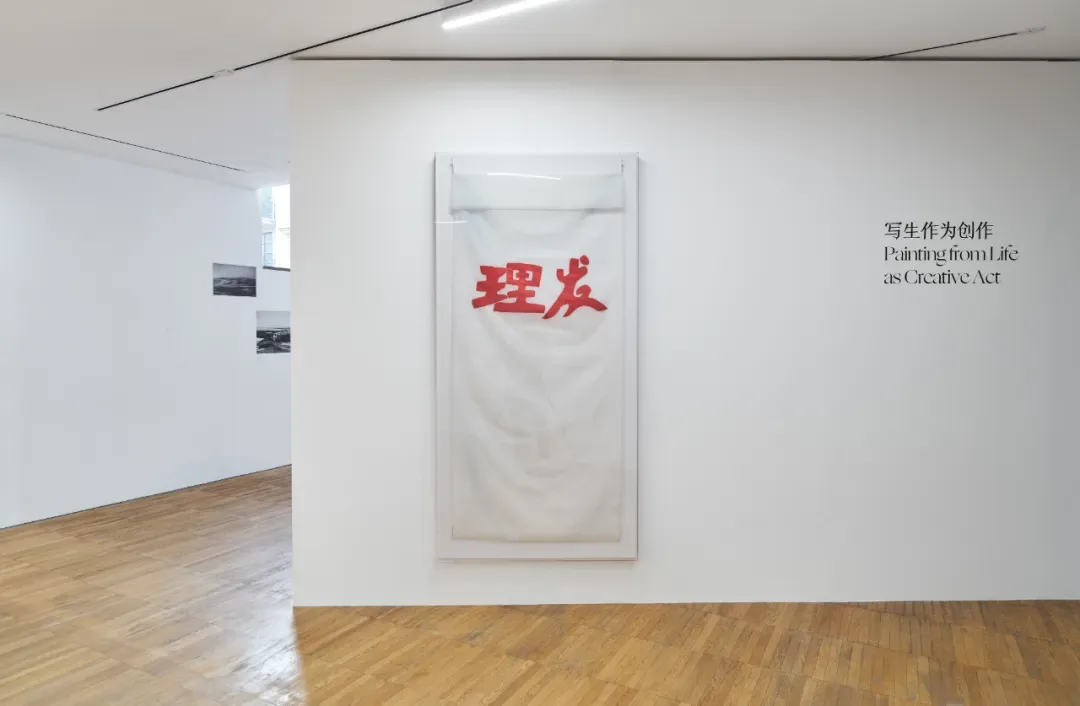
下图:栾雪雁作品
“出门写生!”展览现场,2024年
阿那亚艺术中心,秦皇岛
摄影:孙诗
展览以ONS绘画小组和王音的绘画开场。相比王音的克制,ONS小组的创作更像轻快的即兴游戏。到了二楼的入口,绘画和写生的关系变得更加内敛。红色是这个展厅的线索。垂挂着的长幅白色细纱布就像中国画的卷轴,缝着两个用红化纤布裁剪出来的手写体汉字“理发”(栾雪雁《理发》,2024)。虽然手写招牌会将观众的联想拉到城乡结合部,但栾雪雁并未用现成品的思路创作,而是用减法和控制,仍然用绘画语言来处理这场再现。而她一同展出的绘画也以类似的清减思路,用红与绿这对补色为线索,描画了下乡写生中常见的、乡镇生活里的“小风景”:摆着大葱苗与啤酒瓶的窗台,搪瓷缸和橱柜上的花草装饰……日常生活在此既近又远。栾雪雁的作品对面,史国威的四联画《遗产》(2024)横亘在眼前,石榴色的颜料从如肌肉肌理的岩石照片上渗出,显出纪念碑式的冷峻。
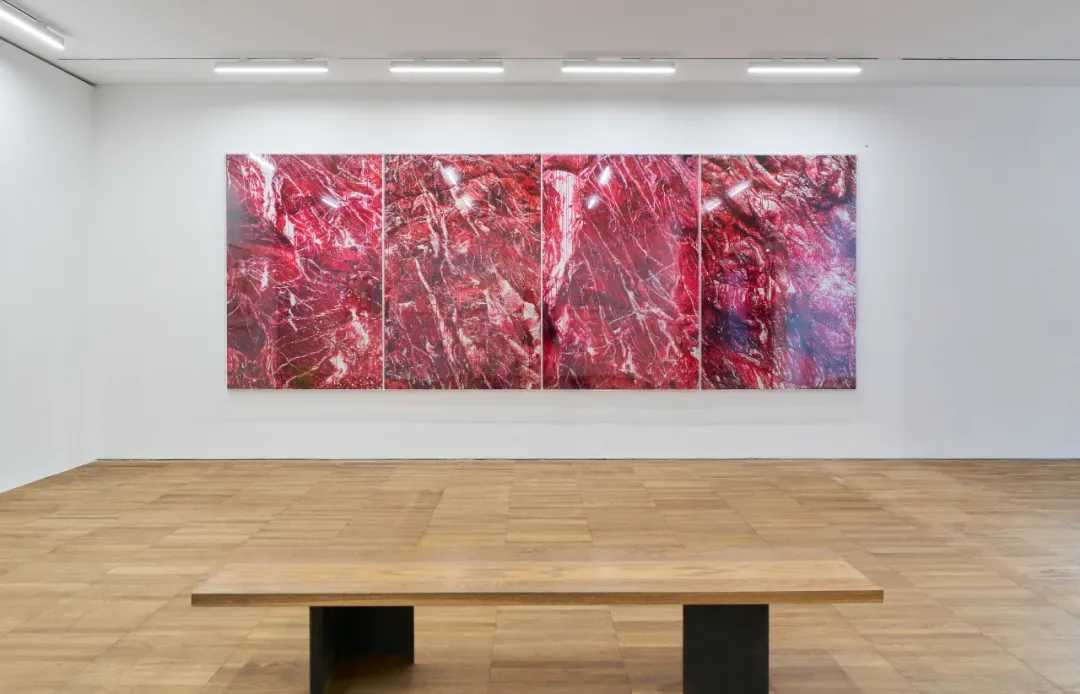
上图:史国威《遗产》
2024年,激光银盐纸基、液体颜料
由阿那亚艺术中心委任创作
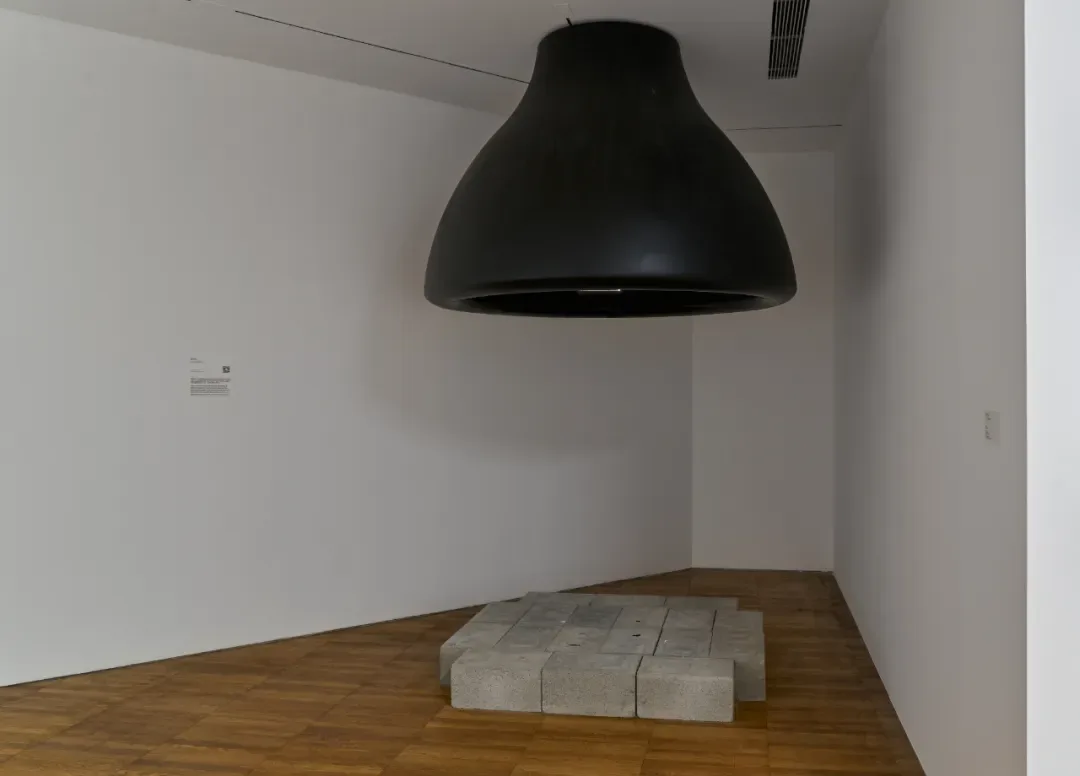
下图:那林呼《旅行日记》
2024年,彩色有声录像
由阿那亚艺术中心委任创作
装置外形设计由声音艺术博物馆原创,经授权使用
“出门写生!”展览现场,2024年
阿那亚艺术中心,秦皇岛
摄影:孙诗
二楼展厅两端分别是那林呼的声音装置(《旅行日记》,2024)、一组记录1930年代北戴河风景的黑白摄影,以及在国内展出过多次的徐晓晓的《饮马长城窟行》(2017—2018)。那林呼的装置如黑色毛毡帽一般悬挂而下,只容一位观众驻足其中,聆听旷野风声。而北戴河的旧照片则让人猜测它们是否替代了无名画会的画作。二楼还有一处“摄影角”——央美雕塑系第三工作室的“春季下乡写生课”成果展示散落在二楼和三楼。“习作”形式活泼,比一般的毕业展要生动许多。几个月前拜访梁硕工作室时,我问他在今天如何教艺术。他说很难,不能再教学生如何用玻璃钢模仿大理石了,或许只能把学生带到“第一现场”——鲜活现实、广袤原野——那里能让学生积累未来还能用得上的经验,能看到早期人类如何在河床上敲击、磨砺捡到的石头(或许可以称之为最早的“雕塑”)。所以,收到阿那亚邀请之后,央美第三工作室选择了去走北戴河和北京之间夹着的燕山。这倒是回应了学院教学体系里的“下乡”和“采风”传统,三工学生的作品也反映了这种身体力行的教学法所激发出的少年心性:比如走到三楼会有一栋木制的立体“迷宫”,攀爬其间的体验似乎是在模拟登山探洞,也可窥见随手写下的诗歌题字。
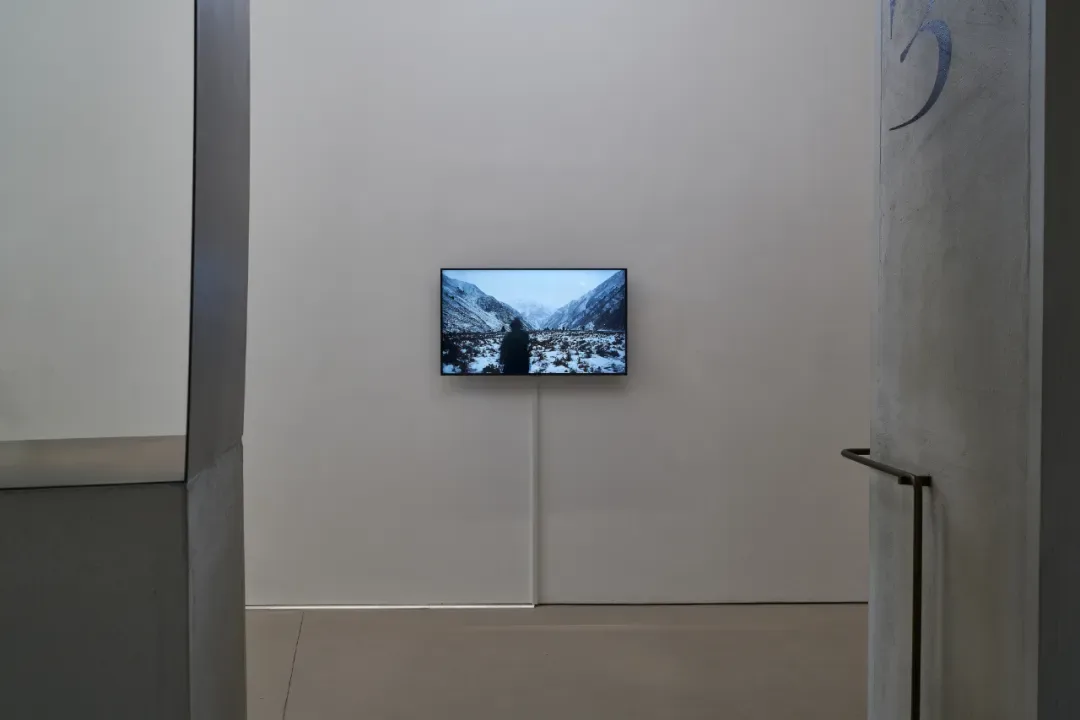
上图:庄辉《祁连山系 - 15》
2016年,单频影像(彩色、有声),10分钟
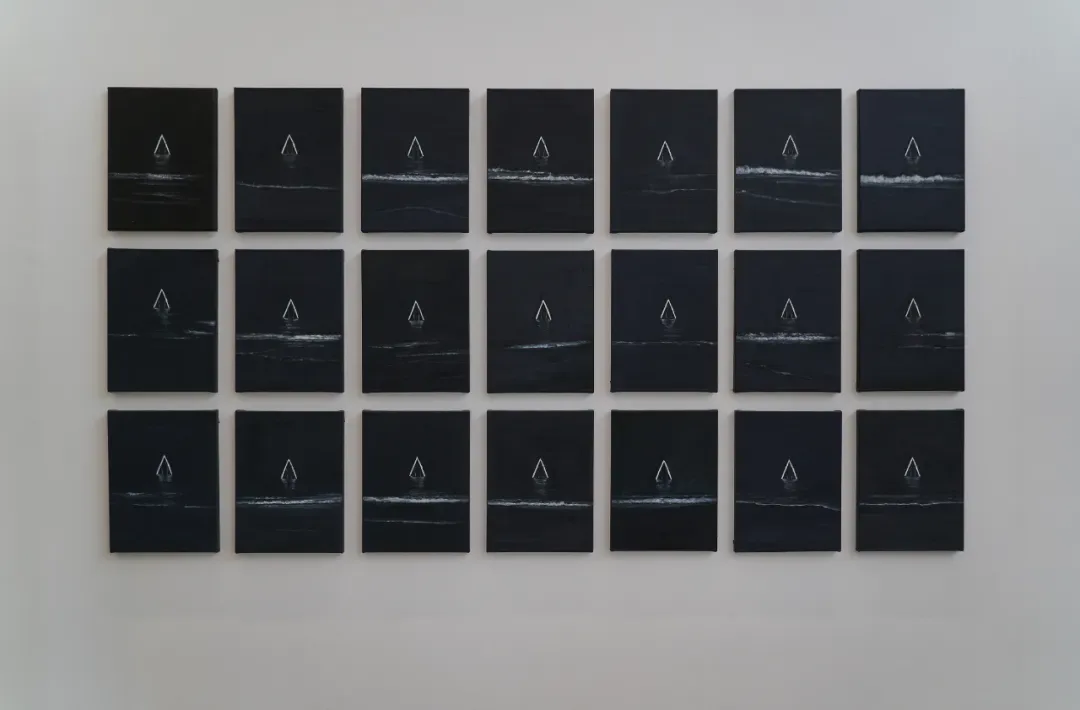
下图:庄辉《老头与海》
2024年,大芬村画师加工布面油画,30 × 40厘米 × 21 幅
由阿那亚艺术中心委任创作
“出门写生!”展览现场,2024年
阿那亚艺术中心,秦皇岛
摄影:孙诗
三楼的入口和最深处的墙面上呈现了庄辉的两组作品。一台屏幕上循环播放着两段视频《祁连山系-4》(2014)与《祁连山系-15》(2016),均选自庄辉持续10年的项目“祁连山系”(2011—2021)。屏幕中,庄辉在固定机位前面对蓝天白云下的开阔水面与漫天飞雪中的连绵山脉挥舞画笔。另一组摄影中则是北戴河夜色里闪光灯下的海面,题目可爱极了——《老头与海》(2024)——听起来就像庄辉的自嘲。张涵露、万青和欧飞鸿这次组成了临时小组,现场观众可以在他们像客厅一样的展区里听到、看到这个临时小组旅行时记录的谈话片段,现场还散落着画在异形纸箱壳子上的松树。提起这三人,人们会想到广州的一些社群实践,比如“社实”“刺纸”“一起练功”和“前台osf”,但对他们三人而言,在金山岭的这趟旅行并不有关社群,反而是场彼此陪伴、反观自身的聊天。在言语中,我们似乎可以分辨出一场热潮已经渐至尾声。不过,他们对自己与社群、艺术与政治之间关系的认知已越发清晰。万青提到,欧飞鸿似乎总让人觉得他并不在意艺术语言,但欧说,艺术语言是他已经“解决”了的问题,他选择书法和壁画,是因为这种“直接的语言”可以“处理现实困境”。对他们而言,艺术当然是政治性的,但并非服务于目标的工具,而是艺术家在表达、邀请、开放或者拒绝时的“工具包”。张涵露相信,在民主和自由之外,“搞艺术是一种更虚无,但也是一种更绝对的对人的解放”。
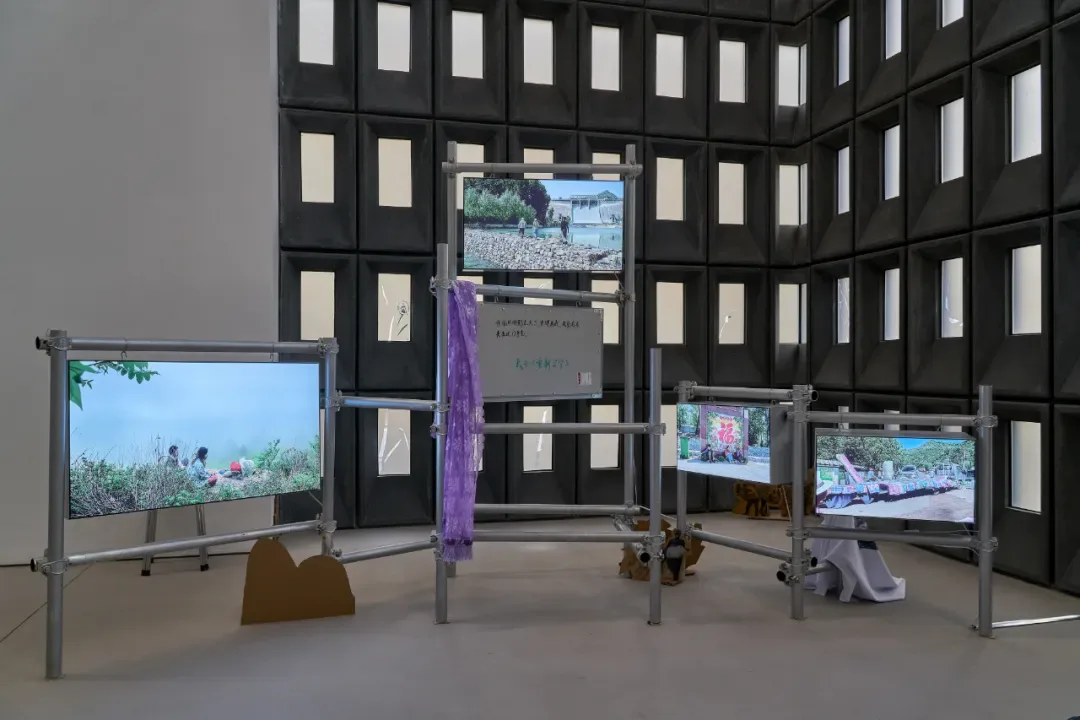
上图:张涵露 × 万青 × 欧飞鸿《五日谈》
2024年,五频视频静帧和音频、墙绘、装置、
视频、信件、摄影、纸板绘画,尺寸可变
由阿那亚艺术中心委任创作
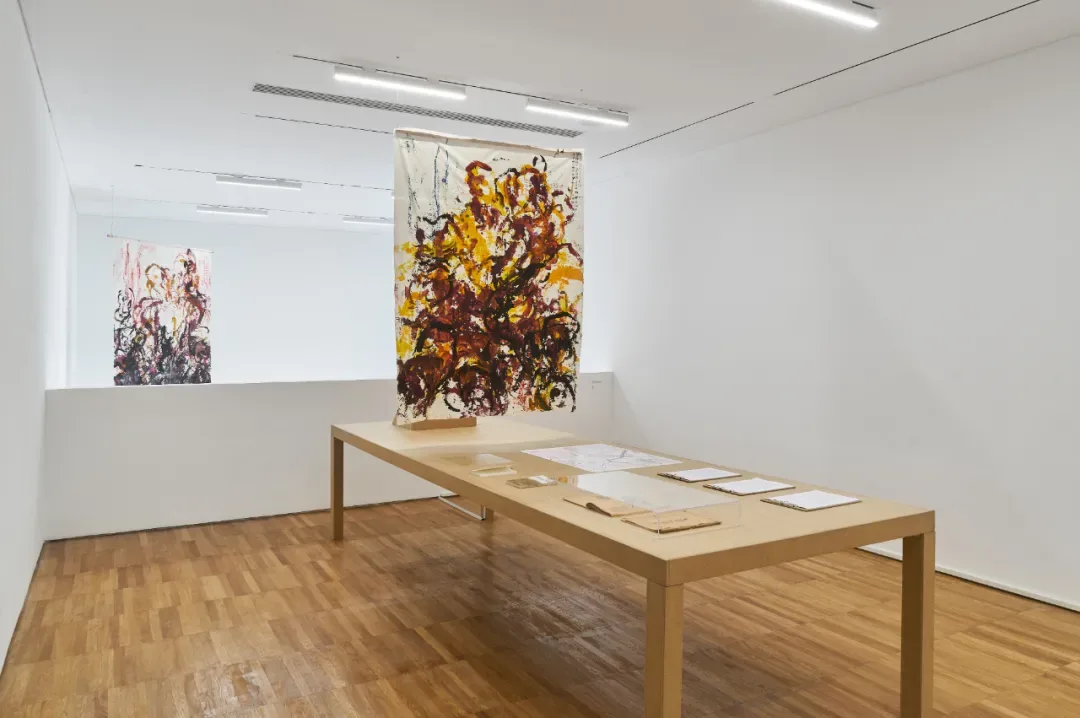
下图:王俊作品
“出门写生!”展览现场,2024年
阿那亚艺术中心,秦皇岛
摄影:孙诗
转至四楼,几幅貌似抽象表现主义的画悬挂在半空。这是王俊的“盲画”。王俊生活在西南,近年都在探索写生,并且发展出了在写生结束后,蒙住眼睛重新调动记忆与感性,画出心中事物的方法。他也梳理了20世纪中国绘画中的写生实践,并利用这次金山岭驻地,重走了画家赵望云在1934年“塞上写生”路线中的唐山遵化至北京古北口段。赵望云曾在战时担任过《大公报》的“写生记者”。他走访各地,画下记忆中的图景,配以行走日记,向读者描绘长城内外的山河人情。赵望云在当时提出过“一手伸向传统,一手伸向生活”的口号,这也是艺术家在社会危机下寻求自身位置与应对方法的反应。而今天的艺术家何尝不也面对着这样的社会?
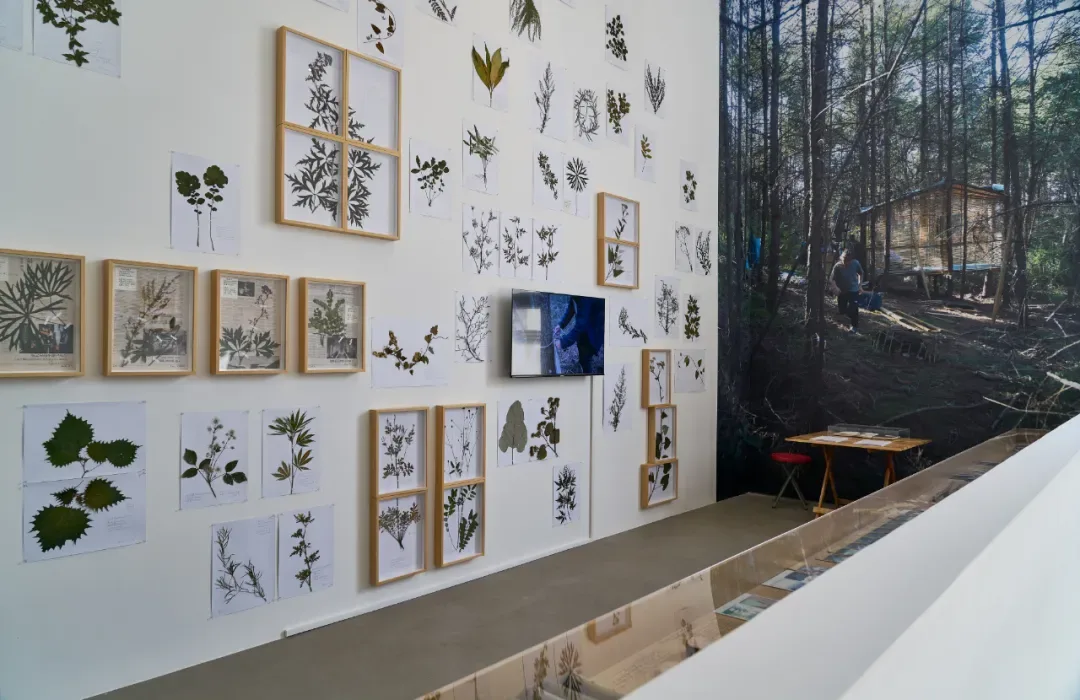
李牧 × 知恩 × 张芳《长城下的植物》
2024年,植物标本、绘画、影像、写作、照片、物件等,尺寸可变
由阿那亚艺术中心委任创作
“出门写生!”展览现场,2024年
阿那亚艺术中心,秦皇岛
摄影:孙诗
旋至五楼,满墙植物标本扑入眼帘。这些标本是李牧、知恩、张芳一家三口在金山岭驻留期间制作的。艺术家李牧和张芳针对儿童的自然艺术教育“野果”已经开展了许久,而这一教育实验的起因也是他们希望给孩子知恩创造出与生活交织的教育场景。培养孩子的耐心、引导其细心观察,是教育中的重要一环。教育,或者说学习,因此也是生活的一部分。“写生”在这里意味着通过亲身观察、耐心思考和具体知识来如其所是地认知周遭。在一旁,陈萧伊的录像《吞吐》(2024)中的山影来自金山岭到北戴河区域,创作的视角则延续着艺术家近年在西南山脉中的行走经验。巨大的嗡鸣声中,山石的身影从黑暗中隐隐浮出,叠加在影像上的文字似乎来自山石、黑鸟的言说。杨圆圆在《幽灵写生》(2024)中讲述了一则影影绰绰的海滨故事,有点像实验话剧。两部录像中间夹着刘任的一方天地:他一贯用草纸作为材料,现在草纸被染成深蓝色,草纸纹路也仿如水波,还将诗句藏在中间。小学时候的木课桌的抽屉被打开,中间放着一本1979年印制的日记本,纸页间出了一些戏谑的有关云的涂鸦。一旁的小装置也由草纸纸浆做成:海鲜风味泡面碗上压着一本由艺术家杜撰而成的《出神——关于中国祥瑞现象的研究与鉴赏》。如果植物标本是如其所是的“写生”,草纸可能是另外一个极端:它不仅是植物纤维的再造,还可以模拟幻境与异兽。
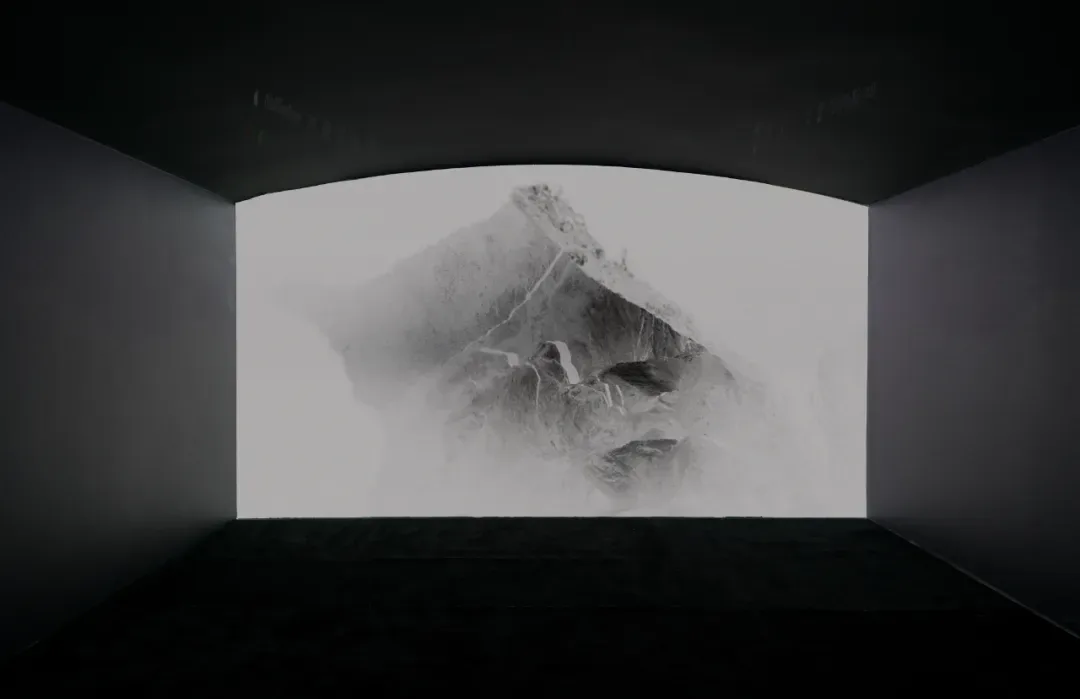
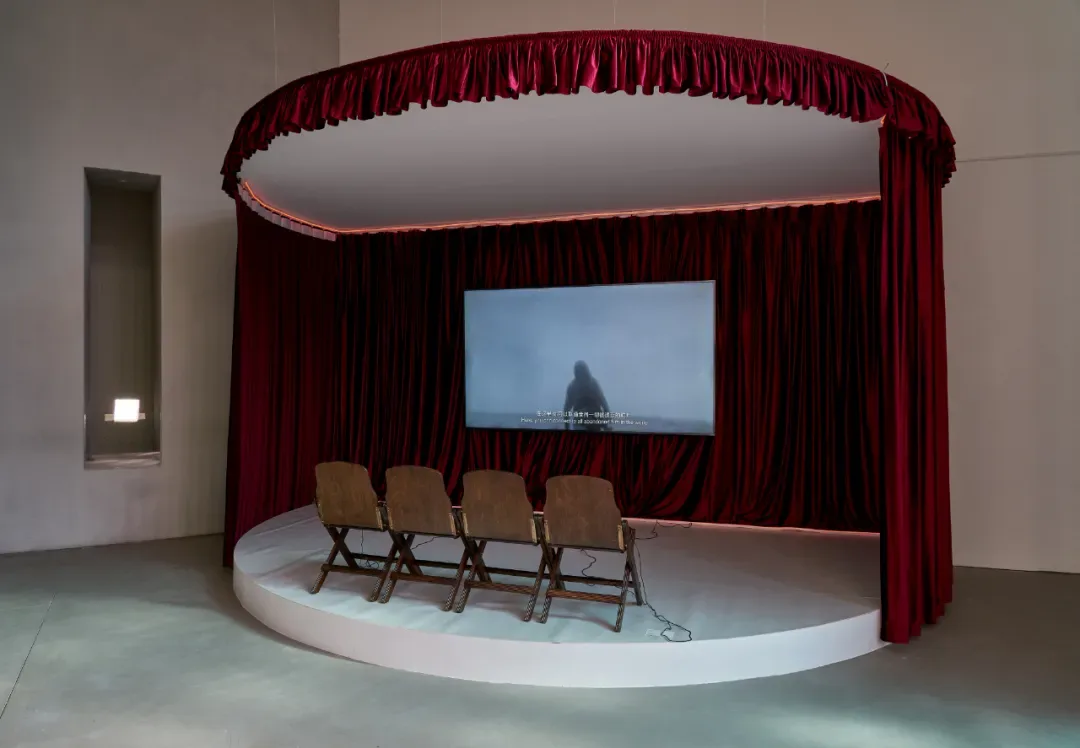
上图:陈萧伊《吞吐》
2024年,单频影像(彩色、有声),18分32秒
由阿那亚艺术中心委任创作
下图:杨圆圆《幽灵写生》
2024年,单频高清录像(彩色、有声),11分44秒
由阿那亚艺术中心委任创作
“出门写生!”展览现场,2024年
阿那亚艺术中心,秦皇岛
摄影:孙诗
行至楼顶露台时,一张《走河旅游导览图》(2024)鼓励人极目四望。虽然实际上看不到,但观众可以借助楼下环绕中庭的壁画和照片来想象“走河”的沿岸风光——那里其实可以算作展览的序言。张东辉一向对权力的运作机制敏感有加。这场展览中首尾呼应的小品,仿佛在提醒,此处绝无化外之地——不管是在机构内,还是在自然里,我们都处在权力之中。当然,“权力”还可以被置换成其他词,比如“情感”“历史”等等。但即便处于这些事物里,我们还能做很多事。在这场展览中,艺术家的“写生”的出发点、对象、方法各有不同。无名画会这一题眼被迫隐匿之后,展览不仅被抹消了历史纵深,其贯穿线索也被打乱。观众必须在杂乱的信息中提醒自己,这是一场有关写生的试验,思考为何这场试验会发生,才能意识到策展小组在“写生”中看到的厚重、紧迫与希望。虽然美术馆无法展出对“生”的摹写、言说与回应,但艺术家以及每一个想创作的人,都还可以寻找各自的现场、重新挖掘艺术传统中的实践脉络,在那里生长、生活。
Machine translation (AI) of the Chinese original, not yet reviewed by the author. Please cite the original.
In this exhibition, the artists’ starting points, subjects and methods of ‘painting from life’ all differ. With its key reference point – the No Name Group – forced out of sight, the show has not only been stripped of its historical depth; its through-line has been scrambled too. Viewers have to keep reminding themselves, amid the jumble of information, that this is an experiment about painting from life, and ask why such an experiment should be happening at all, before they can grasp the weight, urgency and hope the curatorial team saw in ‘painting from life’.
Zhang Donghui, Walking the River
2024, inkjet print on paper, acrylic, waterproof covers, scenic-area signboards, dimensions variable
Commissioned by Aranya Art Center
Installation view, “Paint for Life”, 2024
Aranya Art Center, Qinhuangdao
Photo: Sun Shi
All images courtesy Aranya Art Center
“Paint for Life”, Aranya Art Center, Qinhuangdao, 27 October 2024 – 2 March 2025
According to the artist Luan Xueyan, painting from life (xiesheng) is simple: it’s just ‘painting what you see’. Introducing “Paint for Life”, the group show she recently took part in, is rather harder. How do you review an exhibition from which some 40 per cent of the content was forced out at the last minute? One of the starting points for the exhibition was that in 1975 the No Name Group (Wuming Huahui) went twice to Beidaihe to paint from life – and Beidaihe is exactly where Aranya Art Center is located. At a time when art was all ‘red, bright and shining’, going out to paint landscapes that carried no political message was itself a dangerous act. Leaving Beijing to paint from life in Beidaihe thus took on a radical political charge, and the time and place of those seaside landscapes became an alternative space for personal expression. Yet not only were all the works and texts relating to the No Name Group cut from the exhibition, some of the works that remained were baffling to look at. Li Lang’s video Beidaihe: To the Sea (2024), shot in the city of Beidaihe, contains nearly 20 minutes of street scenes with almost no progression of plot or thought – I couldn’t help asking around, and learned that the video’s subtitles and voiceover had been removed. So we have no way of knowing how this Sichuan-born artist had long imagined Beidaihe, or what he made of his trip there today. The exhibition thus forms an absurd closed loop: going out to paint from life is still free, but back in the museum you just have to put up with it.
Li Lang, Beidaihe: To the Sea
2024, two-channel video, 18 min 58 sec
Commissioned by Aranya Art Center
Installation view, “Paint for Life”, 2024
Aranya Art Center, Qinhuangdao
Photo: Sun Shi
The exhibition took two and a half years to prepare. The curatorial team (Damien Zhang, Chen Xiaoyi and Gao Liangjiao) invited ten artists and four artist groups to respond to the practice of xiesheng. Choosing the Chinese title Chumen xiesheng! – ‘Go out and paint from life!’ – rather than ‘Go out and do fieldwork!’ or ‘Go out and do research!’ is, presumably, a response to the ‘research-based art’ and fieldwork that have become so widely accepted in recent years – a reminder to artists here and now that they can still approach this wide world in ways that come from inside art. Inviting artist groups was perhaps partly inspired by the No Name Group’s example of banding together, and partly a way of discussing today’s community-based practices from the angle of painting from life. The great majority of the works in the show were commissioned: the artists were invited to visit one of Aranya’s two communities, at Beidaihe or at Jinshanling. In the twentieth century Beidaihe, with its blue sea and long beaches, was a favourite spot for artists from northern China to paint from life, and Jinshanling, close to the Great Wall, is hardly unknown either. But clearly the curatorial team did not encourage the artists to dig into the local human geography or hidden histories, or to turn Beidaihe into an ‘issue’. Instead, the artists were encouraged to paint from life, here and now: before what lies in front of them becomes a work, the artists first enter this time and place. Painting from life thus becomes the artist’s bodily interaction with the outside world. This goes beyond art in the narrow sense, touching on the threads of the artists’ lives, and on why painting from life is necessary.
Top: work by the ONS painting group
Bottom: work by Luan Xueyan
Installation view, “Paint for Life”, 2024
Aranya Art Center, Qinhuangdao
Photo: Sun Shi
The exhibition opens with paintings by the ONS painting group and Wang Yin. Next to Wang Yin’s restraint, the ONS group’s work feels more like a light-hearted improvised game. At the entrance to the second floor, the relationship between painting and painting from life turns more inward. Red is the thread running through this gallery. A long hanging length of fine white gauze, like a Chinese scroll painting, has two handwritten-style characters cut from red synthetic fabric sewn on to it: lifa, ‘haircuts’ (Luan Xueyan, Haircut, 2024). Handwritten signs like this pull the viewer’s mind towards the fringes where town meets countryside, but Luan Xueyan doesn’t approach the work as a readymade. She works by subtraction and control, still using the language of painting to handle this act of representation. The paintings shown alongside it follow a similarly pared-down approach, taking the complementary pair of red and green as their thread to depict the ‘small landscapes’ of small-town life so often met on painting trips to the countryside: a windowsill with spring-onion seedlings and beer bottles, an enamel mug, flower decorations on a cupboard… Everyday life here is both near and far. Opposite Luan Xueyan’s work stretches Shi Guowei’s four-panel Heritage (2024): pomegranate-coloured paint seeps out of photographs of rock whose texture looks like muscle, giving it a cold, monumental severity.
Top: Shi Guowei, Heritage
2024, laser-exposed fibre-based silver gelatin paper, liquid paint
Commissioned by Aranya Art Center
Bottom: Na Linhu, Travel Diary
2024, colour video with sound
Commissioned by Aranya Art Center
Installation design by the Sound Art Museum, used with permission
Installation view, “Paint for Life”, 2024
Aranya Art Center, Qinhuangdao
Photo: Sun Shi
At either end of the second-floor gallery are Na Linhu’s sound installation (Travel Diary, 2024), a set of black-and-white photographs of Beidaihe scenery from the 1930s, and Xiaoxiao Xu’s Watering My Horse by a Spring at the Foot of the Long Wall (2017–2018), which has been shown many times in China. Na Linhu’s installation hangs down like a black felt hat, with room for just one viewer to stand inside and listen to the wind across open country. The old photographs of Beidaihe, meanwhile, made me wonder whether they had been put in place of the No Name Group’s paintings. There is also a ‘photography corner’ on the second floor, and the results of the ‘Spring Countryside Sketching Course’ run by the Third Studio of the Central Academy of Fine Arts’ Sculpture Department are scattered across the second and third floors. These ‘studies’ are lively in form – far livelier than your usual graduation show. When I visited Liang Shuo’s studio a few months ago, I asked him how you teach art today. He said it’s hard: you can no longer teach students how to imitate marble in fibreglass; perhaps all you can do is take them to the ‘primary site’ – living reality, vast open country – where they can build up experience that will still be useful to them later, and see how early humans knocked and ground the stones they picked up on riverbeds (what might be called the earliest ‘sculpture’). So when Aranya’s invitation came, the CAFA Third Studio chose to walk the Yanshan Mountains that lie between Beidaihe and Beijing. This does echo the academy’s tradition of ‘going down to the countryside’ and ‘collecting folk material’, and the students’ work reflects the youthful spirit that this learning-by-doing pedagogy sparks: on the third floor, for instance, there is a three-dimensional wooden ‘maze’, and clambering through it feels like a simulation of mountain climbing and caving, with glimpses of poems and inscriptions scribbled here and there.
Top: Zhuang Hui, Qilian Range – 15
2016, single-channel video (colour, sound), 10 min
Bottom: Zhuang Hui, The Old Man and the Sea
2024, oil on canvas, executed by painters from Dafen Village, 30 × 40 cm × 21
Commissioned by Aranya Art Center
Installation view, “Paint for Life”, 2024
Aranya Art Center, Qinhuangdao
Photo: Sun Shi
Two groups of works by Zhuang Hui are shown at the entrance to the third floor and on the wall at its far end. One screen loops two videos, Qilian Range – 4 (2014) and Qilian Range – 15 (2016), both from Zhuang Hui’s ten-year project Qilian Range (2011–2021). On screen, Zhuang Hui stands in front of a fixed camera, waving his paintbrush at an open stretch of water under blue sky and white clouds, and a chain of mountains in swirling snow. The other group shows the sea at night in Beidaihe, lit up by a camera flash, under a delightful title – The Old Man and the Sea (2024) – which sounds just like Zhuang Hui poking fun at himself. Hanlu Zhang, Wan Qing and Ou Feihong formed a temporary group for this show. In their living-room-like section, visitors can hear and see fragments of conversations the group recorded while travelling, and there are pine trees painted on oddly shaped pieces of cardboard box scattered about. These three names call to mind community-based practices in Guangzhou such as Shehui Shijian (Social Practice), Cizhi, ‘Practising Together’ and Front Desk osf, but for the three of them this trip to Jinshanling had nothing to do with community. It was, rather, a conversation in which they kept each other company and looked back at themselves. In what they say, we can perhaps make out that a wave of enthusiasm is drawing to a close. Even so, their understanding of their own relationship to community, and of the relationship between art and politics, has become ever clearer. Wan Qing mentions that Ou Feihong always gives the impression that he doesn’t care about artistic language, but Ou says artistic language is a problem he has already ‘solved’: he chooses calligraphy and murals because this ‘direct language’ can ‘deal with the difficulties of reality’. For them, art is of course political – not as a tool in the service of a goal, but as the ‘toolkit’ an artist draws on when expressing, inviting, opening up or refusing. Hanlu Zhang believes that, beyond democracy and freedom, ‘making art is a more nihilistic, but also a more absolute, liberation of the human being’.
Top: Hanlu Zhang × Wan Qing × Ou Feihong, Five Days’ Talk
2024, stills and audio from five-channel video, wall painting, installation, video, letters, photographs, paintings on cardboard, dimensions variable
Commissioned by Aranya Art Center
Bottom: work by Wang Jun
Installation view, “Paint for Life”, 2024
Aranya Art Center, Qinhuangdao
Photo: Sun Shi
Turning up to the fourth floor, you find several paintings that look like Abstract Expressionism hanging in mid-air. These are Wang Jun’s ‘blind paintings’. Wang Jun lives in south-west China and has spent recent years exploring painting from life. He has developed a method in which, after a session painting from life, he blindfolds himself and draws once more on memory and feeling to paint what is in his mind. He has also traced the history of painting from life in twentieth-century Chinese painting, and used this residency at Jinshanling to retrace the stretch from Zunhua in Tangshan to Gubeikou in Beijing of the painter Zhao Wangyun’s 1934 ‘Sketching Beyond the Great Wall’ route. During the war years Zhao Wangyun worked as a ‘sketching reporter’ for the newspaper Ta Kung Pao. He travelled from place to place, painting scenes from memory and pairing them with walking diaries, depicting for readers the landscapes and people on both sides of the Great Wall. Zhao Wangyun put forward the slogan ‘one hand reaching towards tradition, one hand reaching towards life’, which was also an artist’s response in a time of social crisis, a search for his own position and a way of coping. And don’t today’s artists face just such a society too?
Li Mu × Zhi En × Zhang Fang, Plants Beneath the Great Wall
2024, plant specimens, paintings, video, writing, photographs, objects, etc., dimensions variable
Commissioned by Aranya Art Center
Installation view, “Paint for Life”, 2024
Aranya Art Center, Qinhuangdao
Photo: Sun Shi
Circling up to the fifth floor, you are met by a wall covered in plant specimens. These were made by Li Mu, Zhi En and Zhang Fang – a family of three – during their residency at Jinshanling. The artists Li Mu and Zhang Fang have long been running ‘Wild Fruit’, a nature-and-art education project for children, and the experiment began because they wanted to create a setting for their child, Zhi En, in which education is woven into life. Cultivating a child’s patience and guiding them to observe carefully is an important part of education. Education – or learning – is thus also part of life. ‘Painting from life’ here means getting to know one’s surroundings as they are, through first-hand observation, patient thought and concrete knowledge. Nearby, the mountain silhouettes in Chen Xiaoyi’s video Swallowing and Exhaling (2024) come from the area between Jinshanling and Beidaihe, while its point of view continues the artist’s experience of walking in the mountains of south-west China in recent years. Amid a huge droning hum, the shapes of mountain rock surface faintly out of the darkness, and the text laid over the images seems to be spoken by the rocks and by black birds. In Ghost Sketch (2024), Luka Yuanyuan Yang tells a shadowy seaside story, a bit like experimental theatre. Between the two videos lies a little world of Liu Ren’s own: he has always used straw paper as his material, and here the paper is dyed deep blue, its fibres rippling like water, with lines of poetry hidden inside. The drawer of an old wooden primary-school desk has been pulled open, and in it lies a diary printed in 1979, with some playful doodles about clouds between its pages. A small installation beside it is also made of straw-paper pulp: on top of a seafood-flavour instant-noodle bowl sits a book the artist has made up, Entranced: A Study and Appreciation of Auspicious Phenomena in China. If the plant specimens are painting from life things as they are, the straw paper might be the other extreme: it is not only plant fibre remade, it can also conjure illusory realms and strange beasts.
Top: Chen Xiaoyi, Swallowing and Exhaling
2024, single-channel video (colour, sound), 18 min 32 sec
Commissioned by Aranya Art Center
Bottom: Luka Yuanyuan Yang, Ghost Sketch
2024, single-channel HD video (colour, sound), 11 min 44 sec
Commissioned by Aranya Art Center
Installation view, “Paint for Life”, 2024
Aranya Art Center, Qinhuangdao
Photo: Sun Shi
Up on the roof terrace, a Walking the River Tourist Map (2024) urges you to gaze into the distance. Though you can’t actually see it, the murals and photographs ringing the atrium downstairs let visitors imagine the scenery along the banks of ‘Walking the River’ – which could really be counted as the exhibition’s preface. Zhang Donghui has always been acutely sensitive to how power works. These little pieces, bookending the exhibition, seem to be a reminder that there is no place here beyond its reach – whether inside the institution or out in nature, we are all within power. Of course, ‘power’ could be swapped for other words, such as ‘emotion’ or ‘history’. But even within these things, there is a great deal we can still do. In this exhibition, the artists’ starting points, subjects and methods of ‘painting from life’ all differ. With its key reference point – the No Name Group – forced out of sight, the show has not only been stripped of its historical depth; its through-line has been scrambled too. Viewers have to keep reminding themselves, amid the jumble of information, that this is an experiment about painting from life, and ask why such an experiment should be happening at all, before they can grasp the weight, urgency and hope the curatorial team saw in ‘painting from life’. Although the museum cannot show the depictions of, words about and responses to ‘life’, artists – and anyone who wants to make things – can still each look for their own site, dig once more into the lines of practice within artistic tradition, and grow and live there.