Writing / criticism · 2023 · 中文
Review of "Blue Throat"欲歌声咽,地海难安——评“青喉:开始搅动”
评万丰、叶伟靖策划的「青喉:开始搅动」(Art Central,香港会展中心,2023年3月),从罗玉梅《客途秋恨》出发,写离岸人辗转与自叙的不可能。
“凉风有信,秋月无边,亏我思娇情绪,好比度日如年。”上世纪就已传唱香港的《客途秋恨》,在罗玉梅(Law Yuk Mui)的“电影现场”(improvised cinema) 词穷乐断。幽暗房间里,只有竹板在按着原曲敲击。二胡的弓弦在箱体皮面上拉擦,不成腔调。红绿蓝黄的彩色小球,一开始被仔细放置,临结束时演者却将它们抛入空中;有的砸中了地面上晃动的铜镲,金属回响如旅程将尽,大梦初醒。物与人欲歌而声咽,声响叠着声响,人影叠着人影,却总不成旋律,总有空寂。看资料时,我才知晓那二胡的噪声竟是曾被大陆反复播送、跨越海峡的《思乡曲》。表演者Jonathan也是有名无姓之人——在华人祖先流散到印尼的旅程中,祖先姓氏遗落海底。
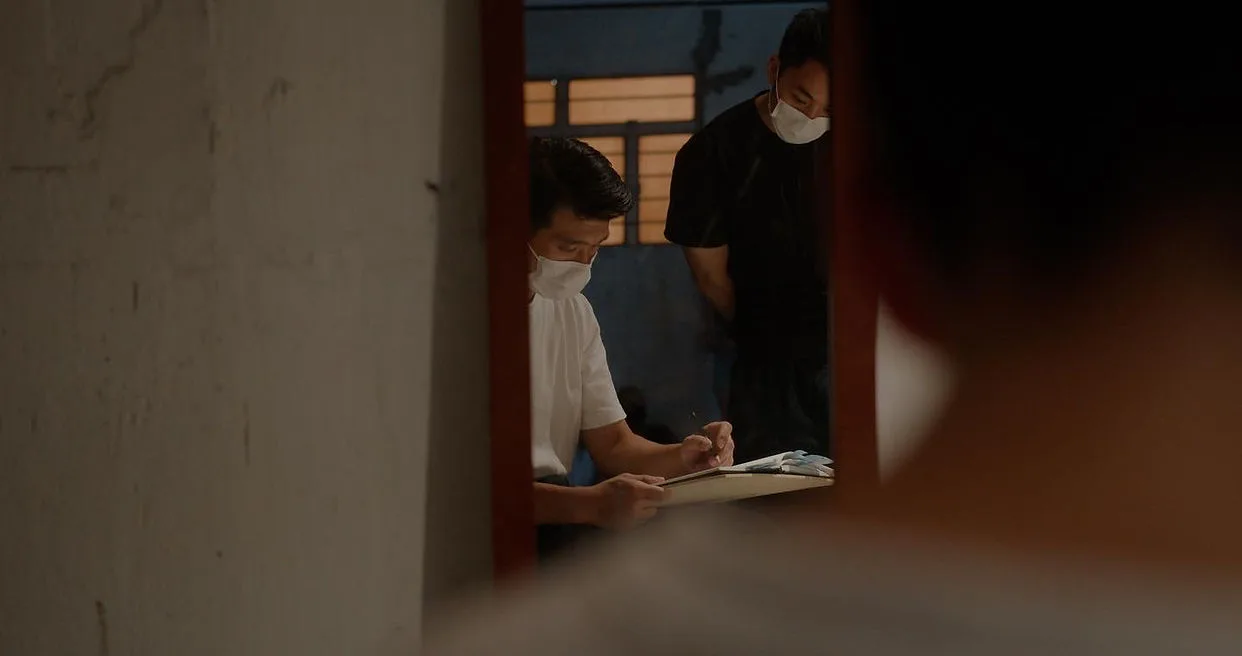
罗玉梅《客途秋恨》,2022年,4K高清、立体声、彩色影像,9分59秒,视觉装置。图片鸣谢艺术家。
《客途秋恨》(2022)的录像在展览里只是一方小小屏幕。我得捂紧耳机才能辨别哪些声音来自屏幕中的幽暗之境,哪些声音来自身旁日光灯下的攒动人群——两方迥异时空,凄苦、欢庆不可相语。“青喉:开始搅动”在香港巴塞尔艺博会期间出现于香港会展中心的三楼。白色展板错落围出一片半开放的区域,对面即是承办方Art Central展会的入口。展览聚集了16位有香港生活经验的艺术家,由万丰和叶伟靖策划。表面上,这次展览是对香港本土艺术家的呈现。细看,他们的作品中满是“本土”的震荡——更准确地说,是身心在家宅、街头、四海的不可安顿。人如此脆弱,即便勤恳上班仍有奔命时的茫然。我一进场先看到的是王顺瑜的丝上水墨画,标题便直接说明了如我般当下年轻人的境况:《我妈说她供我读那么多书就是想让我在外面长出息。可是发现工资一说出来好像也攒不到钱。我想要的是攒钱不是工资高》。
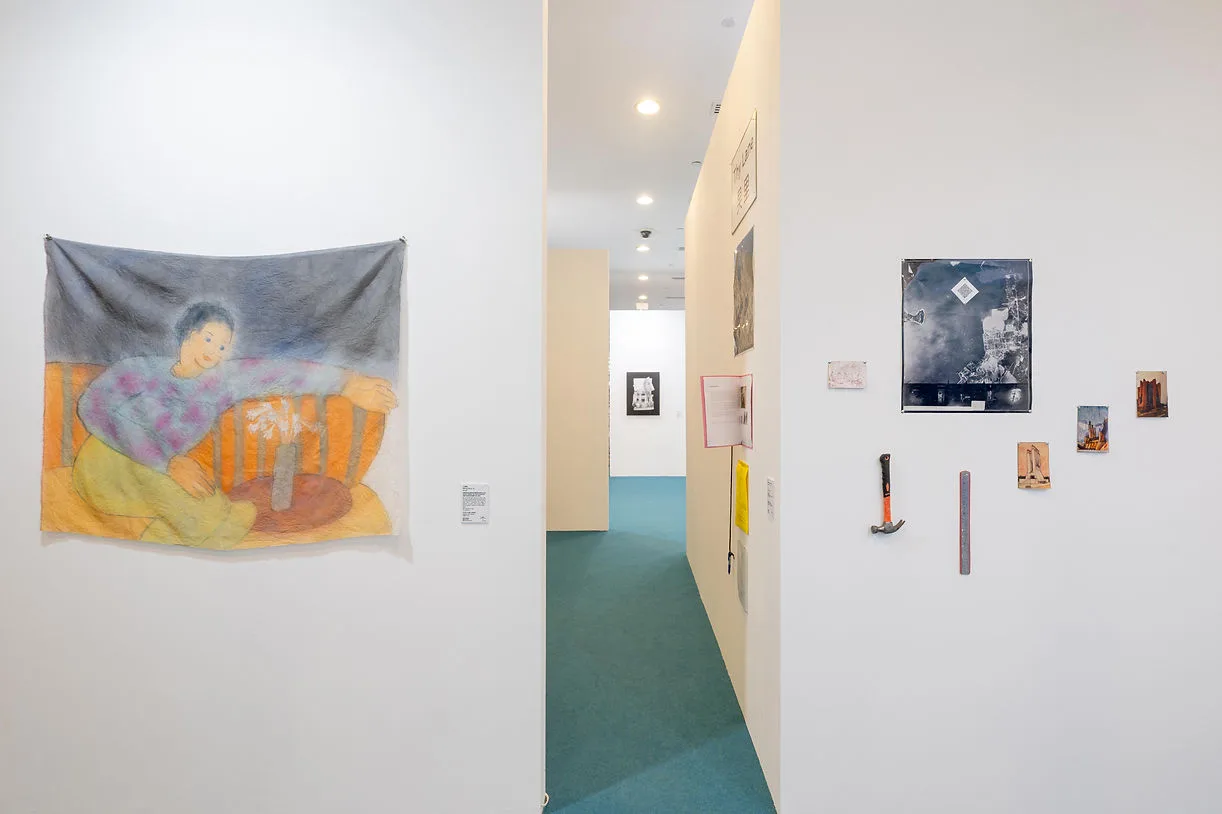
“青喉:开始搅动”展览现场,2023年,左侧为王顺瑜作品,右侧为“Thy Lane Museum”。图片鸣谢Art Central。
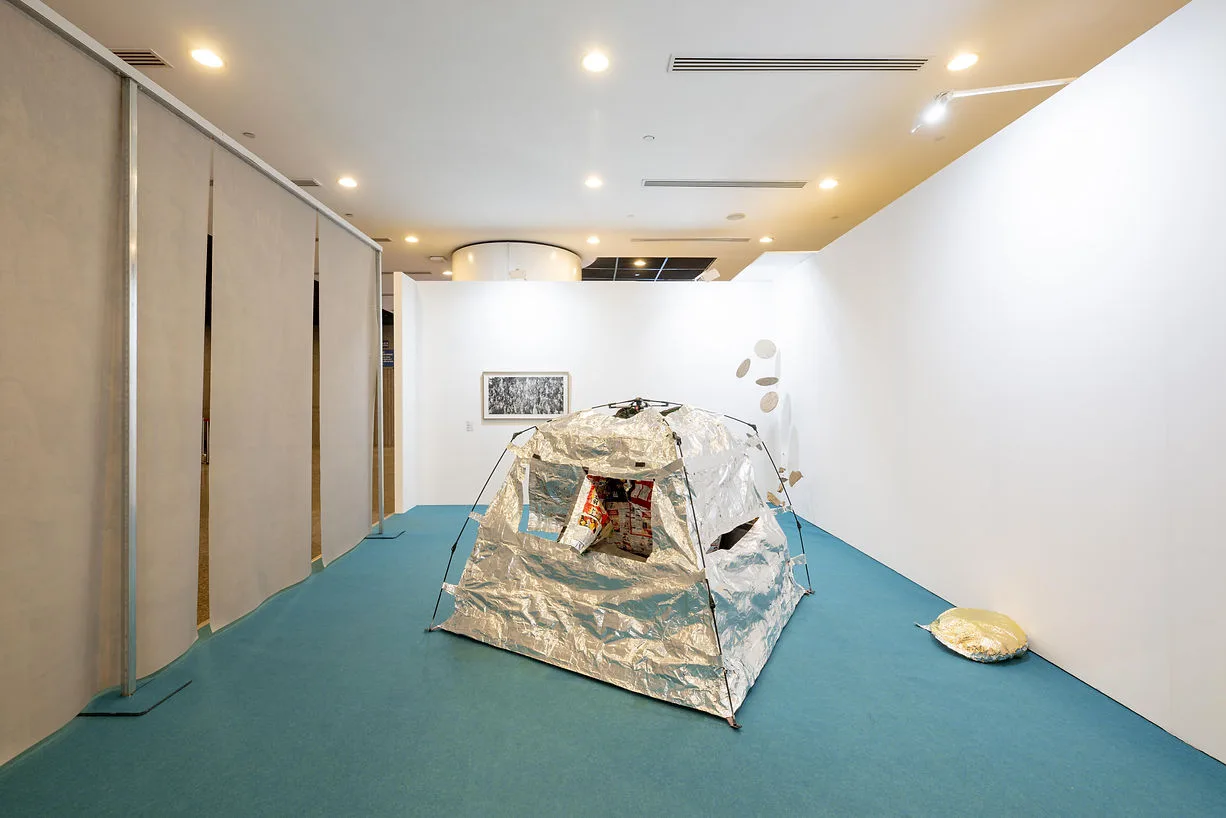
“青喉:开始搅动”展览现场,2023年,凌中云《登陆于会展的帐篷与启德》,2017–23, 零食、方便面铝箔包装袋、帐篷架 竹子、行李箱、家中物件、锈、应急毯,190 × 150 × 190厘米。图片鸣谢Art Central。
《客途秋恨》的创作者罗玉梅近年从香港移居日本,这作品的英文名“The Song of Exile”,像是对应她自己和更多离乡人、离岸人的经历。而有关路途的作品不止这一件。展区里有个用铝箔纸和零食袋搭出的轻飘飘的帐篷,里头摆着摊开的行李箱、泡面、应急保暖毯和蒲团。塑料零食袋的衬里连缀成挡风薄壳,让人觉得应该是几位年轻好友一起吃掉膨化食品后做出来的。想象一下这狭窄天地中只有友人挤在一起,倒是也够温暖。但此时突然有位肥头大耳的和尚,裹着红色僧袍钻进帐篷,探出头来让众位陪客拍照。他脸上的嬉笑让我担心他屁股一歪,帐篷便会被就地掀翻。此刻的错乱感也被帐篷的创作者凌中云(Ling Chung Wan Kevin)调侃了:这作品原本叫《扎营》(2021),现在则叫《登陆于会展的帐篷与启德》(2017–23)——“启德”,是启德机场吗?劳丽丽(Lo Lai Lai Natalie)在录像《阿茲特克饮料》(Aztec Drink,2018)里讲述了自己由于咖啡因过量在飞机上心悸的经历。她配上的动态图像却是流水线上成群结队的罐装饮料:录像正放、倒放、卡顿,流水线正流、逆流、停滞。她最终有惊无险抵达目的地,内在的爆破渐渐平息。两件作品在平易近人的表面下隐隐透出创作者矛盾复杂的状态:困于此地的难捱和脆弱,飞行时刻的兴奋和幻梦,螳臂当车时的幽默和叹息。人,无法平静。
如果把离散作为隐喻,破碎、废弃、重生的意象贯穿了整个展览。离开故乡时,家中的神明要一起从启德机场离开吗?许多港人在离开时会将庇佑自己和家人的神像重新安置在神像山上。这几年飓风过境,有的神像碎裂,也有新的神像上岛,从人间回返山水间。何兆南(South Ho)拍摄的《神话避风所》(2018/2023)在展场变作垂帘;没有穿堂风,但人不经意间会发现自己正与神相视。朱颂琪(Maggie Chu)的《秃石记》(Barren Rocks Reminiscences,2021–22)远看只是趴在墙面、停靠在桌板上的碎屑,走近才能辨认出,墙面上的黑白和彩色香港风景明信片,正依着山峦流线被拼成条带。天空、海洋注入彼此,楼宇、人影悉数裁出。被剪下而倾倒着的中环高楼正落在桌板上,与石头、混凝土、金属线、泥块、废纸壳、螃蟹壳相互嫁接,形成种种异形生命。假如展览里欧阳应霁的《顽石说》(2021)还留有《西游记》和《石头记》中通灵顽石的浪漫幻想,朱颂琪捏出的纷杂“秃石”则写实得多,都是未得造化的刍狗众生。在香港,万物为活下去而活成混乱绞缠。此处的海岸、水流、鱼蟹,此处的南逃客、混血儿、水客小贩,承受填海造陆,承受狭窄逼仄,承受权力更迭。哪一番不是血肉横飞、心神倒转的暴力。
朱頌琪《秃石记》 2021–22年,明信片、纸板、水泥、黏土、钢筋、拾得物,尺寸可变。 图片鸣谢Art Central。
《再化为鱼类》(2023)和《神沙》(God Sand,2017)匍匐在地上。谭敏晴(Michelle Tam)在裹着发泡胶的水泥块上垒起蚝壳;香港街头的高哼(Go Hung)把废纸壳化为纸浆,塑成如蜗牛般半瘫着的一毫(ten cents)香港硬币(硬币年份的前三位似乎是“201”)。《树蛙的下落》(2022)垂悬而下,卢永滔(Ringo Lo)把一串叮叮当当钉在墙头,长链上挂了一个反光水壶、许许多多把钥匙和日漫人偶——少年人的神明相聚,远看如藤蔓,甚或是情人锁。年少时的友谊,以后会是暗夜中的光源吗?这几件作品的材料、名字都含有非人元素。或许是生者不可承受现实时向自然和神明的移情,也或许是借物言身——与时事报纸(韦邦雨[Wai Pong Yu]《山河变奏 9》,2019)和监控(挨壁靠事物所《天眼CCTV》,2022)有关的作品,补齐了展览回应的社会现场。艺术家都处在此时此刻,在时代的漩涡中遭受压制、驱逐、失意,同时生发出抵抗和团结。年轻人大量使用来自香港街头和自然环境的现成物绝非偶然:身处激烈冲撞的现实之中,逼迫而来的问题正是如何重叙此地此身,如何处理绞缠的历史、记忆、言说,如何谈论自己,如何谈论自己和“香港”。
展览标题“青喉”取意于印度教的“搅动乳海”传说。贪婪的神明为了获得不老药而搅动乳海,新的世界诞生于此,也诞生了毁灭世界的剧毒。宇宙与毁灭之神湿婆为拯救世界喝下毒液,他的喉咙因此变为青蓝色。从这一借用看,策展人将艺术家比作搅动世界、回应世界的“青喉者”,意味着他们终将投身于时代。剧烈震动的社会催生创作者表达。他们也将进入地壳、海沟深处,与水泥、蚌壳一道,重塑下一世人类。但相比这种乐观,我在展览中感受到的更多是无可选择。离开香港后,我反复回想起《客途秋恨》里支离破碎的声响。那说的是,离岸人辗转反侧之不可停,离散者畅然自叙之不可能。
展览信息
青喉:开始搅动
Art Central,香港会展中心
2023年3月23日至3月25日
感谢吴作人国际美术基金会对本文稿酬的支持。
感谢沈军和赖非的编辑支持。
Machine translation (AI) of the Chinese original, not yet reviewed by the author. Please cite the original.
‘The cool wind keeps its promise, the autumn moon is boundless; how I pine for my beloved, each day passing like a year.’ The Song of Exile (《客途秋恨》), a Cantonese ballad sung in Hong Kong since the last century, runs out of words and breaks off in Law Yuk Mui’s ‘improvised cinema’. In a dim room, only a pair of bamboo clappers keeps the original tempo. The bow of an erhu scrapes across the skin of the soundbox, never finding a tune. Little balls in red, green, blue and yellow are laid out carefully at first; near the end the performer tosses them into the air, and some hit a cymbal rocking on the floor – the metallic ring sounds like the end of a journey, like waking from a long dream. Things and people try to sing, but their voices catch in their throats. Sound piles on sound, shadow on shadow, but it never becomes a melody; there is always an emptiness. Only when I read the materials did I learn that the erhu’s noise was in fact Song of Nostalgia (《思乡曲》), which the mainland once broadcast again and again across the Strait. The performer, Jonathan, is also a man with a given name but no surname – on his ancestors’ journey into diaspora in Indonesia, the family name was lost at the bottom of the sea.
Law Yuk Mui, The Song of Exile*, 2022, 4K HD, stereo, colour video, 9 min 59 sec, visual installation. Courtesy the artist.*
In the exhibition, the video of The Song of Exile (2022) was just a small screen. I had to press my headphones tight to tell which sounds came from the gloom on the screen and which from the crowd milling under the fluorescent lights beside me – two utterly different spaces and times, one bitter, one festive, with nothing to say to each other. “Blue Throat – Start the Churning” appeared on the third floor of the Hong Kong Convention and Exhibition Centre during Art Basel Hong Kong. White display panels, set at staggered angles, enclosed a half-open area directly opposite the entrance to the Art Central fair that hosted it. Curated by Chris Wan and Jeremy Ip, the exhibition brought together sixteen artists who have lived in Hong Kong. On the surface, it was a showcase of local Hong Kong artists. Look closer, and their work is full of the tremors of the ‘local’ – more precisely, of bodies and minds unable to settle at home, on the street, or anywhere in the wide world. People are so fragile; even working diligently, they are still lost as they run themselves ragged. The first thing I saw on entering was Wong Shun Yu’s ink painting on silk, whose title spells out the situation of young people like me today: My mum says she paid for all my schooling so I could make something of myself out in the world. But it turns out that when you say your salary out loud it’s like you can’t save any money anyway. What I want is to save money, not a high salary (《我妈说她供我读那么多书就是想让我在外面长出息。可是发现工资一说出来好像也攒不到钱。我想要的是攒钱不是工资高》).
Installation view, “Blue Throat – Start the Churning”, 2023. Left: work by Wong Shun Yu; right: “Thy Lane Museum”. Courtesy Art Central.
Installation view, “Blue Throat – Start the Churning”, 2023: Kevin Ling Chung Wan, A Tent Landed at the Convention Centre and Kai Tak*, 2017–23, snack and instant-noodle foil packaging, tent frame, bamboo, suitcase, household objects, rust, emergency blanket, 190 × 150 × 190 cm. Courtesy Art Central.*
Law Yuk Mui, who made The Song of Exile, has moved from Hong Kong to Japan in recent years, and the work’s English title seems to echo her own experience and that of many others who have left home and left these shores. And it was not the only work about journeys. In the exhibition space stood a flimsy tent made of foil and snack wrappers, with an open suitcase, instant noodles, an emergency thermal blanket and a meditation cushion inside. The linings of the plastic snack bags had been stitched together into a thin windproof shell, so that you imagined a few young friends had made it after eating their way through a pile of crisps together. Picture only friends squeezed into that narrow little world – it would be warm enough. But just then a heavy-set, jowly monk wrapped in red robes crawled into the tent and poked his head out for his companions to take photos. His giggling made me worry that one wrong shift of his backside would flip the whole tent over on the spot. The absurdity of the moment was one the tent’s maker, Kevin Ling Chung Wan, had already joked about: the work was originally called Camping (《扎营》, 2021), and now it is called A Tent Landed at the Convention Centre and Kai Tak (《登陆于会展的帐篷与启德》, 2017–23) – ‘Kai Tak’, as in Kai Tak Airport? In her video Aztec Drink (2018), Lo Lai Lai Natalie recounts having heart palpitations on a plane after too much caffeine. The moving images she sets to it, though, are ranks of canned drinks on a production line: the video plays forwards, backwards, stutters; the line flows, reverses, stalls. In the end she reaches her destination safe and sound, and the explosion inside her gradually subsides. Beneath their approachable surfaces, both works quietly reveal the conflicted, complicated state of their makers: the difficulty and fragility of being stuck here, the excitement and reverie of the moment of flight, the humour and sighs of a mantis trying to stop a chariot. People cannot be at peace.
If diaspora is taken as a metaphor, images of breakage, abandonment and rebirth run through the whole exhibition. When you leave your homeland, do the household gods have to leave with you from Kai Tak? Many Hongkongers, before leaving, rehouse the statues of deities that have protected them and their families on a hillside of abandoned god statues. In the typhoons of recent years some of these statues have shattered, while new ones have arrived on the island, returning from the human world to the mountains and waters. South Ho’s photographs Mythical Shelter (《神话避风所》, 2018/2023) became a hanging curtain in the exhibition; there was no draught, yet you might suddenly find yourself face to face with a god. From a distance, Maggie Chu’s Barren Rocks Reminiscences (《秃石记》, 2021–22) looks like nothing more than debris clinging to the wall and resting on a tabletop. Only up close do you realise that the black-and-white and colour postcards of Hong Kong scenery on the wall have been pieced together into strips following the contours of the hills. Sky and sea pour into each other; buildings and figures have all been cut out. Snipped-out, toppling Central high-rises land on the tabletop, grafted onto stones, concrete, wire, lumps of clay, scraps of cardboard and crab shells to form all kinds of mutant life. If Au Yeung Ying Chai’s What the Stone Says (《顽石说》, 2021), also in the show, still holds on to the romantic fantasy of the magical stone in Journey to the West and The Story of the Stone, the jumbled ‘barren rocks’ that Maggie Chu has shaped are far more realist – all of them straw dogs, the multitudes left unblessed by creation. In Hong Kong, everything, in order to survive, has grown into a chaotic tangle. The coastline, currents, fish and crabs here, the refugees who fled south, the mixed-race people, the parallel traders and hawkers here – they have all endured land reclamation, cramped confinement and changes of power. Which of these was not a violence of flesh and blood flying, of minds and hearts turned upside down?
Maggie Chu, Barren Rocks Reminiscences*, 2021–22, postcards, cardboard, cement, clay, steel bars, found objects, dimensions variable. Courtesy Art Central.*
Becoming Fish Again (《再化为鱼类》, 2023) and God Sand (《神沙》, 2017) lay sprawled on the floor. Michelle Tam stacked oyster shells on blocks of concrete wrapped in foam; Go Hung, a presence on the streets of Hong Kong, turned waste cardboard into pulp and moulded it into a ten-cent Hong Kong coin slumped like a snail (the first three digits of the coin’s year seem to be ‘201’). The Whereabouts of the Tree Frog (《树蛙的下落》, 2022) hung down from above: Ringo Lo nailed a jangling string to the top of the wall, a long chain hung with a reflective water bottle, lots and lots of keys and Japanese anime figurines – the gods of youth gathered together, looking from afar like a vine, or even like lovers’ padlocks. Will the friendships of our youth be a source of light in the dark night later on? The materials and titles of these works all contain non-human elements. Perhaps this is the living, unable to bear reality, transferring their feelings onto nature and the gods; or perhaps it is speaking of the self through things. Works dealing with current-affairs newspapers (Wai Pong Yu, Variations on Mountains and Rivers 9 [《山河变奏 9》], 2019) and surveillance (Epical Chamber, CCTV [《天眼CCTV》], 2022) filled in the social reality the exhibition was responding to. The artists all live in the here and now; caught in the whirlpool of their times, they suffer suppression, eviction and disappointment, and at the same time generate resistance and solidarity. It is no accident that young people make such heavy use of readymades from Hong Kong’s streets and natural environment: living amid a reality of violent collisions, the questions pressing in on them are precisely how to retell this place and this body, how to deal with tangled histories, memories and speech, how to talk about themselves, and how to talk about themselves and ‘Hong Kong’.
The title “Blue Throat” comes from the Hindu legend of the Churning of the Ocean of Milk. Greedy gods churned the ocean of milk to obtain the elixir of immortality; a new world was born from it, and so was a deadly poison capable of destroying the world. Shiva, god of the cosmos and of destruction, drank the poison to save the world, and his throat turned blue. Read through this borrowing, the curators liken the artists to ‘blue-throated ones’ who churn and respond to the world, meaning that they will ultimately throw themselves into their times. A society in violent upheaval drives its makers to express themselves. They too will go down into the earth’s crust and the ocean trenches, and together with the cement and the shells, reshape the next generation of humanity. But next to this optimism, what I felt more in the exhibition was a lack of choice. After leaving Hong Kong, I kept thinking back to the broken, fragmented sounds of The Song of Exile. What they speak of is how those who have left these shores toss and turn and can never stop, and how impossible it is for the dispersed to tell their own story freely.
Exhibition information
“Blue Throat – Start the Churning”
Art Central, Hong Kong Convention and Exhibition Centre
23–25 March 2023
With thanks to the Wu Zuoren International Foundation of Fine Arts for supporting the fee for this article.
With thanks to Shen Jun and Lai Fei for their editorial support.