Talk · 2026 · English
Art as Infrastructures of Survival作为生存基础设施的艺术
Speaker (online) on an AAS-in-Asia 2026 panel about art as infrastructures of survival in Hong Kong and Mainland China, with a paper on Wan Qing and self-instigation.
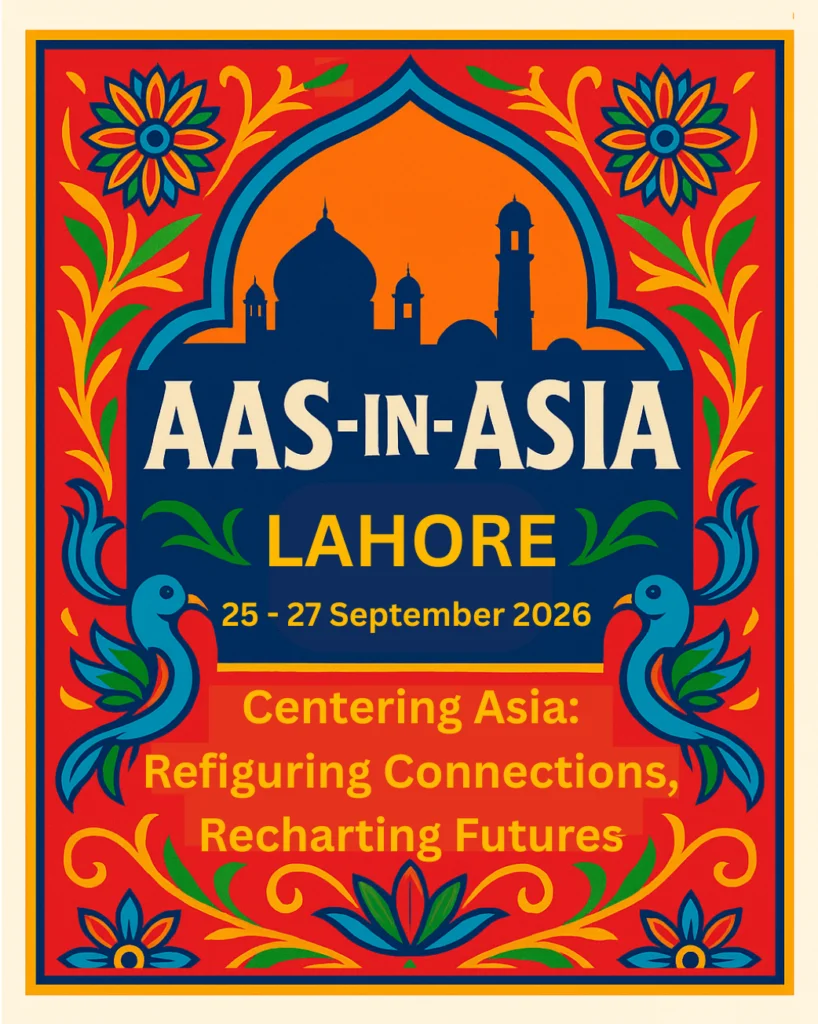
AAS-in-Asia 2026, Lahore, 25–27 September 2026 – Centering Asia: Refiguring Connections, Recharting Futures. Poster
Association for Asian Studies – AAS-in-Asia 2026, Lahore. Panel: Art as Infrastructures of Survival: Art, Agency, and Collective Resilience in Hong Kong and Beyond. Sunday 27 September 2026, 8:30–10:00 (PKT)
I joined the panel online and gave a paper on the artist Wan Qing and self-instigation.
About the panel
This panel examines how artists, cultural practitioners, and communities in Hong Kong and Mainland China build infrastructures of survival through art – creating networks of care, resistance, and self-organisation amid social uncertainty, shrinking civic space, and institutional fragility. Rather than treating art as representational “output”, the four papers foreground artistic and curatorial practices as relational systems that redistribute resources, sustain agency, and hold together vulnerable communities across Asian contexts.
- Ka Ying Wong (Cultural Studies, CUHK): More Than Labour: Filipino Migrant Women’s Art as Cultural Resistance and Collective Identity in Hong Kong
- Fan Xiao (Media Studies, University of Amsterdam): Archives in Action: Curatorial Practices and Everyday Resilience of Self-Hosted Archives in Hong Kong
- Lo Lai Lai Natalie (School of Creative Media, CityU; panel organiser): on fermentation and artist-farmers in Hong Kong
- Nie Xiaoyi (Curating Contemporary Art, Royal College of Art): Self-Instigation as Practice: Wan Qing and Post-Collective Ecologies of Socially Engaged Art in Contemporary China
Discussants: Cheng Shu-fang (National Palace Museum, Taipei) and Minna Valjakka (University of Helsinki).
My paper
Self-Instigation as Practice: Wan Qing and Post-Collective Ecologies of Socially Engaged Art in Contemporary China
This paper focuses on the practice of artist Wan Qing to articulate the notion of self-instigation (ziwo cedong 自我策动) – a mode of artistic work that bridges creation, organisation, living and social inhabitation. Emerging from my ongoing research into shifting modes of curating and socially engaged art in China, self-instigation describes how artists generate their own frameworks of action and creation rather than responding to pre-existing curatorial or institutional agendas.
Through close analysis of Wan Qing’s long-term projects, including both her artworks and her co-running of OSF Front Desk (前台) in Guangzhou, the paper examines the interconnections between her creative practice of making art and her persistent coordination and maintenance to facilitate sharings. These projects construct small-scale ecologies in which artistic language, social relations and labour are inseparable. By situating Wan Qing’s work within a broader discussion of post-collective artistic strategies in contemporary China, the paper argues that self-instigation offers a way to understand how artists today navigate precarity and institutional withdrawal by inventing their own languages of practice. Rather than taking “social engagement” as a predetermined category, self-instigation foregrounds the continuous negotiation between self-organisation and social dependency as an active, generative process that defines the current condition of art-making.
See also: Amateur Editors: Qilu Criticism, a sharing at Front Desk, Guangzhou, 2025.