Writing / criticism · 2020 · 中文
North Korea Photographed by a Chinese一个中国人拍摄的朝鲜
为阿那亚孤独图书馆年度推荐写的短评:一位自称「L」的摄影师四次往返朝鲜拍下的日常,与这一年「内卷」的另一张骑车人照片。
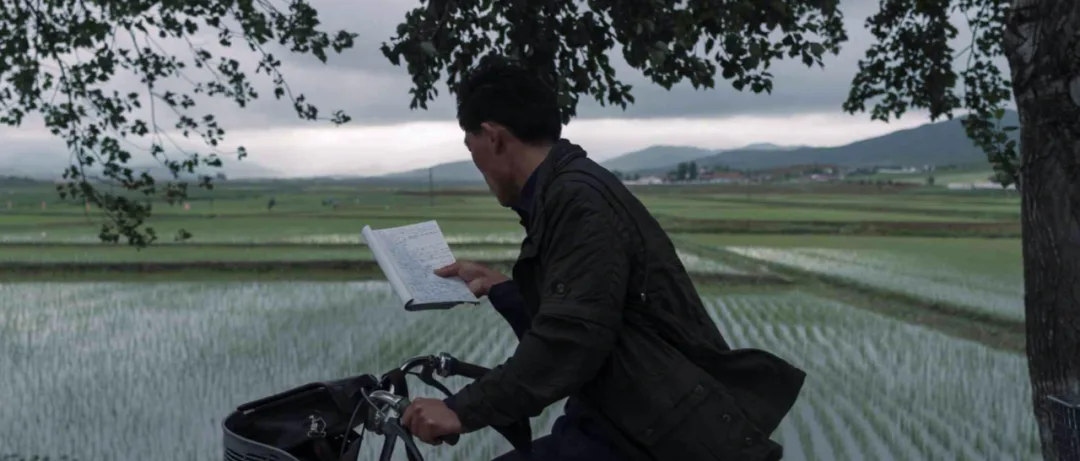
自称“L”的生活在中国的摄影师在2018年6月到2019年9月间,四次前往朝鲜旅行,拍摄了一些照片。其中一张是在初夏的乡间小道,一个中年男人骑着自行车,左手握紧车把,右手在半空握住一册展开的笔记,他微微侧头看着上面手写的英文,时空仿佛是停顿的——风正沿着他敞着的胸怀,穿过身体,吹动起外套的后襟,他身侧点着青秧的水田连绵,极目处,积云与山黛影影绰绰。这张照片很像侯孝贤导演的《恋恋风尘》里的场景,故事里的年轻人骑着摩托,搭上火车离开故乡到外面的都市。
转念,我又想起今年另一张“骑自行车的人”的照片:清华校园里有些拥挤的自行车道上,一位年轻学生一手扶着车把,一手托着正跑着程序的笔记本电脑。后面这张照片被用以图解今年大热的的词汇“内卷”——因为可以用想象力创造出来的新机会越来越少,人们正投入更多的时间去竞争已有的机会。
或许这样的双重联想适合描述我在阅读L的照片时的感受:他既有审慎的熟悉和理解,又带着自省。
中国当然未必是朝鲜的“未来”,这其中的理解,倒不如说是因为经历的相似,让体会过中国改革开放的人得以感受到他们目光中的“未来”和“远方”,以及这两者对内心的宝贵。我以为,正是这种理解给L的照片带来了平静、尊严和美。他的照片没有西方摄影师在拍摄朝鲜时常出现的人造景观(比如Andreas Gursky拍摄的阿里郎节上的大型团体操),而是呈现了他遇到的人们的具体目光——在形形色色的被规划的空间里,人们阅读、眺望、凝视、围观或者发呆,生活在平静中正朝不同的方向展开。
—— 聂小依
图:L,《朝鲜,死水微澜》,原载阿那亚孤独图书馆。
Machine translation (AI) of the Chinese original, not yet reviewed by the author. Please cite the original.
Between June 2018 and September 2019, a photographer living in China who goes by “L” made four trips to North Korea and took a set of photographs. One of them shows a country lane in early summer. A middle-aged man is riding a bicycle, his left hand gripping the handlebar, his right hand holding an open notebook in mid-air. He tilts his head slightly to read the English written in it by hand, and time and space seem to stand still. The wind blows in through his open collar, passes through his body and lifts the back of his jacket. Beside him, paddy fields dotted with green rice seedlings stretch on and on; at the far edge of sight, cumulus clouds and dark-blue hills are dimly visible. The picture looks very much like a scene from Hou Hsiao-hsien’s Dust in the Wind, where the young people ride motorbikes and catch the train out of their home town to the city.
Then I thought of another photograph of a “man on a bicycle” from this year. On a rather crowded bike lane on the Tsinghua University campus, a young student steers with one hand and, with the other, balances an open laptop that is running a program. That picture was used to illustrate the year’s buzzword, neijuan – “involution”: because there are fewer and fewer new opportunities to be created through imagination, people are pouring more and more time into competing for the ones that already exist.
Perhaps this double association is a fair way to describe how I felt looking at L’s photographs: he looks with a careful familiarity and understanding, yet also turns the gaze back on himself.
China is, of course, not necessarily North Korea’s “future”. The understanding here comes rather from a similarity of experience. It lets those who lived through China’s Reform and Opening-up sense the “future” and the “far away” in these people’s eyes, and how precious both are to the inner life. I think it is exactly this understanding that gives L’s photographs their calm, their dignity and their beauty. His pictures have none of the man-made spectacle that so often appears when Western photographers shoot North Korea (such as Andreas Gursky’s pictures of the mass games at the Arirang Festival). Instead they show the particular gazes of the people he met. In all kinds of planned spaces, people read, look into the distance, stare, gather round to watch, or simply space out – and life, in its calm, is unfolding in different directions.
— Nie Xiaoyi
Image: L, North Korea: Ripples on Still Water (《朝鲜,死水微澜》), first published by the Aranya Seashore Library.